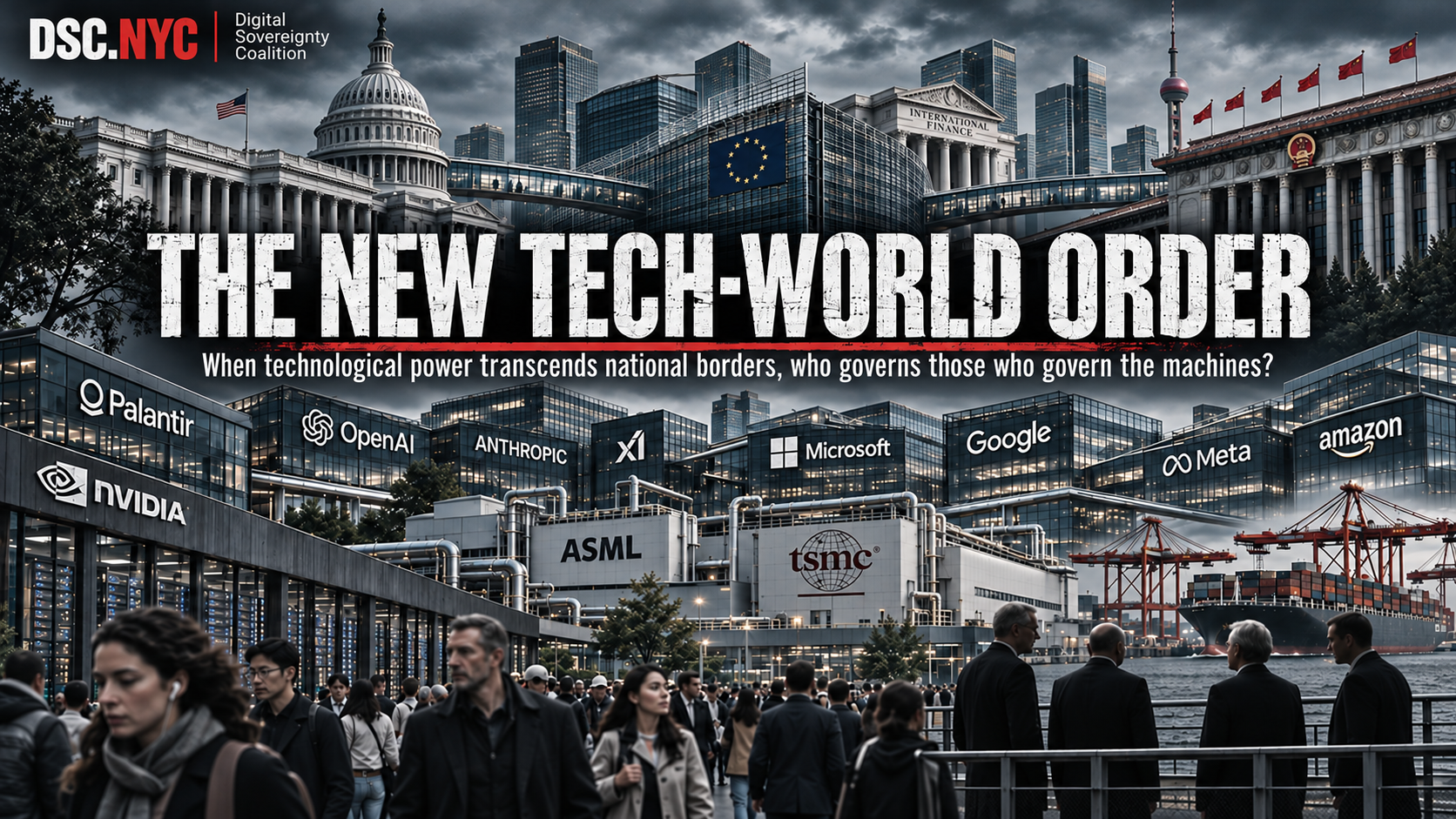
The world is undergoing a redistribution of power that cannot be understood exclusively through the traditional frameworks of capitalism, geopolitics, or technological innovation.
Artificial intelligence, computational infrastructure, digital identity, financial networks, satellite communications, and vast repositories of human data are becoming foundational components of modern civilization.
The institutions that control these systems increasingly possess the capacity to influence the conditions under which governments govern, economies operate, institutions communicate, and human beings participate in society.
This transformation is not necessarily the product of a coordinated global agenda. It is the consequence of converging economic incentives, technological dependencies, political ambitions, and unprecedented concentrations of computational capability.
Digital Sovereignty Coalition describes this emerging configuration of power as The New Tech-World Order.
The central question is not whether technology will transform civilization.
It is whether democratic societies will retain the authority to determine the conditions of that transformation.
§01
FROM THE INDUSTRIAL ORDER TO THE COMPUTATIONAL ORDER
The industrial revolutions established new centers of power around machinery, energy, transportation, manufacturing, and capital.
The emerging computational order introduces another dimension of power: the capacity to collect, interpret, predict, and increasingly influence human activity at scale.
Where industrial power depended heavily upon control of physical resources, computational power increasingly depends upon control of:
Artificial intelligence and foundational models.
Advanced semiconductor manufacturing.
Cloud computing and data centers.
Energy production and distribution.
Human and institutional data.
Digital identity and authentication.
Global communications infrastructure.
Automated financial and decision-making systems.
Where industrial power depended heavily upon control of physical resources, computational power increasingly depends upon control of:
These resources are not replacing traditional forms of power. They are becoming integrated with them.
The result is a new architecture of institutional dependency.
§02
THE EMERGENCE OF THE TECH-STATE
Governments increasingly depend upon privately developed technological infrastructure to perform essential public functions.
Defense, intelligence, healthcare, education, transportation, cybersecurity, financial administration, and public communications all operate within technological ecosystems that governments do not necessarily own or independently control.
The Tech-State emerges when governmental authority and concentrated technological capability become deeply interdependent.
The danger is not simply privatization.
It is the possibility that democratic institutions may retain formal authority while progressively losing the operational independence necessary to exercise it.
A government may possess constitutional authority while depending upon private institutions for the technological means through which that authority is exercised.
Political administrations change. Elections redistribute governmental authority. Public officials enter and leave office.
Technological infrastructure can remain embedded across successive administrations.
When private technological systems become indispensable to public institutions, their owners may acquire forms of influence that extend beyond ordinary commercial relationships.
This influence can emerge through procurement, lobbying, infrastructure dependency, technical expertise, political access, and the institutional costs of replacing established systems.
Techno-State Capture describes the risk that concentrated technological interests acquire disproportionate influence over the institutions responsible for governing them.
It does not require a secret agreement.
It requires dependencies sufficient to make independence costly.
§04
TECHNO-WELFARE ROYALTY
The relationship between technological wealth and public resources demands greater examination.
Publicly financed research, government contracts, tax incentives, infrastructure investment, energy concessions, and other forms of institutional support can contribute to private technological expansion.
Public-private collaboration can produce substantial benefits. However, when the public assumes significant risks while ownership, profits, and decision-making authority remain concentrated, questions of accountability and equitable distribution arise.
Who finances technological progress?
Who owns its infrastructure?
Who receives its economic rewards?
And who bears the consequences when speculative investments fail?
The concept of Techno-Welfare Royalty examines these imbalances without treating all public-private partnerships as inherently exploitative.
Technological innovation must not become a mechanism through which public resources systematically generate private power without corresponding public accountability.
Artificial intelligence is frequently presented as software.
Its underlying architecture is considerably more complex.
Advanced AI depends upon semiconductor fabrication, lithography, specialized hardware, energy, cooling systems, data centers, communications networks, software ecosystems, and financial capital.
These systems are distributed across nations but remain concentrated in particular institutions and geographic regions.
Countries that lack independent access to critical computational resources may find their technological development constrained by foreign corporations, export policies, geopolitical alliances, or commercial agreements.
The capacity to access intelligence is not equivalent to the capacity to control its infrastructure.
This distinction will become increasingly consequential as artificial intelligence becomes embedded within essential national functions.
Historically, imperial power has operated through territorial expansion, resource extraction, military dominance, economic dependency, and cultural influence.
Artificial intelligence introduces the possibility of another form of dependency.
Nations may retain territorial independence while relying upon externally controlled systems for intelligence, communications, education, economic participation, cybersecurity, and administrative decision-making.
AI Imperialism examines how technological dependency could constrain national, cultural, institutional, and individual self-determination.
Its mechanisms may include:
Dependency upon foreign computational infrastructure.
Extraction of data from populations without meaningful reciprocal benefit.
Concentration of intellectual property and technological ownership.
Dominance of particular languages, cultural assumptions, and institutional values within AI systems.
Restrictions on access to advanced computational capabilities.
Commercial or political conditions imposed through indispensable technological services.
Its mechanisms may include:
The challenge extends beyond competition between major geopolitical powers.
It concerns the ability of all nations and communities to participate in technological development without surrendering their sovereignty.
§07
THE GEOPOLITICS OF INTELLIGENCE
The emerging computational order is not a unified global system.
The United States, China, the European Union, India, and other geopolitical actors are pursuing different combinations of technological development, industrial policy, national security, regulation, and institutional sovereignty.
Competition over artificial intelligence increasingly intersects with competition over energy, semiconductors, manufacturing, communications, military capability, and economic influence.
Yet geopolitical competition does not automatically protect individual liberty.
A nation can pursue technological sovereignty while restricting the sovereignty of its citizens.
Likewise, private technological innovation does not automatically guarantee democratic freedom.
Digital Sovereignty Coalition distinguishes between national technological sovereignty and individual digital sovereignty.
Neither should be pursued at the expense of the other.
§08
THE PRIVATIZATION OF NATIONAL SECURITY
Artificial intelligence is increasingly being considered and deployed across defense, intelligence, cybersecurity, logistics, and other national security functions.
Private technological companies possess capabilities that can be valuable to governments.
However, the integration of proprietary systems into critical national security infrastructure raises fundamental questions:
Who retains operational control?
Who can independently audit these systems?
Who determines their permissible use?
Who has the authority to suspend or terminate their operation?
Can governments replace these systems without compromising essential functions?
What happens when corporate interests conflict with constitutional obligations?
However, the integration of proprietary systems into critical national security infrastructure raises fundamental questions:
Alignment between a technology company and a government does not establish democratic accountability.
Alignment without control is not sovereignty.
The ultimate authority over systems exercising public power must remain subject to lawful, democratic, and constitutionally accountable oversight.
§09
THE HUMAN BEING AS INFRASTRUCTURE
The New Tech-World Order is not solely a contest between governments and corporations.
Human beings themselves are becoming increasingly integral to the computational economy.
Our communications, movements, relationships, preferences, consumption patterns, biometric characteristics, and expressions of identity can become inputs into systems designed to classify, predict, and influence behavior.
Digital Sovereignty Coalition describes the accumulation and interaction of these informational fragments through its framework of the Computational Mosaic.
The resulting computational representations may influence access to employment, financial services, insurance, education, information, and institutional opportunities.
When systems infer characteristics that individuals have never explicitly disclosed, traditional concepts of privacy and consent become insufficient.
Participation in modern civilization must not be interpreted as unconditional permission to extract, reconstruct, and commercially exploit the human being.
The influence of technological corporations increasingly extends beyond the products and services they sell.
Their infrastructure can mediate communication, commerce, political discourse, access to information, institutional decision-making, and increasingly the production of knowledge itself.
The concentration of these capabilities raises questions that cannot be addressed exclusively through conventional consumer protection or competition policy.
The issue is not whether technological leaders should be wealthy, successful, influential, or ambitious.
It is whether any private institution should acquire capabilities so indispensable to civilization that meaningful democratic oversight becomes impractical.
Innovation does not confer a democratic mandate.
Technical expertise does not confer constitutional authority.
Economic success does not confer the right to determine the future of humanity.
§11
EXTRACTIVE AND NON-EXTRACTIVE TECHNOLOGICAL CIVILIZATION
The emerging technological order is not inevitable in its present form.
Technology can be designed around extraction, dependency, behavioral manipulation, and concentrated ownership.
It can also be designed around privacy, interoperability, transparency, accessibility, individual autonomy, distributed ownership, and public benefit.
The distinction between extractive and non-extractive technologists is therefore not a rejection of technological advancement.
It is an examination of the purposes, incentives, institutional structures, and consequences of technological development.
The future should not require humanity to choose between technological progress and human freedom.
Transformations of institutional power do not always announce themselves through visible political ruptures.
They can emerge through convenience, efficiency, incremental adoption, administrative modernization, and ordinary commercial transactions.
A new application.
A faster payment system.
A more efficient government service.
A personalized educational platform.
An automated security system.
Each development may provide genuine benefits. Yet their cumulative effects can alter the distribution of power in ways that are difficult to recognize when examined individually.
The danger is not that technological progress occurs.
The danger is that societies may normalize new dependencies without establishing the safeguards necessary to preserve their freedom.
By the time a dependency becomes unmistakable, replacing it may be extraordinarily difficult.
The most consequential effects of the emerging computational order may be experienced by generations that had no opportunity to influence its formation.
Children born into technologically mediated societies may never experience a world in which participation does not routinely generate data, behavioral predictions, and computational identities.
Their freedoms must not depend upon the commercial preferences of institutions established before they were born.
This responsibility extends across national borders, racial and cultural communities, economic classes, and generations.
It must explicitly recognize Indigenous data sovereignty, tribal sovereignty, historically marginalized populations, African and Afro-descendant communities, Asian communities and diasporas, and societies whose technological development has been shaped by unequal access to capital and infrastructure.
Digital sovereignty cannot be a privilege reserved for wealthy nations or technologically sophisticated individuals.
It must be a universally accessible foundation for human self-determination.
§14
A PLURALITY OF DIGITAL SOVEREIGNTY
Digital Sovereignty Coalition does not advocate replacing one centralized technological authority with another.
A sustainable democratic technological civilization requires a plurality of digital sovereignty: the capacity of individuals, communities, institutions, and nations to exercise meaningful authority over their technological participation.
Such an architecture should support:
Individual computational self-determination.
Meaningful consent and inference sovereignty.
Public-interest computational infrastructure.
Interoperability and technological portability.
Independent auditing and constitutional oversight.
Non-extractive technological development.
International cooperation without compulsory technological dependency.
Civic AI governed through transparent and accountable institutional frameworks.
Such an architecture should support:
Digital Sovereignty Coalition advances the Right to Civic AI and the proposed Civic Machina architecture as contributions toward this alternative.
The objective is not to obstruct innovation.
It is to ensure that innovation remains compatible with human liberty, democratic governance, and constitutional accountability.
§15
CONSTITUTION BEFORE CAPABILITY
The capacity to build a technological system does not establish the legitimacy of its deployment.
The ability to predict human behavior does not establish the right to govern through prediction.
The ability to reconstruct human identity does not establish ownership of that identity.
The ability to automate public authority does not establish the right to exercise it without democratic accountability.
The New Tech-World Order presents humanity with a choice about the institutional foundations of technological civilization.
Will technological capability determine the boundaries of human freedom?
Or will human freedom determine the permissible boundaries of technological capability?
Constitution Before Capability.
This is not an argument against the future.
It is an argument for humanity's right to participate in determining it.
DSC Lexicon
NEW TECH-WORLD ORDER
An emerging global power structure in which control over computational infrastructure, artificial intelligence, data, capital, and digital identity increasingly determines the distribution of political, economic, and societal power. The term describes structural transformations arising from technological concentration, institutional dependency, geopolitical competition, and economic incentives. It does not assert the existence of a coordinated clandestine global agenda.
THE NEW TECH-WORLD ORDER is an investigative and analytical framework developed by Digital Sovereignty Coalition to examine the emerging relationship between computational power, governmental authority, financial concentration, geopolitical dependency, and human self-determination.
This investigation draws upon official government records, regulatory findings, judicial proceedings, international policy documents, academic research, technical evaluations, and corporate disclosures.
Digital Sovereignty Coalition distinguishes between documented institutional developments, reported findings, corporate representations, analytical interpretations, prospective risks, and proposed democratic alternatives.
Government contract ceilings are not represented as actual expenditures. Corporate partnerships are not inherently evidence of misconduct. Technological concentration does not independently establish governmental capture.
The term NEW TECH-WORLD ORDER does not allege the existence of a coordinated clandestine global agenda. It identifies an emerging configuration of power whose institutional relationships, economic incentives, technological dependencies, and consequences warrant sustained democratic scrutiny.
The purpose of this investigation is not to oppose technological innovation.
It is to examine the conditions under which technological innovation can remain compatible with human freedom, constitutional accountability, and democratic self-determination.
CONSTITUTION BEFORE CAPABILITY.
Master Evidence Registry
MASTER EVIDENCE REGISTRY
48 evidence entries across 16 manuscript sections. Repeated source references are intentional; they do not represent 48 unique publications. Source-level audit pending.