
INSTITUTIONAL POWER / COMPUTATIONAL SOVEREIGNTY / NATIONAL SECURITY / AI POLITICAL ECONOMY
NVIDIA AND THE
CONCENTRATION OF COMPUTATIONAL POWER
National Security. Corporate Influence. Financial Dependence. Democratic Oversight.
What happens when one corporation becomes essential to the functioning of an entire technological civilization?
COMPUTE
The hardware and software layer on which advanced AI depends.
CAPITAL
The investment relationships that finance the AI build-out.
GOVERNMENT
Export controls, procurement, and the boundaries of public authority.
NATIONAL SECURITY
Concentration as a strategic exposure — and an oversight problem.
WHEN ONE COMPANY BECOMES INFRASTRUCTURE
Artificial intelligence is increasingly being integrated into the institutions, industries, and systems upon which modern societies depend.
But beneath the applications, algorithms, and promises of technological progress lies a more fundamental question: who controls the computing infrastructure that makes advanced AI possible?
Nvidia occupies an unusually consequential position in this emerging economy. Its semiconductor technologies, software ecosystem, networking products, strategic investments, and commercial partnerships connect it to frontier AI laboratories, major cloud providers, scientific institutions, industrial automation, and government research.
These relationships have helped accelerate innovation. They also raise questions about concentration, institutional dependence, market access, and systemic resilience.
What happens when the computing infrastructure supporting an increasingly consequential technological ecosystem depends heavily on one corporation? And who exercises meaningful oversight when that corporation's commercial interests intersect with national security, international competition, financial markets, and government policy?
COMPUTATIONAL DEPENDENCE CAN BECOME INSTITUTIONAL DEPENDENCE.
This investigation examines how that dependence develops, who benefits from it, and what safeguards may be necessary to protect the public interest.
Founder-approved artwork placed above. No substitute imagery has been generated at any point.
SECTION 01
THE ARCHITECTURE OF DEPENDENCE
Nvidia occupies a position in the global artificial intelligence economy that few corporations in any industry have held: its technology sits underneath the frontier.
The large-scale training and deployment of modern AI systems runs overwhelmingly on accelerated computing, and accelerated computing at scale means, in practice, Nvidia's GPUs, its networking, and its software stack.
This page examines that position systematically — not as a profile of a company or a chief executive, but as a question about the structure of the technological civilization being built on top of it.
GPU HARDWARE AND AI ACCELERATORS
Nvidia's data-center GPUs define the reference platform for frontier AI training and much of commercial inference.
CUDA AND THE SOFTWARE ECOSYSTEM
Nearly two decades of CUDA libraries, compilers, and tooling make Nvidia's platform the default target for AI software development — a moat measured in developer habit, not just silicon.
AI DATA-CENTER INFRASTRUCTURE
Complete reference architectures — racks, systems, and interconnects — sold to hyperscalers, neoclouds, and sovereign operators.
HIGH-PERFORMANCE NETWORKING
NVLink and the InfiniBand line acquired with Mellanox make Nvidia a supplier of the fabric that ties AI clusters together, not merely the chips inside them.
CLOUD COMPUTING
Nvidia's technology underlies third-party clouds, and Nvidia extends into the cloud layer through partnerships and its own software and services offerings.
FRONTIER AI TRAINING AND INFERENCE
Nearly every publicly known frontier-scale training run has been executed on Nvidia systems.
ROBOTICS AND AUTONOMOUS SYSTEMS
Simulation platforms, onboard computing, and robotics software position Nvidia at the center of physical AI.
SCIENTIFIC COMPUTING
Research institutions and national laboratories use Nvidia systems for simulation, drug discovery, climate modeling, and fundamental science.
DEFENSE AND NATIONAL-SECURITY APPLICATIONS
Nvidia technology flows into defense AI, autonomy, sensing, and command-and-control programs.
SOVEREIGN AI INITIATIVES
National governments build domestic AI capability on Nvidia platforms — a dependency Nvidia explicitly markets.
CORPORATE INVESTMENT AND INFRASTRUCTURE FINANCING
Nvidia is simultaneously a supplier, an investor, and a demand amplifier across the AI ecosystem — the subject of Section 02.
Four distinctions keep this analysis honest:
MARKET DOMINANCE
Holding the dominant position in a fast-growing market — even overwhelmingly — is a market outcome, not a legal finding.
VENDOR DEPENDENCE
Customers and industries can be structurally dependent on a supplier's products without any law being broken or any control being exercised over them.
INTEROPERABILITY BARRIERS
Software ecosystems can raise switching costs and entrench a platform through technical lock-in — a competitive concern distinct from dominance itself.
ACTUAL MONOPOLY FINDINGS
A monopoly determination is a legal conclusion reached by regulators or courts after process. This page reports documented positions and proceedings and does not render its own antitrust verdict.
Concentration is documented here using dated, attributed measures rather than unsourced percentages:
Fiscal year 2025 total revenue reported at approximately $130.5 billion, with data-center revenue reported at approximately $115.2 billion.
REPORTED
Nvidia full-year results announcement, February 2025. Figures to be re-verified against Nvidia's investor relations disclosures before publication.
Analyst estimates place Nvidia's share of AI accelerator shipments at a substantial majority of the market.
REPORTED
Widely reported independent analyst estimates; not independently verified by DSC, and estimates vary by segment and definition.
Nvidia's annual report discloses revenue concentration among a small number of direct customers.
DOCUMENTED IN PART
Customer-concentration disclosures exist in Nvidia's SEC filings; the specific percentages and identities as disclosed require verification against the filing itself.
Nvidia's market capitalization crossed four trillion dollars in July 2025 — the first company reported to reach that milestone.
REPORTED
Widely reported milestone based on market data; re-verify before publication.
Manufacturing concentration: Nvidia designs its leading accelerators for production primarily at TSMC's most advanced process nodes.
DOCUMENTED
Consistent with Nvidia's public disclosures as a fabless semiconductor company and TSMC's published process roadmap; supply-chain concentration is examined further in Section 05.
CAN A SOCIETY EXERCISE MEANINGFUL TECHNOLOGICAL SELF-DETERMINATION WHEN ESSENTIAL COMPUTING CAPABILITIES DEPEND HEAVILY ON ONE CORPORATE ECOSYSTEM?
SECTION 02
NVIDIA'S FINANCIAL WEB
Investment, financing, and the economics of computational dependence.
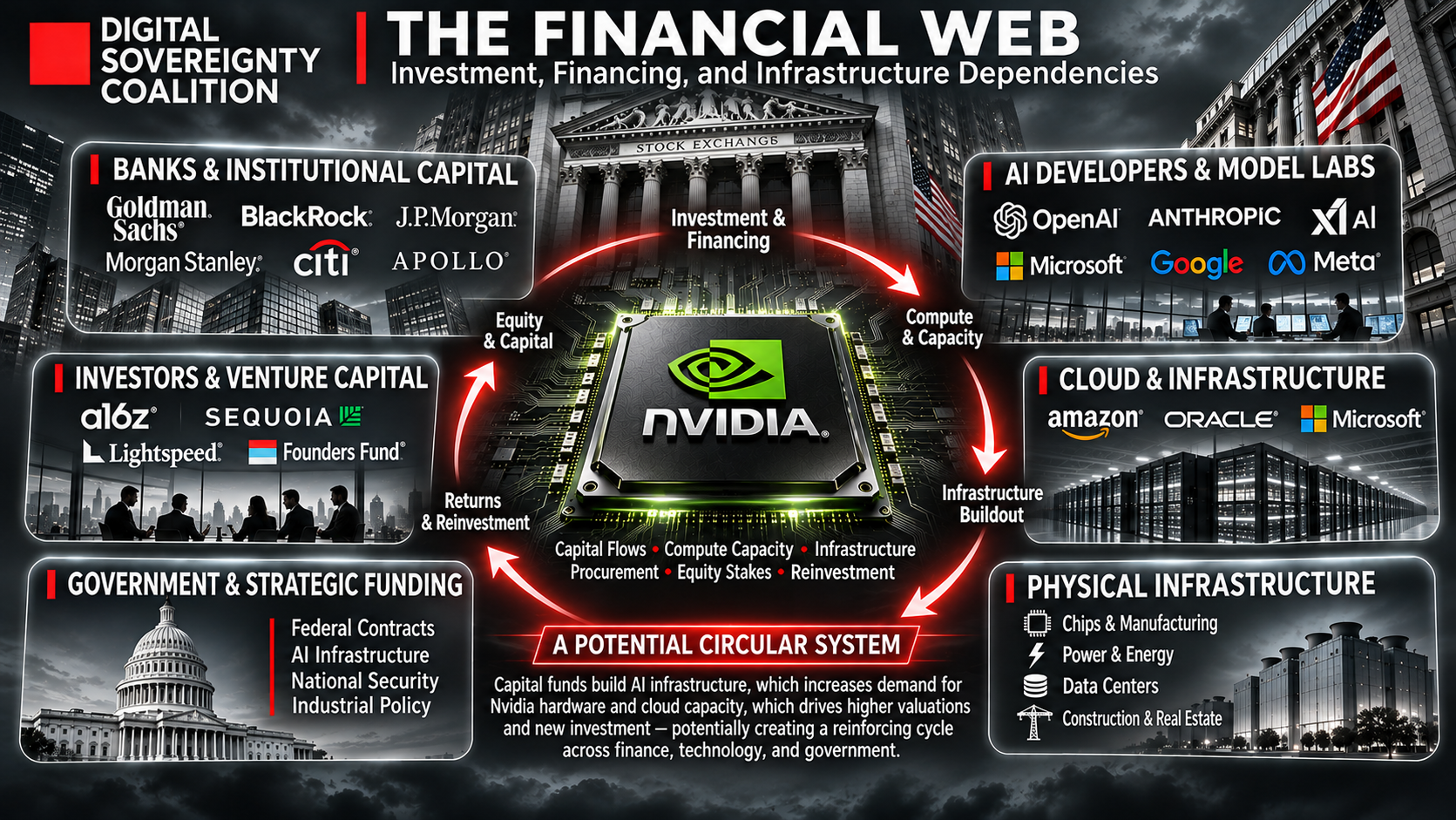
Nvidia's financial relationships extend far beyond selling chips. The company invests in AI developers, commits capital to cloud and data-center ventures, supplies systems on credit-adjacent terms, and benefits from infrastructure financing it did not originate.
Understanding that web requires distinguishing forms of entanglement that are routinely conflated in public discussion.
EQUITY OWNERSHIP
Holding shares in another company — with the rights and risks ownership carries.
MINORITY INVESTMENTS
Strategic stakes that signal alignment and secure supply or demand without conferring control.
STRATEGIC PARTNERSHIPS
Publicly announced commercial collaborations, often with co-marketing and roadmap commitments.
JOINT VENTURES
Shared new entities with pooled capital and defined scope.
SUPPLY AGREEMENTS
Contracts to deliver hardware or services — the core vendor relationship.
CLOUD-CAPACITY COMMITMENTS
Long-dated agreements to purchase or provide computing capacity, which can resemble financing in their effect on demand.
DEBT FINANCING
Lending or credit arrangements within the ecosystem.
INFRASTRUCTURE INVESTMENT VEHICLES
Participation in funds and vehicles that finance data centers and energy.
REVENUE RELATIONSHIPS
Ordinary customer-supplier revenue — the largest category, and the least remarkable per transaction.
COMMITMENTS VERSUS COMPLETED DEPLOYMENT
An announced commitment is not deployed capacity. Both matter; they are different facts.
Documented and reported relationships involve OpenAI, Anthropic, xAI, CoreWeave, Microsoft, Amazon, Alphabet/Google, Meta, Oracle, major data-center developers, and private-equity and institutional capital providers. This page does not present every listed company as an Nvidia investee — each relationship is typed individually in the ecosystem directory in Section 03, with its evidence record.
The circular financing question concerns capital that may move through interconnected relationships:
Where such structures exist, analysts have raised the possibility that they create:
- Concentrated counterparty risk.
- Revenue dependencies that overstate durable demand.
- Demand amplification across the chain.
- Valuation interdependence among ecosystem participants.
- Barriers to market entry for competitors.
- Systemic exposure if a major node fails.
- Potential conflicts between a supplier's competitive and investment interests.
Do not characterize any documented commercial arrangement as circular financing unless the underlying structure supports that description. This page examines the question as a question — and connects it to DSC's existing AI Ouroboros framework in Section 12.
WHO ULTIMATELY BEARS THE RISK WHEN THE SUPPLIER, THE INVESTOR, AND THE DEMAND ENGINE ARE PARTS OF THE SAME STRUCTURE?
The infrastructure of artificial intelligence is not financed by technology companies alone. Banks, institutional investors, private-equity firms, venture capital funds, cloud providers, and governments participate in financing the infrastructure required to develop and deploy advanced AI systems.
Data centers require substantial investments in land, electricity, cooling systems, networking equipment, construction, and specialized computing hardware. The resulting financial relationships connect companies that would otherwise appear to occupy separate positions within the economy.
Nvidia participates in this environment through hardware sales, software and infrastructure offerings, strategic partnerships, and investments. Some financial relationships may reinforce demand across interconnected sectors: capital can support AI developers, which purchase computing capacity from cloud providers, which invest in data centers and hardware. Growing demand can attract additional financing and encourage further infrastructure expansion.
But rising investment does not necessarily establish sustainable profitability — and interconnected financial relationships do not, by themselves, prove market manipulation or improper conduct. The relevant investigative question is whether financial dependencies create vulnerabilities that individual participants — or their regulators — may not fully recognize.
WHO FINANCES THE COMPUTATIONAL ECONOMY?
The verified roles under examination:
Capital commitments are distinguished from completed investments, equity stakes from loans, and financing relationships from direct ownership.
WHEN INVESTMENT, INFRASTRUCTURE, AND REVENUE BECOME INTERDEPENDENT, RISKS MAY TRAVEL BEYOND THE COMPANIES THAT ORIGINALLY CREATED THEM.
SECTION 03
THE NVIDIA COMPUTATIONAL ECOSYSTEM
An interconnected industry built upon advanced computing infrastructure.
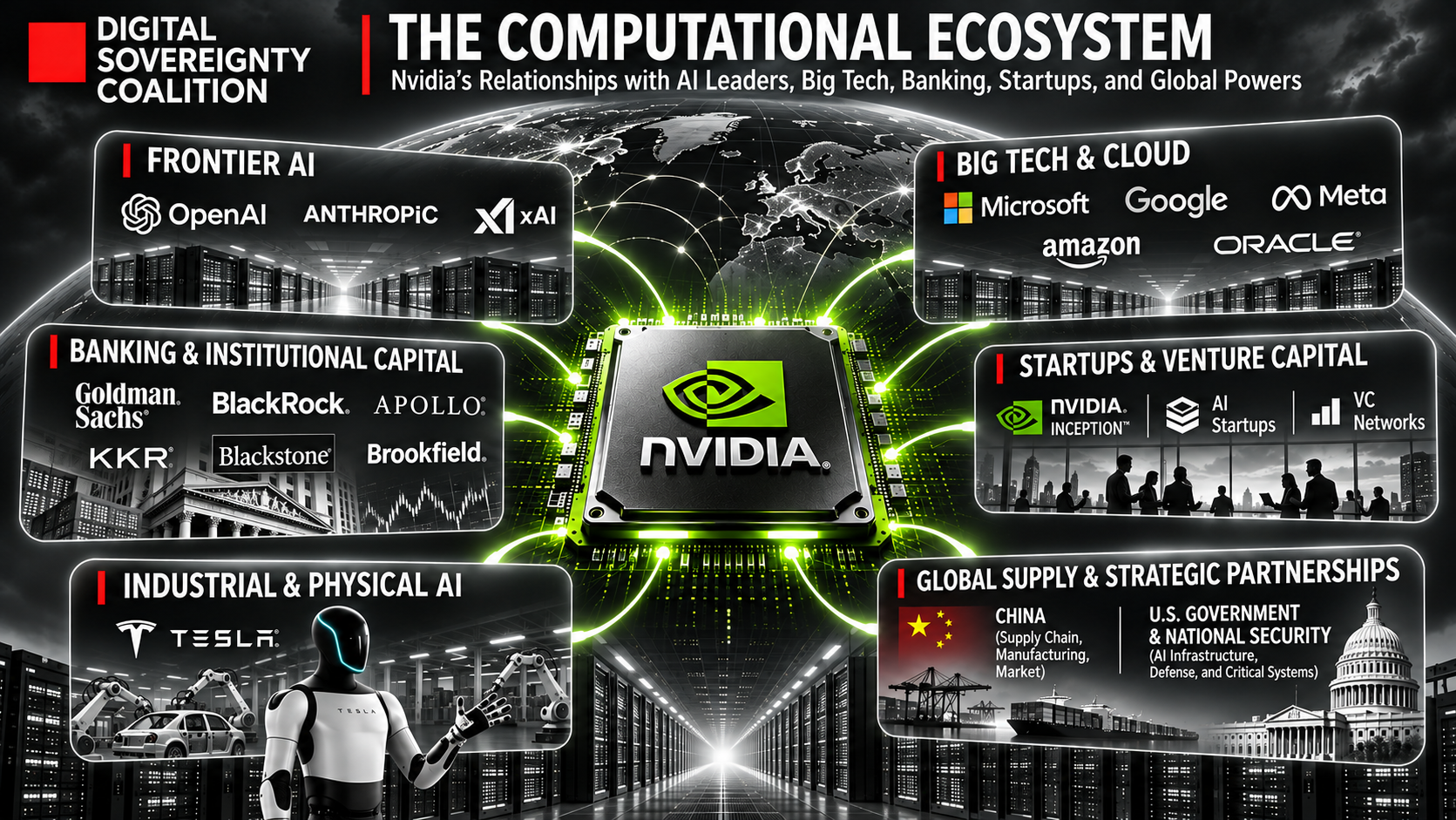
The directory below documents Nvidia's relationships across the AI economy. Each entry carries its relationship type, its evidence classification, and its supporting source. A relationship's presence in this directory is a documentation statement, not an allegation — most of what appears here is ordinary commerce, and ordinary commerce at this scale is precisely why the structural questions matter.
NVIDIA
Relationship types used throughout the map and directory:
EQUITY
Ownership of shares in an entity.
CUSTOMER
The counterparty buys Nvidia systems or services.
SUPPLIER
The counterparty supplies Nvidia — silicon, equipment, or services.
FINANCING
Investment, commitment, or capital arrangement.
PARTNERSHIP
Announced commercial or technical collaboration.
GOVERNMENT CONTRACT
Contractual relationship with a government entity.
REGULATORY AUTHORITY
A government body exercises licensing or oversight authority over Nvidia.
The directory is the authoritative record. It is filterable by relationship type, keyboard-accessible, and each entry opens its full evidence record — entities involved, nature, date, verified amount where available, supporting source, qualifications, and last verification date. Lines between entities are never drawn where only a commercial partnership exists.
REPORTED
Announced letter of intent for Nvidia to invest up to $100 billion in OpenAI, tied to OpenAI's planned deployment of at least 10 gigawatts of Nvidia systems; OpenAI is simultaneously a major Nvidia customer.
REPORTED
Announced investment commitment alongside Microsoft, with Anthropic committing to purchase Nvidia systems and Microsoft Azure capacity.
REPORTED
Nvidia has been an investor in CoreWeave since its early years; CoreWeave is a major purchaser of Nvidia systems and resells that capacity to AI developers.
DOCUMENTED
Nvidia designs its leading accelerators for fabrication primarily at TSMC's most advanced process nodes; TSMC is the critical manufacturing link in Nvidia's supply chain.
DOCUMENTED — REVIEWED
Announced expansion of the NVIDIA Vera Rubin architecture to multi-gigawatt scale on Oracle Cloud Infrastructure, with the NVIDIA Vera CPU coming to OCI.
DOCUMENTED IN PART
The largest cloud and platform companies are among Nvidia's largest customers for data-center systems; Nvidia's annual report discloses revenue concentration among a small number of direct customers.
DOCUMENTED
BIS administers the export-control regime governing Nvidia's most advanced accelerators, including successive restrictions and licensing requirements.
DOCUMENTED IN PART
Nvidia-class computing supports U.S. defense AI, autonomy, sensing, and command-and-control programs.
REPORTED
China historically represents a major market for Nvidia data-center products; export controls have progressively restricted access, with reported restrictions on the H20 in April 2025 and a reported mid-2025 arrangement involving remittance to the U.S. government of a share of H20 China revenue to resume sales.
DOCUMENTED — REVIEWED
National sovereign-AI collaborations announced on Nvidia's newsroom, including Korea-focused announcements on physical AI, agentic AI, and sovereign AI infrastructure with NVLink Fusion (with Rebellions and SK Telecom).
REPORTED
Reported participation in xAI funding rounds and reported system supply to xAI training infrastructure.
REPORTED
Reported Nvidia participation in financing for data-center development, including announced involvement in large data-center and energy infrastructure arrangements.
REPORTED
Nvidia invests across the AI ecosystem through its NVentures arm; the portfolio spans AI developers, infrastructure, and adjacent technologies.
DOCUMENTED
The CUDA platform and its developer ecosystem are Nvidia proprietary software; the platform's ubiquity across AI research and engineering creates a dependency that is technical rather than contractual.
DOCUMENTED
Nvidia's Isaac simulation platform, Jetson edge computing, and automotive platforms anchor the physical-AI and autonomy ecosystem; robotics developers build on Nvidia platforms.
WHICH OF THESE EDGES COULD BECOME LEVERS OF INFLUENCE — AND WHO WOULD NOTICE?
RELATIONSHIPS ARE NOT INTERCHANGEABLE
A company purchasing Nvidia hardware is not necessarily owned or controlled by Nvidia. A company participating in a commercial partnership is not necessarily an Nvidia investor. A startup receiving development support does not necessarily have an equity relationship with Nvidia.
The distinction matters because technological dependence, financial influence, and legal control are different forms of power.
The investigative questions this framework pursues:
SECTION 04
THE GOVERNMENT RELATIONSHIP
The intersection of technological infrastructure, private enterprise, and public authority.
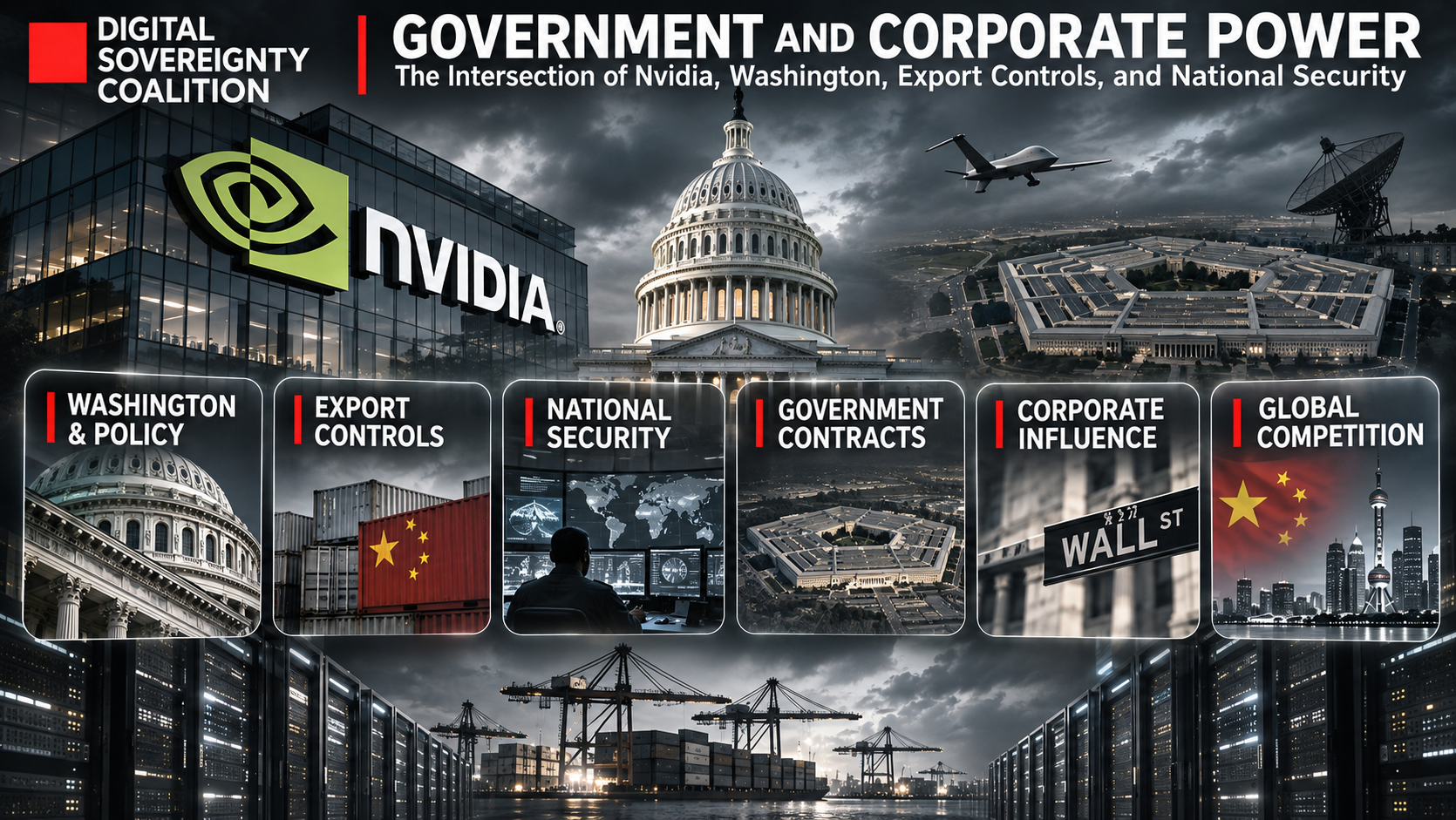
Nvidia's relationship with the United States government runs through procurement, regulation, licensing, and policy advocacy — and through the personal financial interests of officials who make relevant decisions.
These are different channels, and the first analytical obligation is to keep them separate.
EXECUTIVE BRANCH DECISION-MAKING
Export-control and national-security determinations concentrate significant authority in the executive branch.
DEPARTMENT OF COMMERCE
Commerce houses the export-control apparatus that governs advanced computing sales.
BUREAU OF INDUSTRY AND SECURITY
BIS administers the licensing regime for advanced chips and the entity list that shapes who may receive them.
DEPARTMENT OF DEFENSE
Defense programs consume Nvidia-class computing for autonomy, sensing, and command-and-control applications.
CONGRESSIONAL OVERSIGHT
Congress legislates on export controls, investigates enforcement, and holds hearings on AI and national security.
FEDERAL RESEARCH AND COMPUTING INITIATIVES
Federal scientific computing initiatives procure Nvidia-class systems for national laboratories and research networks.
EXPORT-CONTROL LICENSING
Individual licenses, license exceptions, and entity-list determinations decide specific transactions.
LOBBYING
Nvidia lobbies the federal government on export controls, tax, and technology policy; lobbying disclosures are public records.
CAMPAIGN FINANCE AND POLITICAL CONTRIBUTIONS
Corporate and individual political giving is documented in public filings by the Federal Election Commission.
FEDERAL PROCUREMENT AND NATIONAL-SECURITY INFRASTRUCTURE
Nvidia-class systems underpin federal computing infrastructure, making the vendor a strategic dependency of the state itself.
GOVERNMENTAL DECISION-MAKING AUTHORITY RESTS WITH OFFICIALS ACCOUNTABLE TO LAW. PRIVATE-SECTOR INFLUENCE — LOBBYING, ADVOCACY, ACCESS — IS REAL, BUT IT IS NOT AUTHORITY, AND CONFLATING THE TWO CORRUPTS BOTH ANALYSIS AND ACCOUNTABILITY.
One specific documented-interest question requires its own file: reported Nvidia securities transactions by the President of the United States or Trump-controlled entities. DSC has not verified any such transaction as of the review date on this page, and therefore asserts none. The case file is structured to receive verified data when financial disclosures are reviewed:
CRITICAL SAFEGUARD: NEVER DESCRIBE THE WHITE HOUSE AS OWNING PART OF NVIDIA MERELY BECAUSE AN INCUMBENT PRESIDENT HOLDS OR TRADED ITS STOCK. A PERSONAL PORTFOLIO IS NOT SOVEREIGN EQUITY. AND NO DISCLOSED INVESTMENT, BY ITSELF, PROVES THAT ANY POLICY DECISION WAS IMPROPERLY INFLUENCED — EACH QUESTION ABOVE MUST BE ANSWERED SEPARATELY, ON EVIDENCE.
WHERE DOES PUBLIC AUTHORITY END AND PRIVATE INFLUENCE BEGIN — AND WHO AUDITS THE BOUNDARY?
Governments depend increasingly on private technology companies to supply computing systems, cybersecurity products, cloud infrastructure, and advanced AI capabilities. At the same time, technology companies depend upon governments for regulatory authorization, market access, government contracts, intellectual-property protections, and the legal environment in which they operate.
These relationships are not inherently improper. Public-private cooperation has contributed to scientific research, national defense, infrastructure development, and economic growth. However, cooperation raises governance questions when a company becomes strategically important to national technological capacity.
Nvidia's position in advanced AI computing places it within policy debates involving export restrictions, economic competitiveness, national security, research funding, and industrial strategy. Government decisions can influence the markets available to Nvidia. Nvidia's technology and commercial arguments can, in turn, inform government assessments.
The question is not whether government and industry should communicate. It is whether the public institutions responsible for oversight retain sufficient independence, transparency, and accountability.
FINANCIAL INTERESTS AND PUBLIC DECISIONS
Reported financial interests held by public officials, their associated entities, or government investment vehicles are examined using official disclosures wherever available. Personal investment holdings are distinguished from governmental ownership. For each relevant case, the framework determines:
Possession of a financial interest in a regulated company is never treated, by itself, as evidence of corruption.
WHO EXERCISES OVERSIGHT WHEN CORPORATE TECHNOLOGY BECOMES ESSENTIAL TO GOVERNMENT CAPABILITY?
WHEN PRIVATE TECHNOLOGY BECOMES PUBLIC INFRASTRUCTURE
Advanced computing is increasingly supplied by private corporations but employed in activities with profound public consequences. Government agencies, national laboratories, military organizations, universities, cloud providers, and private companies may depend on commercially controlled technologies for essential functions.
These relationships create important opportunities for innovation and cooperation. They also raise questions about how public authority should interact with private technological power.
Nvidia's position illustrates the challenge. Its products support commercial AI development while also participating in broader technological systems relevant to national competitiveness and security. At the same time, government decisions concerning export restrictions, industrial policy, procurement, and international commerce can materially affect Nvidia's business.
The relationship is therefore reciprocal. Private companies depend upon government authority. Governments increasingly depend upon private technological capability.
Seven distinct concepts govern this boundary. They are different claims with different evidentiary requirements, and they are never treated as interchangeable on this page:
LEGITIMATE GOVERNMENT-INDUSTRY COOPERATION
Documented, authorized interaction between public institutions and private firms — advisory processes, procurement, and research collaboration.
CORPORATE LOBBYING
Lawful advocacy for policy positions. It must be disclosed where law requires, and it is distinct from policy authority.
POLITICAL ACCESS
Meetings, communications, and relationships with decision-makers. Access is established by records of the interaction; a meeting itself does not constitute improper influence.
CONFLICTS OF INTEREST
Circumstances in which a decision-maker's private interests could bear on public duties. Requires documented interests and the applicable ethics rules.
REGULATORY CAPTURE
A systemic condition in which an agency consistently serves the regulated industry's interests over the public's. Requires a pattern of evidence, not a single decision.
IMPROPER INFLUENCE
A specific claim that pressure, favors, or inducements affected a particular decision. Requires evidence connecting the influence to the decision.
CORRUPTION
A legal violation — a quid pro quo or abuse of public office for private benefit. Requires the highest evidentiary standard and is never presumed.
Each rung of this ladder requires more evidence than the last. Moving up it without evidence is the analytical error this framework exists to prevent.
WHEN PRIVATE COMPUTATIONAL POWER BECOMES ESSENTIAL TO PUBLIC CAPABILITY, WHO EXERCISES INDEPENDENT OVERSIGHT?
FINANCIAL INTERESTS: SEVEN CATEGORIES THAT ARE NOT INTERCHANGEABLE
Financial conflicts involving government officials and strategically important corporations are examined through seven distinct categories. Each names a different legal and factual relationship, and each requires different evidence.
PERSONAL OWNERSHIP
An official's direct or indirect financial holdings, documented through official disclosures.
INDEPENDENT INVESTMENT MANAGEMENT
Holdings managed by third parties under applicable arrangements. Management by others does not, by itself, eliminate an official's financial interest.
BLIND TRUST
A specific legal structure with defined restrictions and oversight. The term is not a generic synonym for managed investments, and trust status is verified, not assumed.
GOVERNMENT OWNERSHIP
Equity or economic interests legally held by public entities — categorically distinct from any official's personal portfolio.
PUBLIC PROCUREMENT
Government purchases of products or services, governed by procurement law rather than ethics-filing regimes.
CORPORATE CONTRIBUTIONS
Donations or commitments made to political, ceremonial, or institutional activities, subject to their own disclosure rules.
REGULATORY AUTHORITY
Official powers that can affect commercial activity. Authority is held by agencies, not by counterparties.
These categories may interact. Their coexistence is not, by itself, evidence of corruption; each interaction is examined on evidence, under the framework already applied in this section.
WHAT PUBLIC DISCLOSURE AND INDEPENDENT REVIEW SHOULD APPLY WHEN GOVERNMENT POLICY CAN MATERIALLY AFFECT THE VALUE OF ASSETS HELD BY PUBLIC OFFICIALS?
DOCUMENTED CASE FILE — OPENED NOVEMBER 12, 2026 — STATUS: UNVERIFIED, PENDING PRIMARY SOURCES
THE PRICE OF ACCESS: NVIDIA, THE WHITE HOUSE, AND CORPORATE INFLUENCE
This case file examines Nvidia's engagement with the current administration across five subjects. It is opened in staging so that each subject can be populated exclusively from primary documentation — meeting records, contribution records, appointment records, lobbying disclosures, and financial disclosures — as they are reviewed.
No meeting, contribution, advisory role, lobbying position, or financial holding has been verified by DSC as of the review date. Nothing below asserts that any such event occurred or that any relationship was improper. Each entry states what would have to be established, and by what evidence, before the record could support it.
MEETING RECORDS
Dates, participants, and publicly documented purposes of any meetings involving Jensen Huang, the President, senior White House officials, Commerce Department officials, and other government decision-makers.
POLICY CONTEXT
The policy issues relevant to each documented meeting.
SUBSEQUENT DECISIONS
Official decisions that followed, with dates.
CAUSAL EVIDENCE
Whether reliable evidence establishes any causal relationship between access and any decision. A meeting itself does not constitute improper influence.
Access becomes an investigative subject only when records exist to examine. None have been reviewed.
THE AMOUNT
Reporting describes an alleged or confirmed contribution or commitment of $25 million toward the White House ballroom project. The amount, the donor entity, and whether any commitment was fulfilled are unverified.
THE RECIPIENT
The legal and institutional recipient of the contribution, and the disclosure requirements applicable to it.
THE TIMING
The timing of the contribution relative to government decisions involving Nvidia.
THE SEPARATION
Documented donations are separated from allegations concerning their purpose. A donation is not evidence of an exchange.
The ballroom project itself is examined in DSC's The Underground State investigation. Corporate-contribution records specific to Nvidia have not been reviewed.
THE APPOINTMENT
The date and instrument of any appointment of Jensen Huang to a federal science and technology advisory body.
LEGAL AUTHORITY
The body's legal authority and charter.
ETHICS REQUIREMENTS
The ethics requirements applicable to the role.
NATURE OF ROLE
Whether the role was advisory or decision-making.
FINANCIAL INTEREST
Whether Nvidia held financial interests affected by the body's recommendations.
Advisory service is a lawful and common form of expert participation in government; it becomes an examination subject only through its documented terms.
POSITIONS TAKEN
Nvidia's public advocacy concerning restrictions on AI chip exports, tracked in the China Export-Control Advocacy case file in Layer Two.
GOVERNMENT POSITIONS
The positions taken by the relevant government agencies.
THE DISTINCTION
Advocacy is distinct from actual policy authority. Lobbying is lawful; policy authority rests with officials accountable to law.
This part extends the existing export-control advocacy case file rather than duplicating it.
TRANSACTIONS
Official disclosures concerning any Nvidia stock transactions or holdings by Donald Trump: transaction dates, disclosed transaction ranges, ownership arrangements, and investment-management structure.
ETHICS FRAME
Applicable ethical restrictions, relevant official decisions, and any documented recusal or exemption.
THE DISTINCTION
Personal holdings by a president do not constitute equity ownership by the White House or the federal government. A managed investment portfolio is not described as a legally qualified blind trust without verifying its status.
Examined in the Presidential Financial Disclosures case file in Layer Two. No Nvidia transaction has been verified by DSC.
WHEN POLITICAL ACCESS, CORPORATE CONTRIBUTIONS, INVESTMENT HOLDINGS, AND REGULATORY AUTHORITY INTERSECT, WHAT SAFEGUARDS PROTECT PUBLIC DECISION-MAKING?
Cross-references TECHNO-STATE CAPTURE and its Price of Access section; that investigation is linked, not reproduced.
NOVEMBER 13 — CONGRESSIONAL STOCK TRADING AND THE NVIDIA CONTROVERSY — STATUS: REPORTED, FILINGS PENDING VERIFICATION
WHO KNEW WHAT — AND WHO TRADED WHEN?
The New York Post reports that a trust benefiting Representative Ro Khanna's wife sold Nvidia securities on September 4 and October 7, 2026, in reported value ranges of $1,001 to $15,000 per transaction. The transactions preceded the market decline associated with disclosures involving Nvidia's former chief executive.
Representative Khanna's office has denied that he or his staff possessed advance knowledge of the Nvidia controversy. His spokesperson stated that Khanna did not direct the trades. That denial is recorded here prominently, and the independently managed trust arrangement described by his office is examined on its own terms.
The examination asks whether the trades were part of a broader portfolio pattern involving simultaneous purchases and sales of unrelated securities; the extent to which the trust was independently managed; and whether Representative Khanna or his spouse held legally relevant control over the transactions. It also records Khanna's public support for legislation restricting congressional stock trading.
PRIMARY ARTICLE UNDER EXAMINATION
Josh Koehn
New York Post / California Post
November 12, 2026
primary article ↗REPORTED — THE ARTICLE HAS NOT YET BEEN REVIEWED BY DSC
Verification requirements — from the official House records:
PERIODIC TRANSACTION REPORTS
House Periodic Transaction Reports, including the October 7, 2026 filing numbered 9116376 and the November 5, 2026 filing numbered 9116399 — confirming exact transaction dates, reporting dates, securities, transaction types, disclosed owners, value ranges, and trust identifiers.
FILING DATES VERSUS TRADE DATES
The two are distinct events. This record does not confuse them.
VALUE RANGES
No exact profit may be inferred from a disclosure range. The ranges are recorded as disclosed, and as nothing more.
COMMITTEE MEMBERSHIP
No inference of access to classified information may be drawn from committee membership alone.
Broader bipartisan review — households identified in the same reporting:
Transactions reported in connection with Pete Sessions.
Transactions reported in connection with Dan Meuser.
Transactions reported in connection with Gil Cisneros.
Each is reviewed from official House filings using the same standards. This investigation is not selectively framed around one party.
Recorded for each transaction:
- Member and party.
- Beneficial account owner.
- Transaction date.
- Filing date.
- Purchase or sale.
- Reported amount range.
- Committee jurisdiction.
- Applicable disclosure rules.
- Public explanation, where available.
This record does not publish accusations of insider trading. Transaction timing alone establishes neither knowledge nor wrongdoing.
The structural question:
The relevant policy issue is not whether a timely transaction automatically establishes wrongdoing. It is whether current disclosure and ethics rules adequately address investment activity involving members of Congress, their spouses, dependents, and trusts.
- The STOCK Act, and what it requires.
- House financial-disclosure requirements.
- Applicable enforcement mechanisms, and their record of use.
- Spousal and family trading.
- Independently managed trusts, and what they do and do not guarantee.
- Information asymmetry between legislators and the market.
- Existing congressional trading-ban proposals.
- Disclosure delays.
- The practical limits of public oversight.
WHEN LEGISLATORS HAVE ACCESS TO MARKET-SENSITIVE GOVERNMENT INFORMATION, WHAT SAFEGUARDS SHOULD GOVERN THEIR HOUSEHOLDS' SECURITIES TRANSACTIONS?
SECTION 05
CHINA, EXPORT CONTROLS, AND NATIONAL SECURITY
Semiconductor supply chains, export restrictions, and geopolitical competition.
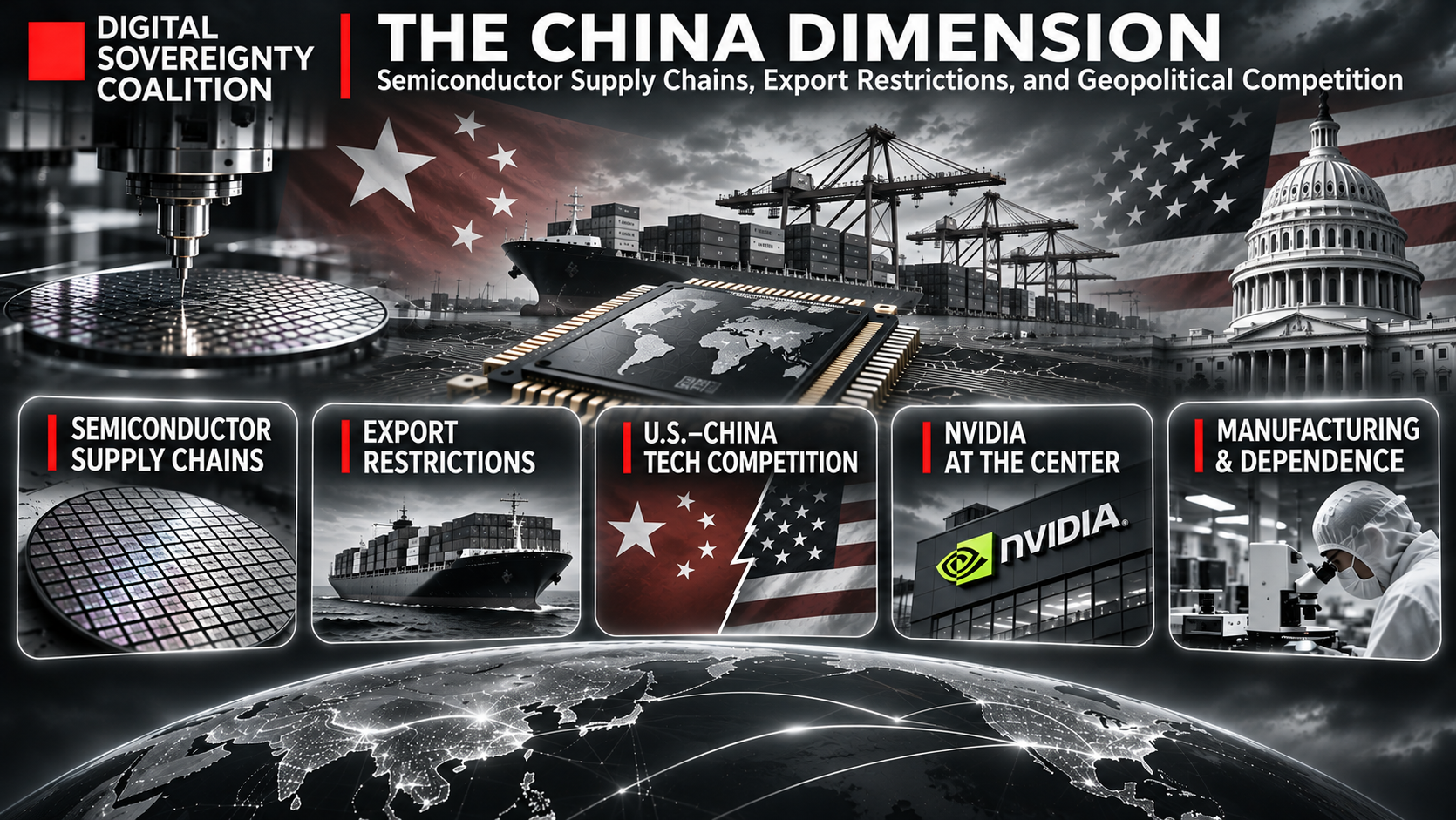
No commercial relationship exposes the tension between Nvidia's growth and United States national-security policy more directly than China.
Chinese demand for advanced AI computing is enormous; United States export controls exist to keep the most capable technology from strengthening the computing base of a strategic competitor; and Nvidia has advocated publicly against the restrictions that govern its own products.
All three facts can be true at once. This section examines their interaction.
- Nvidia's advocacy regarding AI chip exports: the company has publicly and repeatedly argued that broad restrictions harm American competitiveness while failing to achieve their security objectives — advocacy that is lawful, documented, and in tension with the regime it targets.
- Export-control classifications: successive BIS rules have restricted successive generations of Nvidia's accelerators, and product redesigns have been engineered to fall on particular sides of performance thresholds.
- Licensing and enforcement: license requirements, entity-list designations, and enforcement actions define what commerce is lawful — and enforcement of the boundary is itself contested terrain.
- Chinese demand: China represents a major historical market for Nvidia's data-center products, and lost access carries material revenue consequences the company discloses and discusses publicly.
- Domestic Chinese chip development: restriction creates incentive. Chinese firms are developing domestic accelerators with state support, and the long-run effect of export controls on that development is a genuinely open analytical question.
- Semiconductor supply-chain dependencies: the same controls that restrict sales rely on chokepoints — advanced lithography, advanced packaging, and Taiwan-centered fabrication — that the United States does not unilaterally command.
- Taiwan's strategic importance: the island produces the overwhelming majority of leading-edge logic, including the fabrication of Nvidia's own designs, making its security a direct variable in every calculation on this page.
- Third-country cloud computing: restricted chips can be reached from outside China through cloud services operated in permissive jurisdictions — a documented leakage concern in export-control policy debates.
- Potential diversion of restricted technology: diversion is a real enforcement problem with documented cases in adjacent regimes; its scale in the AI-accelerator context is contested and fact-dependent.
- International competition for sovereign AI infrastructure: states worldwide are purchasing sovereign AI capability, and United States export policy shapes whether they buy Nvidia systems, domestic alternatives, or Chinese ones.
The analytical questions this section holds open:
- Does restricting advanced chip exports materially protect national security?
- Could restrictions accelerate domestic semiconductor development in China — a strategic cost that outlasts any single product cycle?
- What risks arise from exporting chips, cloud services, or associated technical capabilities even under license?
- Which commercial incentives may diverge from national-security priorities, and how are those divergences governed?
- How should legitimate commerce be distinguished from unlawful diversion or espionage — in law, and in practice?
- Who evaluates and resolves disagreements between industry and government, and is that adjudication independent of both?
Competing export-control arguments are presented on their merits. Restrictionists argue that advanced compute is a strategic military asset and that the precautionary burden falls on commerce. Expansionists argue that global market dominance is itself a strategic asset, that blanket restrictions hand the market to competitors, and that enforcement should target diversion rather than commerce. Both positions deserve documented treatment — and both are arguments, not findings. This page records verified policy outcomes and documented public positions, and does not assume the private motives of any participant.
WHEN A CORPORATION'S LARGEST STRATEGIC MARKET AND ITS GOVERNMENT'S PRINCIPAL STRATEGIC RIVAL ARE THE SAME COUNTRY, WHOSE INTERESTS SET THE POLICY?
Advanced semiconductors are both commercial products and technologies with strategic significance. They support scientific computing, AI development, industrial automation, military research, and numerous civilian applications.
Their production depends upon international networks of research, manufacturing, equipment suppliers, materials, specialized labor, and logistical infrastructure. No single country controls every component of this global system.
Nvidia's role illustrates the complexity of these dependencies. The company's commercial interests intersect with American export policies, Chinese demand for computing technology, Taiwan's semiconductor manufacturing significance, and broader competition over technological capabilities.
Restrictions on advanced semiconductor exports are often intended to limit access to technologies considered strategically sensitive. Supporters argue that appropriate controls can protect national-security interests. Critics and industry representatives raise concerns about lost commercial opportunities, enforcement challenges, and incentives for competitors to develop alternative technologies. The resulting policy dilemma cannot be reduced to a simple choice between innovation and security.
THE EXPORT-CONTROL QUESTION
Documented Nvidia advocacy concerning AI chip exports to China is examined to establish:
WHEN COMMERCIAL INCENTIVES AND NATIONAL-SECURITY PRIORITIES DIVERGE, WHO HAS THE AUTHORITY TO DECIDE?
DOCUMENTED CASE STUDY — STATUS: UNVERIFIED — PENDING PRIMARY SOURCES
COMMERCE, MEGASPEED, AND EXPORT-CONTROL ENFORCEMENT
Reporting describes a Commerce Department investigation concerning Megaspeed and suspected diversion of restricted AI chips — including reported communications involving Nvidia's general counsel, the role of senior Commerce officials, reported changes in the investigation's handling, and a possible referral or transfer to the Justice Department.
DSC has not reviewed the underlying records. The structure below exists so the case study can be built exclusively from documented materials — dockets, agency records, congressional correspondence, and court filings — with every allegation attributed and every implicated organization's response included where available.
Investigative subjects, each awaiting documentation:
- The company's documented activities.
- The relevant export-control restrictions.
- The specific allegations concerning unauthorized transfers.
- The Commerce Department's investigative responsibilities.
- Reported communications involving Nvidia's general counsel.
- The role of senior Commerce officials.
- Reported changes in the investigation's handling.
- Any referral or transfer to the Justice Department.
- Congressional oversight of the matter.
- Publicly documented findings or charges, if any.
Allegations concerning the suspected foreign-intelligence connections of individuals are not presented as proven findings.
A transfer between agencies is not, by itself, evidence of improper interference; the question is whether evidence supports claims of unusual procedures, conflicts, or investigative obstruction.
The responses of implicated organizations and officials are included where available.
CAN EXPORT-CONTROL ENFORCEMENT REMAIN INDEPENDENT WHEN THE SUBJECT MATTER INVOLVES CORPORATIONS OF EXCEPTIONAL ECONOMIC AND STRATEGIC SIGNIFICANCE?
NOVEMBER 13 EXPANSION — THE COMMERCE DEPARTMENT — STATUS: REPORTED, PENDING EDITORIAL VERIFICATION
HOWARD LUTNICK, THE COMMERCE DEPARTMENT, AND THE MEGASPEED DECISIONS
The Commerce Department holds responsibility for advanced semiconductor export controls, including the regulatory decisions connected to Megaspeed. This case study examines how that responsibility was exercised.
The examination covers Secretary Howard Lutnick's authority; Jeffrey Kessler's responsibilities; Bureau of Industry and Security investigations; reported communications by Nvidia general counsel Tim Teter; the handling of Megaspeed-related inquiries; proposed restrictions; export licensing; alleged procedural delays; subsequent enforcement action; and agency responses and denials.
This examination does not imply that Secretary Lutnick directed every action undertaken by the Commerce Department. Departmental decisions involve many officials and standing procedures; attributing a decision to a principal requires evidence of that principal's involvement.
WHEN AGENCIES DISAGREED
Wall Street Journal reporting of November 13, 2026 describes Treasury Secretary Scott Bessent publicly stating that Treasury, State, Defense, and the Office of the United States Trade Representative supported restricting Megaspeed, while the Commerce Department did not implement the relevant restrictions.
The statement is recorded here as an attributed public statement by a cabinet official describing interagency disagreement. It is evidence of what a senior official has said. It is not itself a finding about what occurred inside the agencies.
REPORTED — ATTRIBUTED STATEMENT BY A CABINET OFFICIAL; THE UNDERLYING REPORTING HAS NOT YET BEEN REVIEWED BY DSC
What the record must determine from primary documentation:
WHEN NATIONAL-SECURITY AGENCIES RECOMMEND ACTION, WHO IS ACCOUNTABLE FOR A REGULATOR'S DECISION NOT TO IMPLEMENT IT?
NOVEMBER 13 EXPANSION — FINANCIAL INTERESTS — STATUS: REPORTED, PENDING EDITORIAL VERIFICATION
CANTOR FITZGERALD, HOWARD LUTNICK, AND THE QUESTION OF FINANCIAL INTERESTS
This examination covers reported Cantor Fitzgerald holdings in Nvidia and Howard Lutnick's historical role in the financial institution he led for decades.
The record distinguishes institutional portfolio positions, client holdings, proprietary investments, personal beneficial ownership, and family-controlled interests. These are different categories with different ethical and legal significance, and collapsing them produces false conclusions in both directions.
The examination assembles: the relevant Cantor financial interests; Lutnick's divestiture arrangements; the October 2025 reported transfer of interests; the roles of his sons and the relevant family-controlled entities; applicable financial disclosures; ethics agreements; recusal obligations and exemptions; and any demonstrable intersection between financial interests and regulatory decisions.
A financial holding may not be attributed to an individual simply because an institution with which he was associated held it. Ownership, control, and benefit are established separately, from documentation.
Categories the record maintains separately:
INSTITUTIONAL PORTFOLIO POSITIONS
Positions held by the firm as an institution.
CLIENT HOLDINGS
Positions held for clients; the firm facilitates, but does not own, the exposure.
PROPRIETARY INVESTMENTS
Positions held with the firm's own capital.
PERSONAL BENEFICIAL OWNERSHIP
Direct beneficial ownership by the individual.
FAMILY-CONTROLLED INTERESTS
Interests held through family members or family-controlled entities, examined for their actual control and benefit.
THE EXISTENCE OF A FINANCIAL RELATIONSHIP IDENTIFIES A QUESTION FOR ETHICS REVIEW; IT DOES NOT ITSELF ESTABLISH CORRUPTION.
SECTION 06
DOCUMENTED CASE STUDY
JENSEN HUANG: PERSONAL VULNERABILITY, CORPORATE POWER, AND NATIONAL SECURITY
When leadership and national infrastructure become closely intertwined, how are potential counterintelligence vulnerabilities independently assessed?
This case study is presented because the questions it raises are institutional, not personal. It is structured as four analytical tracks, each with its own evidentiary standard. The page investigates systems of power; the case study investigates what one system did — and did not yet establish — about a single individual.
Personal vulnerability, corporate leadership, and the security of strategically important infrastructure.
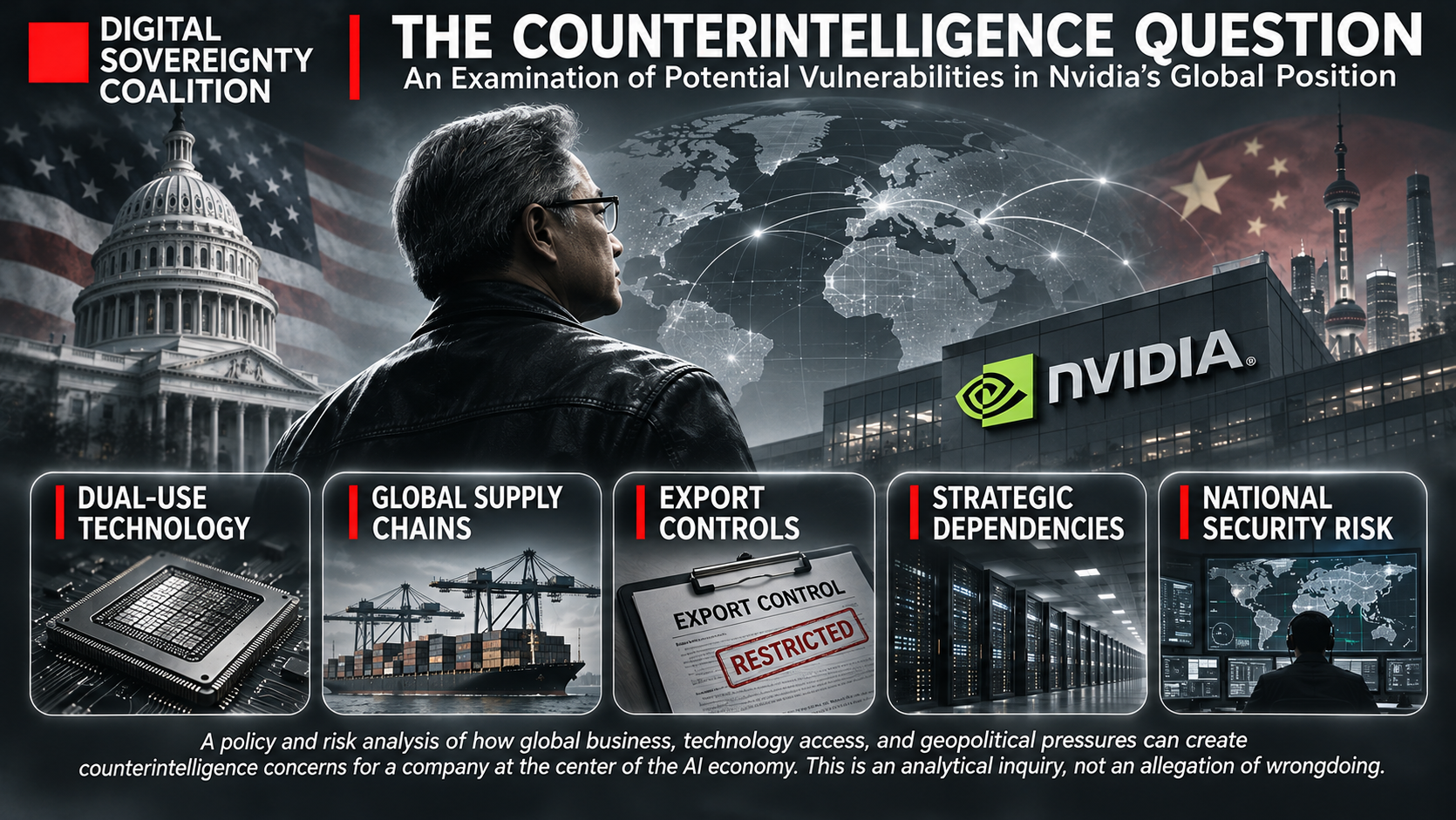
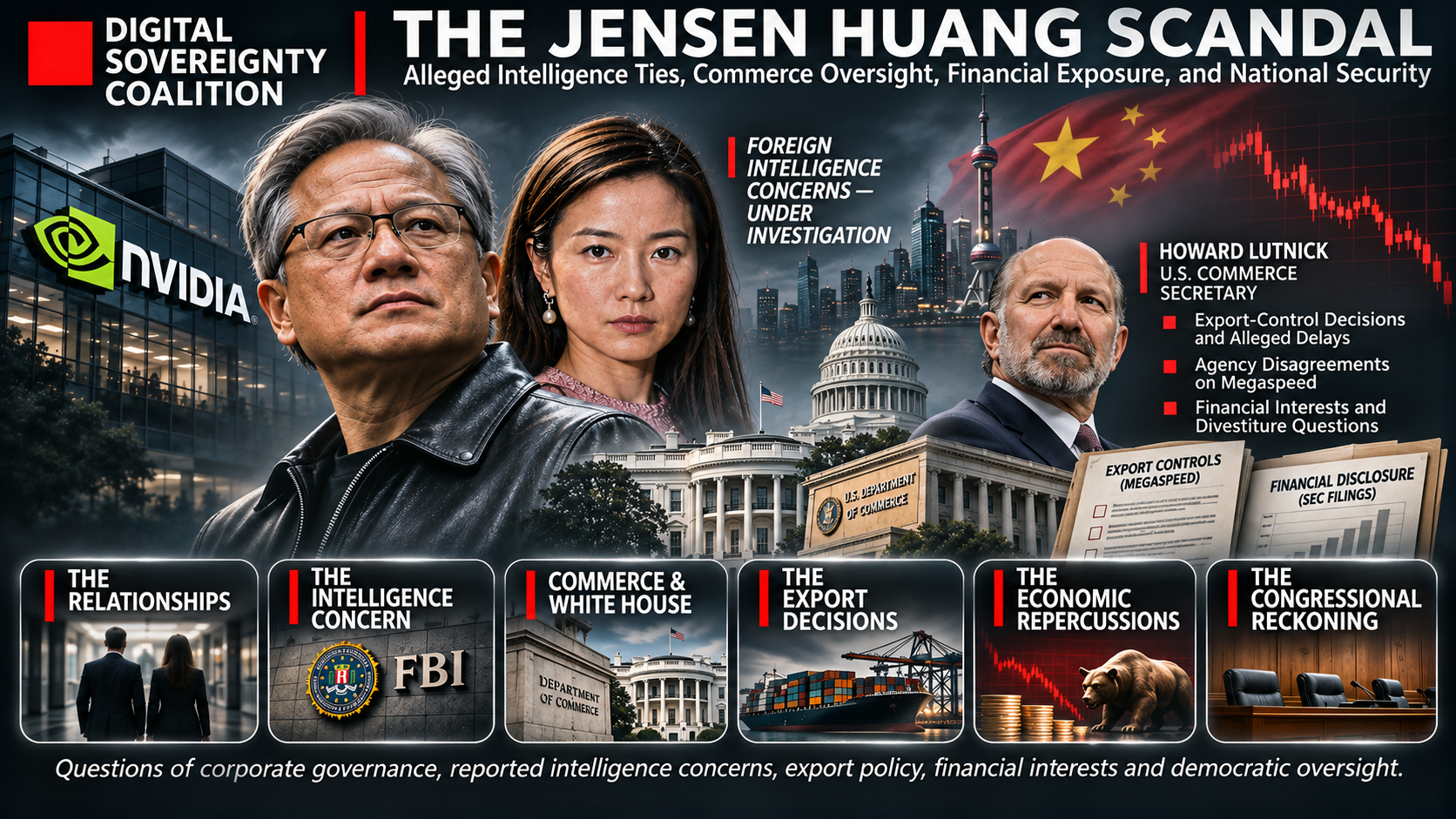
Synthetic document imagery within the illustration is illustrative. It is not treated as an authentic investigative record.
In November 2026, Nvidia's own Board of Directors confirmed the existence of serious reporting: recent reporting, as the Board put it, that founder and chief executive Jensen Huang had been the target of a foreign intelligence effort. The Board initiated an independent investigation. What is documented below comes from Nvidia's primary statements — reviewed and quoted verbatim.
What the underlying press reports allege, in detail, is a separate evidentiary layer. DSC has not yet reviewed the original reporting; specific allegations, the identity of any reported third party, and any alleged intelligence-service connection are therefore labeled unverified and await founder-supplied sources in the editorial verification pass.
Reporting that Jensen Huang has been the target of a foreign intelligence effort.
DOCUMENTED AS REPORTING
Acknowledged in the Statement From NVIDIA Board of Directors, November 8, 2026. The Board's acknowledgment documents that the reporting exists and was serious enough to act on; it does not verify the accuracy of any specific underlying allegation.
An independent Board investigation with outside counsel.
DOCUMENTED
The Board statement announces a committee of independent directors assisted by outside independent counsel; the November 10 statement identifies the retained counsel.
The Board's position that no compromise is known.
DOCUMENTED
The Board stated it has no reason to believe that either national security or NVIDIA secrets were compromised, and that its inquiry will examine all available information. Statement From NVIDIA Board of Directors, November 8, 2026.
Huang's acknowledgment of personal misconduct.
PARTY ACKNOWLEDGMENT
In a company-wide message dated November 8, 2026, Huang acknowledged infidelity to his wife and accepted responsibility, while addressing the national-security reporting separately.
Huang's cooperation with the investigation.
PARTY ACKNOWLEDGMENT
The Board statement records that Huang fully supports the review and has committed to cooperating with it; Huang's own message states that he supports the investigation and will cooperate fully.
Any specific alleged connection between the reported personal relationship and a foreign intelligence service.
UNVERIFIED — PENDING
DSC has not reviewed the underlying reporting. No specific allegation is asserted, attributed, or characterized on this page.
Any government counterintelligence assessment, notification, or investigation.
UNVERIFIED — PENDING
No primary documentation reviewed. If such records exist, they are classified or law-enforcement sensitive; DSC will not manufacture findings.
Any denial or dispute of specific allegations beyond the statements recorded here.
UNVERIFIED — PENDING
The statements above are the totality of what DSC has reviewed; later findings, denials, corrections, or exonerating information will be added prominently as they are verified.
THE DISTINCTION THAT GOVERNS THIS PAGE: A PERSONAL RELATIONSHIP DOES NOT ESTABLISH ESPIONAGE. ADVOCACY FOR EXPORTS DOES NOT ESTABLISH FOREIGN INFLUENCE. A FINANCIAL INTEREST DOES NOT, BY ITSELF, ESTABLISH A CORRUPT DECISION.
Whether intelligence concerning a chief executive reaches the President — and when — is a question with a documented answer or none. The distinction between intelligence being available to an agency and actually reaching a named decision-maker is the difference between a fact and a rumor with a security clearance.
This track constructs its chronology in Section 07's timeline structure. As of the review date, DSC has verified no entry in the intelligence-and-warnings or government-decisions categories, and asserts none. Claims that a President knew of the matter at any particular time are not treated as established facts — they are treated as claims to be investigated explicitly.
When intelligence community awareness of the reported matter began.
UNVERIFIED — PENDING
Requires primary documentation or attributions from identified officials; none reviewed.
Whether security assessments were conducted and by whom.
UNVERIFIED — PENDING
None reviewed.
Whether and when notifications reached executive officials, including the President.
UNVERIFIED — PENDING
None reviewed. Any claim that the President was informed at any time is treated as a reported claim, not a fact, until documentation exists.
Whether export-control decisions before and after any relevant briefing changed in response to it.
UNVERIFIED — PENDING
Causal analysis requires the chronology to exist first; temporal proximity alone proves nothing.
Whether subsequent congressional inquiries have been opened.
UNVERIFIED — PENDING
None reviewed as of the review date.
WHERE COMPETING NEWS ACCOUNTS DISAGREE, THIS PAGE WILL SHOW THE DISAGREEMENT RATHER THAN RESOLVE IT BY ASSERTION.
This is an unresolved counterintelligence question, and this page declines to answer it. What can be examined are the structural questions that any such case must answer: whether there is public evidence of attempted coercion; whether unauthorized information access has been established; whether actual policy or commercial decisions were influenced; whether safeguards were activated; whether corporate security processes were adequate; whether government reviews were independent; and what evidence could distinguish suspicion from demonstrated compromise.
Infidelity is not espionage. Embarrassment is not treason. Personal vulnerability is a risk factor, and routine advocacy is a lawful activity. None of them is proof of anything — and a page that treated any of them as proof would be doing exactly what it criticizes.
Public evidence of attempted coercion.
UNRESOLVED
No public evidence reviewed by DSC as of the review date.
Unauthorized information access.
UNRESOLVED
The Board states it has no reason to believe secrets were compromised; the independent inquiry will examine all available information.
Influence on policy or commercial decisions.
UNRESOLVED
No demonstrated influence; none asserted.
Whether corporate and governmental safeguards were activated and whether the reviews are independent.
PARTIALLY DOCUMENTED
The Board's independent investigation with outside counsel is documented; the independence and scope of any governmental review is not.
POTENTIAL EXPOSURE IS NOT PROVEN COMPROMISE.
The case's significance does not depend on its outcome. If a founder-CEO becomes the subject of serious counterintelligence questions, the institutional consequences propagate regardless of whether the underlying concern is substantiated: corporate governance faces a leadership-continuity question; public markets re-price concentration risk; strategic investments and national-security contracts face review; export licensing acquires a personal dimension; critical infrastructure exposes its dependency on one decision-maker; and allied governments that built sovereign AI programs on one company's platform discover what sovereign meant.
This page examines institutional resilience without assuming that any particular alleged intelligence threat succeeded. The point is not that the system failed. The point is that the system's strength was never tested before now — and that its design deserves scrutiny independent of this case's resolution.
WHETHER THE ALLEGATIONS PROVE TRUE, PROVE FALSE, OR REMAIN UNRESOLVED, THE STRUCTURAL QUESTIONS OF THIS PAGE SURVIVE THE VERDICT.
POTENTIAL EXPOSURE IS NOT PROVEN COMPROMISE.
NVIDIA'S AND HUANG'S STATEMENTS — PRIMARY DOCUMENTS, REVIEWED AND QUOTED VERBATIM:
The NVIDIA Board is initiating an independent investigation in light of recent reporting that founder and CEO Jensen Huang has been the target of a foreign intelligence effort. A committee of independent directors, assisted by outside independent counsel, will oversee the investigation. The Board prioritizes U.S. national and economic security, which is paramount to the interests of NVIDIA and its shareholders.
— NVIDIA Board of Directors, November 8, 2026
While the Board has no reason to believe that either national security or NVIDIA secrets were compromised, the Board's inquiry will examine all available information. Jensen fully supports the review and has committed to cooperating with it. The Board has confidence in Jensen and his leadership team and will provide further updates as appropriate.
— NVIDIA Board of Directors, November 8, 2026
I owe my family and all of you an apology. I was unfaithful to my wife. My actions hurt her and our children. There is no excuse for what I did. I am deeply sorry. I take full responsibility for what I did and the hurt I caused, and I accept the criticism that comes with it.
— Jensen Huang, message to NVIDIA employees, November 8, 2026
Regarding the national security concerns raised in news reports, NVIDIA's Board of Directors has initiated an independent investigation. I support the investigation and will cooperate fully. I love our country and our company. I am committed to protecting NVIDIA and supporting America's national security. I am proud and grateful to be an American. My family bears no responsibility for my choices. I do.
— Jensen Huang, message to NVIDIA employees, November 8, 2026
The independent members of the NVIDIA Board have retained former acting U.S. Attorney of the Southern District of New York Joon H. Kim and his firm Wachtell, Lipton, Rosen & Katz to conduct a thorough and independent investigation as was announced on Sunday.
— Independent members of the NVIDIA Board, November 10, 2026
The underlying press reporting, any governmental records, and any subsequent developments are pending editorial verification with founder-supplied sources. Until then, this page asserts only what the primary documents above establish — and labels everything else as unresolved.
NOVEMBER 13 EXPANSION — EVIDENTIARY DISCIPLINE IN THE CASE STUDY
The reported relationships involving Nvidia's former chief executive have raised questions about the security arrangements surrounding strategically important corporate leadership.
This investigation distinguishes a personal relationship, a suspected intelligence approach, attempted exploitation, actual compromise, and corporate or governmental responsibility. These are different evidentiary categories, and each requires its own standard of proof.
The examination covers what credible reporting establishes about Alice Huang, Megaspeed, Nvidia's internal reviews, reported additional relationships, and the board's handling of potential conflicts — together with statements and denials by the individuals and organizations involved.
A suspected intelligence relationship is not described as proven espionage anywhere in this record. Where verification is incomplete, the relevant item is marked as requiring editorial review rather than presented as established.
The five evidentiary categories this case study maintains:
A PERSONAL RELATIONSHIP
A verified private association between individuals. Establishing it requires reliable documentation of the relationship itself.
A SUSPECTED INTELLIGENCE APPROACH
Reporting that an intelligence service may have sought access through a personal association. A suspicion is not an operation, and an operation is not a conclusion.
ATTEMPTED EXPLOITATION
Evidence that an approach was made with the purpose of extracting influence or information. Intent must be shown, not assumed.
ACTUAL COMPROMISE
Evidence that information or influence was actually obtained. This is the highest evidentiary bar in the case study, and nothing in the record asserts it.
CORPORATE OR GOVERNMENTAL RESPONSIBILITY
What the board, corporate security, or government agencies knew, when, and what they did — a separate question from any individual's conduct.
POTENTIAL VULNERABILITY IS NOT PROVEN COMPROMISE.
The security of a corporation depends on more than the protection of its computer systems. Executive access, confidential information, international business relationships, corporate decision-making, and institutional governance can create additional forms of exposure.
Counterintelligence authorities distinguish potential vulnerabilities from demonstrated compromise. A person may be targeted without knowingly cooperating. A personal relationship may create a theoretical vulnerability without resulting in coercion. A security investigation may identify concerns without establishing misconduct.
These distinctions are particularly important when allegations involve executives responsible for strategically significant technology.
FOUR SEPARATE EVIDENTIARY CATEGORIES
These are separate evidentiary categories, not a presumed sequence of events. The case files in this section already apply these standards — each item is classified by what the record actually establishes, not by what reporting alleges.
THE ABSENCE OF PROVEN COMPROMISE DOES NOT ELIMINATE THE NEED FOR INSTITUTIONAL SAFEGUARDS.
THE INTELLIGENCE GAP: WHO MUST BE WARNED?
A dedicated institutional question is now examined within the counterintelligence analysis: when the government identifies a potential threat to strategically important private infrastructure, what happens next — and who is responsible for protective action?
The examination covers government knowledge of the reported intelligence concerns, the timing of relevant intelligence warnings, whether a defensive briefing to Jensen Huang or Nvidia was considered, and whether notification was offered, delivered, deferred, or withheld.
It also covers the surrounding legal and institutional architecture: FBI counterintelligence responsibilities, Justice Department oversight, intelligence-community dissemination procedures, the protection of ongoing investigations, corporate-security responsibilities, and the legal constraints that shape what any institution may share, with whom, and when.
This investigation does not conclude that a required briefing was improperly withheld. That conclusion would require evidence of both the applicable duty and the relevant facts. Neither has been verified by DSC as of the review date.
Subjects under examination:
- Government knowledge of the reported intelligence concerns, and when it developed.
- The timing of relevant intelligence warnings within the government.
- Whether a defensive briefing to Huang or Nvidia was ever considered.
- Whether notification was offered, delivered, deferred, or withheld — and by whom.
- FBI counterintelligence responsibilities in cases involving strategically important corporate leadership.
- Justice Department oversight of counterintelligence matters.
- Intelligence-community dissemination procedures, including need-to-know restrictions.
- The protection of ongoing investigations as a constraint on notification.
- Corporate-security responsibilities for executive protection and threat response.
- The legal constraints governing what agencies may disclose to private parties.
Institutional responsibility matrix — responsibilities as generally established in law and practice; no finding is made about how they were applied in this case:
FBI · RESPONSIBILITY UNDER EXAMINATION
Counterintelligence investigation and defensive briefings to targets of suspected intelligence activity, where investigation rules permit.
INTELLIGENCE COMMUNITY · RESPONSIBILITY UNDER EXAMINATION
Collection, analysis, and controlled dissemination of intelligence concerning foreign-intelligence activity.
DEPARTMENT OF JUSTICE · RESPONSIBILITY UNDER EXAMINATION
Legal oversight of counterintelligence and criminal investigations, including prosecution decisions.
COMMERCE / BIS · RESPONSIBILITY UNDER EXAMINATION
Export-control administration for advanced semiconductors and enforcement of licensing decisions.
CORPORATE SECURITY · RESPONSIBILITY UNDER EXAMINATION
Executive protection, threat assessment, and coordination with government agencies where lawfully permitted.
NVIDIA BOARD · RESPONSIBILITY UNDER EXAMINATION
Oversight of executive security arrangements, conflicts of interest, and corporate governance.
CONGRESSIONAL OVERSIGHT · RESPONSIBILITY UNDER EXAMINATION
Legislative oversight of counterintelligence practice, notification procedures, and export-control administration.
WHEN GOVERNMENT IDENTIFIES A POTENTIAL THREAT TO STRATEGICALLY IMPORTANT PRIVATE INFRASTRUCTURE, WHO IS RESPONSIBLE FOR PROTECTIVE ACTION?
SECTION 07
THE PRESIDENTIAL KNOWLEDGE TIMELINE
A standing chronology built to be updated without restructuring the page. Three event categories share one timeline: intelligence and warnings, government decisions, and corporate and commercial actions. Related events sit on the same chronology precisely so that overlap can be examined — and so that it can be seen that temporal proximity proves nothing by itself.
INTELLIGENCE AND WARNINGS
Reports, assessments, and notifications within the intelligence community and to officials.
GOVERNMENT DECISIONS
Export-control, licensing, procurement, and enforcement actions by government bodies.
CORPORATE AND COMMERCIAL ACTIONS
Statements, investigations, filings, and transactions by Nvidia and ecosystem participants.
ENTRY REQUIREMENTS
- Event date, and the date the information became public.
- Named source for every entry.
- Evidence classification: DOCUMENTED, REPORTED, DISPUTED, UNDER INVESTIGATION, ANALYTICAL ASSESSMENT, or UNRESOLVED.
- Relevant government or corporate actor.
- Official response, where available.
- Link to primary documentation or reliable reporting.
- Update history preserving earlier reporting and later corrections.
The purpose of this timeline is to make it possible to investigate whether warnings, financial interests, lobbying, and export decisions overlapped — not to imply that their temporal proximity proves wrongdoing.
NVIDIA Board of Directors: Board announces independent investigation into reporting that Huang was the target of a foreign intelligence effort; states it has no reason to believe national security or NVIDIA secrets were compromised.
Response: Jensen Huang, same day: support for the investigation and full cooperation.
Source: Statement From NVIDIA Board of Directors — nvidianews.nvidia.com · Information public: November 8, 2026
primary documentation ↗Jensen Huang, founder and CEO: Huang acknowledges personal misconduct, accepts responsibility, and addresses the national-security reporting: support for the independent investigation and full cooperation.
Response: This message is the response.
Source: A Message to Our Company — nvidianews.nvidia.com · Information public: November 8, 2026
primary documentation ↗Independent members of the NVIDIA Board: Independent directors retain Joon H. Kim, former acting U.S. Attorney for the Southern District of New York, and Wachtell, Lipton, Rosen & Katz to conduct the investigation.
Response: None required.
Source: Statement From the Independent Members of the NVIDIA Board — nvidianews.nvidia.com · Information public: November 10, 2026
primary documentation ↗No verified entries exist yet in the INTELLIGENCE AND WARNINGS or GOVERNMENT DECISIONS categories. Entries are added only with a date, a named source, and an evidence classification — this page does not generate unsupported chronology.
Update history: timeline created November 12, 2026 with the three corporate entries above. Earlier reporting and later corrections will be preserved here as they are verified.
NOVEMBER 12, 2026 ADDITION
NVIDIA Board of Directors: Jensen Huang resigns as President, Chief Executive Officer, and board member, effective immediately; Colette Kress appointed Interim CEO while retaining CFO responsibilities; Harvey C. Jones appointed first-ever Chair of the Board; the Board initiates a search for a permanent CEO. The announcement does not state a reason for the resignation.
Response: Statements by Harvey C. Jones (Chair) and Colette Kress (Interim CEO) in the same announcement.
Source: NVIDIA Announces CEO Transition — investor.nvidia.com · Information public: November 12, 2026
primary documentation ↗The INTELLIGENCE AND WARNINGS and GOVERNMENT DECISIONS categories remain without verified entries as of this update. CHRONOLOGICAL PROXIMITY IS NOT PROOF OF CAUSATION — the chronology exists so that overlap can be examined, not presumed.
NOVEMBER 13 EXPANSION — THE PRESIDENTIAL KNOWLEDGE TIMELINE
The evidence-linked chronology expands to examine the full sequence of the reported controversy: the earliest reported intelligence concerns; the dates on which agencies reportedly received relevant information; when President Trump was reportedly briefed; the reported briefing of Secretary of State Marco Rubio; Howard Lutnick's reported knowledge; corporate meetings and governmental decisions; export-control approvals and restrictions; and the subsequent congressional scrutiny.
Every entry continues to record its occurrence date, first-publication date, source, responsible institution, and verified outcome. Where reports conflict, the disagreement is presented rather than resolved by selection.
One distinction governs the entire chronology: agency possession of intelligence is not the same event as a specific official's confirmed receipt of it. An agency's possession of information does not establish that any named official received it, was briefed on it, or acted upon it.
Events the expanded timeline will document as sources are verified:
- The earliest reported intelligence concerns.
- Dates on which agencies reportedly received relevant information.
- When President Trump was reportedly briefed.
- The reported briefing of Secretary of State Marco Rubio.
- Howard Lutnick's reported knowledge.
- Corporate meetings and governmental decisions in sequence.
- Export-control approvals and restrictions, with dates.
- Subsequent congressional scrutiny, with dates.
Distinctions the timeline maintains:
AGENCY POSSESSION
An agency holds relevant information. This fact alone attributes knowledge to no official.
CONFIRMED RECEIPT
A named official verifiably received specific information, on a documented date, through a documented channel.
SEQUENCE
Sequence is evidence of timing, not automatic proof of causation.
NO INTELLIGENCE OR GOVERNMENT TIMELINE ENTRIES HAVE BEEN VERIFIED BY DSC. THIS EXPANSION DEFINES WHAT EACH FUTURE ENTRY MUST ESTABLISH BEFORE IT IS RECORDED — REVIEW REQUIRED, EDITORIAL VERIFICATION PENDING.
SECTION 08
JENSEN HUANG'S REACH ACROSS THE AI ECOSYSTEM
Jensen Huang is not every decision Nvidia makes. Confusing a chief executive's personal authority with every independent act of a corporation this size produces bad analysis in both directions — overcrediting the individual and undercrediting the institution.
What can be examined is where his personal involvement is verified, and what authority structures surround it.
- Strategic investments: Nvidia's venture and strategic investment activity, including through its NVentures arm, shapes the ecosystem's cap table.
- Partnerships with AI laboratories: headline partnerships with frontier developers are negotiated at the top of the company.
- Major computing infrastructure agreements: multi-gigawatt system agreements with cloud providers are company-defining commitments.
- Government engagement: engagement with United States and foreign governments on export policy and sovereign AI.
- International export negotiations: the intersection of commerce and export control reaches the chief executive's desk.
- Sovereign AI initiatives: national AI programs marketed and negotiated at the head-of-state level.
- Public investment announcements: the company's most consequential capital commitments are announced under his name.
- Hardware roadmap decisions: annual architecture cadence is a leadership-shaped commitment to customers.
- Robotics and autonomous systems: the physical-AI platform strategy is an executive narrative as much as a product line.
- Corporate leadership and succession: the structure examined in Section 09.
Five distinct authorities are routinely conflated in coverage of this case:
PERSONAL AUTHORITY
What the founder-CEO decides by virtue of his personal position, credibility, and control of the agenda.
BOARD AUTHORITY
What the board directs, oversees, and can independently investigate — as it is doing now.
CORPORATE DECISIONS
What the institution decides through management structures, committees, and processes.
MARKET DEPENDENCIES
What customers, industries, and governments do because their own infrastructure depends on the company — regardless of any corporate decision.
GOVERNMENTAL AUTHORITY
What only the state can do: license, restrict, investigate, prosecute. No corporate officer holds it, and no market position substitutes for it.
THE OPEN QUESTION IS PROPORTIONALITY: ARE OVERSIGHT ARRANGEMENTS PROPORTIONATE TO THE POTENTIAL CONSEQUENCES OF A HIGHLY CENTRALIZED CORPORATE LEADERSHIP STRUCTURE AT THE CENTER OF NATIONAL INFRASTRUCTURE?
NOVEMBER 13 EXPANSION — OVERSIGHT STATUS DISCIPLINE
The November 11 Warren–Coons records-preservation entry is preserved exactly as recorded, and subsequent House and Senate inquiries are incorporated beneath the same discipline as they develop.
The examination covers requests involving Jensen Huang, Howard Lutnick, Jeffrey Kessler, Nvidia general counsel Tim Teter, the officials responsible for export controls, and the officials responsible for intelligence dissemination.
Each proceeding is recorded at its actual status — the categories are not interchangeable:
PROPOSED HEARINGS
A request or announcement that a hearing occur. Nothing has convened.
SCHEDULED APPEARANCES
A hearing or appearance with a set date. Testimony has not been given.
COMPLETED TESTIMONY
A witness has appeared and spoken. Statements are not findings.
SWORN EVIDENCE
Testimony given under oath, with the legal consequences that follow.
CONGRESSIONAL FINDINGS
Findings formally adopted by a committee or the chamber.
A request for testimony is not a finding of wrongdoing. The actual status and date of each proceeding are maintained as they develop.
SECTION 09
SUCCESSION, GOVERNANCE, AND SYSTEMIC RISK
Nvidia's significance to the AI economy raises a governance question that ordinary corporate-governance checklists were never designed for: does the company possess institutional protections adequate to what its disruption would mean?
The relevant inquiry spans:
DATED CASE UPDATE — NOVEMBER 12, 2026 — VERIFIED AGAINST PRIMARY SOURCE
THE FOUNDER DEPARTS. THE DEPENDENCIES REMAIN.
Verified November 12, 2026 against NVIDIA Investor Relations, "NVIDIA Announces CEO Transition" (November 12, 2026), reviewed and quoted verbatim.
What the primary announcement establishes:
- Jensen Huang has resigned as President, Chief Executive Officer, and a member of the Board of Directors, effective immediately.
- Colette Kress, Executive Vice President and Chief Financial Officer, has been appointed Interim Chief Executive Officer and will continue to serve as CFO until a permanent successor has been named.
- Harvey C. Jones has been appointed the company's first-ever Chair of the Board.
- The Board is initiating a search for a permanent Chief Executive Officer and will consider internal and external candidates.
- Kress has served as EVP and CFO since joining the company in September 2013, after nearly 25 years in finance roles at technology companies including Cisco and Microsoft; Jones is described as an entrepreneur, technology executive, and venture investor, formerly CEO and Executive Chairman of Synopsys.
- The Chair's statement records the Board's expectation that operations, customer commitments, and the product roadmap will continue without interruption.
- The announcement does not state a reason for the resignation, and no causal connection to any investigation or to any specific event is asserted in it.
- Third-quarter fiscal 2027 financial results remain scheduled for November 17, 2026, as previously announced.
The departure of Nvidia's longtime founder-CEO marks an important test of institutional resilience in the artificial intelligence economy.
Nvidia's technologies, commercial partnerships, investment relationships, and infrastructure dependencies extend across some of the most consequential areas of modern computing. Its leadership transition therefore raises questions beyond corporate succession.
How much of Nvidia's strategic direction depended upon the personal authority, relationships, and judgment of its founder? Which responsibilities are institutionalized within the company's board, executive leadership, security functions, and operational structure? And what happens when a corporation central to advanced AI development must demonstrate that its operations can continue independently of the individual most closely associated with its rise?
The issue is not whether leadership changes inevitably cause technological disruption. It is whether governance and continuity arrangements are proportionate to the company's significance within a much larger ecosystem.
THE FOUNDER MAY DEPART. THE COMPUTATIONAL DEPENDENCIES REMAIN.
- Board independence — and what independence means when the founder holds structural influence over director selection.
- Executive succession planning — whether a credible, tested succession exists for a leadership transition at the top.
- Risk committees — whether enterprise risk oversight reaches counterintelligence and concentration risk specifically.
- Counterintelligence protocols — corporate security processes for executive protection, information access, and insider risk.
- Disclosure obligations — what a public company must disclose about executive-level investigations, and when.
- National-security compliance — export-control, classified-work, and controlled-technology regimes inside the company.
- Enterprise continuity — operational resilience if leadership, supply, or regulatory conditions changed abruptly.
- Conflict-of-interest policies — how personal financial and personal-relationship interests are governed.
- Shareholder accountability — the rights of public shareholders to examine governance questions of this magnitude.
- Vendor and customer contingency planning — whether Nvidia's own customers have documented alternatives.
DISTINGUISH REGULATORY REQUIREMENTS FROM SUGGESTED BEST PRACTICES. SOME OF THE ITEMS ABOVE ARE LEGAL OBLIGATIONS; OTHERS ARE ASPIRATIONS THAT SOUND LIKE OBLIGATIONS. THE GAP BETWEEN THEM IS WHERE RISK LIVES.
A second structural question: do major cloud providers and AI laboratories hold meaningful alternatives if commercial, technological, or regulatory disruptions affect Nvidia? Merchant accelerators exist and are developing; custom silicon programs are underway at the largest customers; software lock-in remains the hardest layer to replace. The honest answer today is partial substitution, at higher cost, over years — not equivalence.
No hypothetical disruption scenario is presented on this page as an actual event. Contingency analysis describes capability, not prediction.
IF THE ANSWER TO A LEADERSHIP CONTINUITY QUESTION IS THAT THE INSTITUTION WOULD FIGURE IT OUT, IS THAT RESILIENCE — OR THE ABSENCE OF A PLAN?
A LIVE TEST OF INSTITUTIONAL DEPENDENCE
An unexpected leadership transition can reveal whether a company whose products are foundational to other organizations possesses continuity arrangements proportionate to its role. The examination is empirical: it compares what the company states about continuity with what can be independently observed.
Company statements concerning continuity are distinguished from independently observed outcomes. Nvidia is not assumed to have lacked a board or succession procedures merely because commentators have questioned its preparedness — the existence and operation of governance procedures is a factual question, examined on records.
Consequences are examined for the organizations whose operations rest on Nvidia's technologies — as potential exposure, not asserted disruption:
AI laboratories.
Cloud providers.
Institutional investors.
Semiconductor suppliers.
Government agencies.
Defense technology providers.
Startup ecosystems.
Scientific research institutions.
International customers.
DEMONSTRATED DISRUPTION REQUIRES OBSERVED EVIDENCE. HYPOTHETICAL EXPOSURE IS A STRUCTURAL QUESTION, NOT AN EVENT.
CAN A CORPORATION BECOME SO SYSTEMICALLY IMPORTANT THAT ITS INTERNAL GOVERNANCE BECOMES A MATTER OF BROADER PUBLIC CONCERN?
WHEN FOUNDERS BECOME INSTITUTIONS
COMMENTARY AND PUBLISHED ANALYSIS — NOT A LEGAL OR GOVERNMENTAL FINDING
Gary Sernovitz, Lives of the Tech Caesars, New York Magazine / Intelligencer, November 13, 2026.
source article ↗The analysis examines founder ownership, voting power, special share classes, board independence, succession arrangements, executive authority, shareholder rights, concentrated private influence, and the public's dependence on the underlying technologies.
This investigation compares verified governance structures across Nvidia and selected major technology firms, and distinguishes influence from legal control throughout. A founder's perceived indispensability is not the same fact as his formal authority, and neither substitutes for the other in analysis.
The source is recorded as commentary and published analysis. It informs the framework; it carries no evidentiary weight as to conduct.
Governance dimensions under examination:
- Founder ownership and voting power.
- Special share classes.
- Board independence.
- Succession arrangements.
- Executive authority.
- Shareholder rights.
- Concentrated private influence.
- The public's dependence on the underlying technologies.
INFLUENCE IS NOT LEGAL CONTROL.
The Techno-Welfare Royalty investigation examines the same founder-power question from the side of public capital and private fortune.
WHEN A TECHNOLOGY FOUNDER BECOMES SYSTEMICALLY IMPORTANT, CAN CORPORATE GOVERNANCE ALONE PROTECT THE PUBLIC INTEREST?
SECTION 10
WHO BENEFITS, WHO DEPENDS, WHO BEARS THE RISK?
Concentration's benefits and burdens do not fall on the same populations. Investors and executives capture the upside that markets price; the following constituencies absorb consequences that markets rarely price at all.
- Independent AI startups: access to advanced compute is gated by allocation, price, and the terms large buyers enjoy.
- Public universities: research computing competes with hyperscale demand for the same scarce systems.
- Researchers: individual scientists' ambition is bounded by the allocation they can obtain.
- Small businesses: AI adoption at the small-business layer means renting capability from the same concentrated stack.
- Nonprofit technology developers: public-interest builders compete for compute against entities with billions in committed capacity.
- Governments: national computing strategies are purchased from, or built around, a small set of suppliers.
- Workers: the labor-market effects of AI deployment arrive through infrastructure that workers neither chose nor govern.
- Consumers: the services, prices, and protections consumers experience are shaped upstream at the compute layer.
- Underfunded communities: communities with the least access to capital and computing have the least capacity to shape or contest the systems being built.
- Countries with limited computational infrastructure: sovereign AI in most of the world means dependence on a handful of foreign suppliers.
WHO HAS ACCESS TO COMPUTATIONAL POWER, AND WHO IS EXCLUDED FROM BUILDING THE FUTURE?
Documented disparities in access to financing and computing resources belong in this section with data. Generalized demographic claims without data are not made here — the exclusion question deserves better than assertion.
This analysis connects directly to DSC's SCARCITY REGIME TRIANGLE — the structural dependency of advanced computation on three constrained inputs:
ENERGY
Data centers are energy infrastructure. Who bears the cost, and who bears the externalities?
HARDWARE
Accelerators concentrate in one dominant supplier and a narrow fabrication base.
SOFTWARE
The software stack shapes which research is practical, and by whom.
Technological concentration is not merely a concern for governments, investors, and corporate executives. Its consequences may extend to research institutions, independent developers, public-interest organizations, workers, consumers, and communities with limited access to computing infrastructure.
A technology sector in which advanced computing is expensive, geographically concentrated, or dependent on a small number of providers may create significant barriers to participation. These barriers influence who can conduct research, develop new products, compete commercially, and shape the technological systems increasingly integrated into public life.
Digital Sovereignty Coalition maintains that meaningful technological progress requires more than the expansion of computational capability. It requires attention to who possesses that capability, under what conditions it is accessible, and who remains excluded.
THE FUTURE OF ARTIFICIAL INTELLIGENCE SHOULD NOT BE DETERMINED EXCLUSIVELY BY THOSE WHO CAN AFFORD TO BUILD IT.
SECTION 11
THE NATIONAL SECURITY–SHAREHOLDER CONFLICT
A company at the center of national infrastructure serves two principals whose interests usually align and sometimes do not: its shareholders, and the public whose security its technology affects.
- Shareholder value versus export restrictions that close strategic markets.
- Executive compensation structures that reward growth over geopolitical caution.
- Corporate growth imperatives versus the pacing of technology diffusion to competitors.
- International market access versus national-security control lists.
- Federal strategic priorities versus commercial product roadmaps.
- National security planning versus market-price discovery.
- Public accountability versus proprietary secrecy.
- Legal duties to shareholders versus duties officials owe to the public — held by different people, under different law.
The legal duties are distinct and must not be merged: corporate directors and officers owe fiduciary duties to the corporation and its shareholders under state corporate law; federal officials owe duties to the public under statute, regulation, and the Constitution. A corporate officer has no authority to sacrifice shareholders for national security, and an official has no authority to direct corporate strategy — each operates inside their own mandate, and the friction between the mandates is resolved by law and process, not by goodwill.
WHEN A CORPORATION'S COMMERCIAL INTERESTS DIVERGE FROM A GOVERNMENT'S NATIONAL-SECURITY ASSESSMENT, WHO HAS THE AUTHORITY TO DECIDE — AND WHO INDEPENDENTLY EVALUATES THE DECISION?
MARKET EXPOSURE AND THE LEADERSHIP TRANSITION
Nvidia is among the largest components of major American stock indices, and its securities are held directly and indirectly by retirement funds, institutional portfolios, and individual investors. A leadership transition at a company of this scale is therefore also a market event — and market reactions are themselves evidence that requires careful handling.
Verified market developments following the November 12 announcement will be recorded here with precise trading dates and primary market data. No figures appear yet: DSC has not verified trading-day data as of the review date.
Distinctions the record will maintain:
- Intraday price movements — distinct from closing price changes.
- Closing price changes — distinct from cumulative multi-day moves.
- Market-capitalization changes — computed, and distinguished from realized losses.
- Broader technology-sector movements — which may occur for reasons unrelated to Nvidia.
- Company-specific volatility — measured against sector and index baselines.
- Analyst interpretations — attributed commentary, not data.
TEMPORARY INTRADAY LOSSES ARE NOT PERMANENT REALIZED LOSSES. CLAIMS ABOUT TRILLION-DOLLAR VALUATION CHANGES IN COMMENTARY ARE VERIFIED AGAINST MARKET DATA BEFORE THEY APPEAR ON THIS PAGE — AND ARE OMITTED IF THEY CANNOT BE.
Channels of broader exposure under examination:
- Major stock indices with Nvidia as a principal component.
- Retirement funds and indexed portfolios.
- Institutional portfolios with concentrated technology exposure.
- AI infrastructure financing that presumes Nvidia supply.
- Semiconductor suppliers with Nvidia-dependent demand.
- Venture-backed companies building on Nvidia platforms.
- Cloud-service providers' equipment planning.
- Investor confidence in the AI financing cycle.
Market correlations are not demonstrated causal effects. The examination identifies exposure channels; establishing causation requires evidence, and none is asserted.
HOW MUCH OF THE MARKET'S STATED VALUE RESTS ON ONE COMPANY'S CONTINUITY?
SECTION 12
THE AI OUROBOROS CONNECTION
The reinforcing cycle of capital, computing, and artificial intelligence.
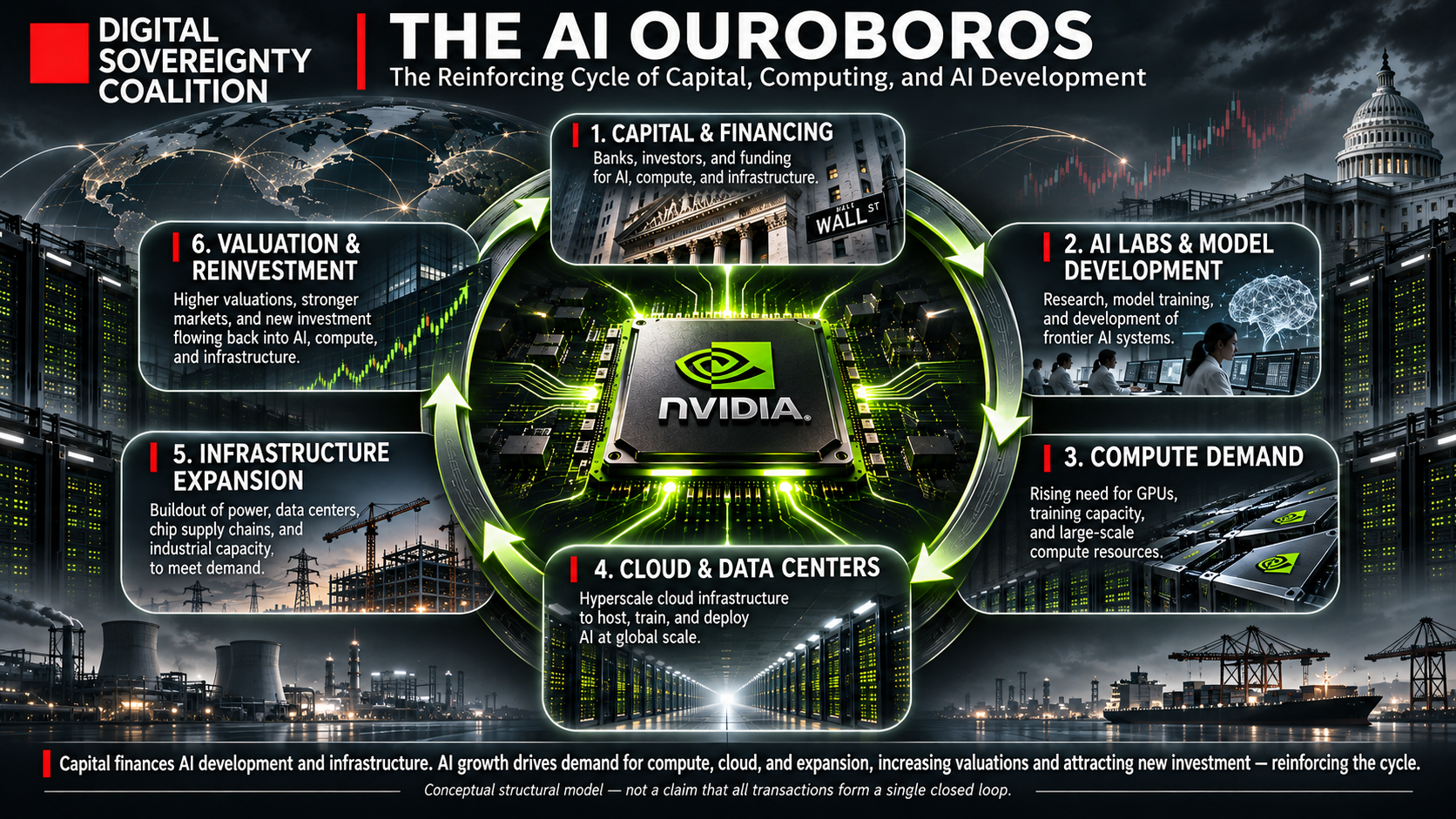
Digital Sovereignty Coalition's AI Ouroboros framework describes an economy in which dependency relationships reinforce one another: capital finances AI developers; AI developers purchase computing capacity; cloud providers expand data centers; data centers purchase accelerators; hardware suppliers reinvest in the ecosystem; and infrastructure demand attracts additional financing.
Nvidia sits at the center of that circuit — as supplier to nearly every node, and as an investor in several of them.
This is a structural analytical model, not a claim that every transaction belongs to a closed financial loop. Each arrangement must be examined on its own structure, as Section 02 requires.
Interconnected commitments may amplify risk — valuation interdependence, concentrated counterparty exposure, demand that partly finances itself — while simultaneously supporting legitimate innovation and infrastructure expansion at a pace markets could not otherwise organize. Both things are true, and honest analysis holds both.
The full framework, including the approved infographic, lives in THE FUTURE AT STAKE.
Read the framework in full:
THE AI OUROBOROSThe cycle can accelerate innovation. It can also create financial interdependencies and amplify the consequences of changes in market demand, supply constraints, financing conditions, or regulatory policy.
Nvidia occupies an important position within this system because its computing technologies support substantial portions of advanced AI development and deployment. But Nvidia is not the entire system. The surrounding institutions, investors, infrastructure operators, developers, and governments are essential to understanding how the cycle functions.
THE SIX STAGES
A reinforcing economic relationship is not necessarily a fraudulent, artificially manufactured, or unsustainable one. The framework describes structural incentives and potential dependencies. The empirical investigation must determine when specific financial relationships create genuine risks.
WHEN AN INDUSTRY'S GROWTH DEPENDS ON THE CONTINUOUS REINFORCEMENT OF CAPITAL, COMPUTE, AND INFRASTRUCTURE, WHAT HAPPENS WHEN ONE PART OF THE CYCLE WEAKENS?
COMPARATIVE SYSTEMIC DEPENDENCE
NVIDIA, SATELLITE INFRASTRUCTURE, CLOUD PROVIDERS, AND PRIVATE POWER
Nvidia is not the only private provider whose products have become difficult for public institutions to replace. A bounded comparison with other strategically important infrastructure providers identifies what is common — and what is not — about private technological power.
The comparison is deliberately careful: these companies do not have identical powers, legal status, or contractual responsibilities, and nothing here implies that they do.
Providers examined for comparison:
SPACEX AND STARLINK
Satellite internet infrastructure with significant government and consumer dependence, and a single-provider profile in several markets.
MAJOR CLOUD INFRASTRUCTURE PROVIDERS
A small number of firms operating much of the cloud capacity on which government, research, and commerce run.
DEFENSE TECHNOLOGY CONTRACTORS
Firms whose software and systems are embedded in national-security operations, including the companies examined in Techno-State Capture.
SEMICONDUCTOR EQUIPMENT SUPPLIERS
Extreme-ultraviolet lithography and related equipment concentrated in a single supplier — examined in ASML and Semiconductor Sovereignty.
CRITICAL TELECOMMUNICATIONS INFRASTRUCTURE PROVIDERS
The network operators and equipment vendors on which connectivity itself depends.
Dimensions on which each provider is compared:
Ownership structures.
Technology concentration.
Government contracts.
National-security dependencies.
Regulatory authority.
Corporate decision-making.
Continuity arrangements.
Availability of substitutes.
The comparison identifies structural similarities in concentration and dependence. It does not equate legal powers, market positions, or contractual obligations.
The conceptual connection: private technological power may become especially consequential when public institutions cannot easily replace or independently operate the systems upon which they depend.
Related DSC investigations:
ANALYTICAL FRAMEWORK
WHEN MARKET POWER BECOMES SYSTEMIC POWER
A corporation may become influential because its products are innovative, efficient, reliable, and widely adopted. Such influence does not automatically establish unlawful monopolization or improper conduct.
However, as a technology becomes essential to increasingly important activities, the consequences of disruptions, governance failures, or strategic decisions can extend beyond a company's immediate customers. At that point, the relevant question changes. It is no longer solely whether the corporation is commercially successful. It becomes whether the institutions depending upon its technology possess sufficient alternatives, safeguards, and independent oversight.
CONCENTRATED COMPUTING INFRASTRUCTURE CAN CREATE:
These risks vary by sector and require supporting evidence. This framework cross-references DSC's Convergence Threshold and Singularity of Control examinations — related analyses of technological convergence and control, analytically distinct from the concentration threshold examined here.
MARKET LEADERSHIP IS A COMMERCIAL CONDITION. SYSTEMIC DEPENDENCE IS A GOVERNANCE QUESTION.
SECTION 13
DEMOCRATIC SAFEGUARDS AND COMPUTATIONAL SOVEREIGNTY
The solutions. Digital Sovereignty Coalition examines the following safeguards — offered as a program for democratic oversight of concentrated computational power:
DIGITAL SOVEREIGNTY DOES NOT REQUIRE ABANDONING PRIVATE-SECTOR INNOVATION. THE GOAL IS TO REDUCE UNACCOUNTABLE DEPENDENCIES WHILE PROTECTING LAWFUL INNOVATION, CIVIL LIBERTIES, COMPETITION, AND SCIENTIFIC PROGRESS.
DSC's proposed Civic AI principles and Civic Machina architecture are conceptual responses to these questions — frameworks for accountable AI, not deployed or proven alternatives to Nvidia's technology. Nothing in this investigation should be read as claiming otherwise.
THE QUESTION IS NOT WHETHER ONE EXECUTIVE CAN BE TRUSTED INDEFINITELY.
THE QUESTION IS WHETHER THE INSTITUTIONS THAT DEPEND ON CONCENTRATED COMPUTATIONAL POWER POSSESS SAFEGUARDS STRONG ENOUGH THAT THEY DO NOT HAVE TO.
NOVEMBER 13 — THE STRENGTHENED SAFEGUARD AGENDA
The investigation's ten-point safeguard program is preserved in full. The November 13 review adds emphasis on the safeguards this update makes concrete.
Safeguards carrying new emphasis:
COUNTERINTELLIGENCE WARNING PROCEDURES
Effective, reviewable procedures for warning strategically important private infrastructure of suspected intelligence activity — including when a warning is considered, offered, delivered, deferred, or withheld.
GOVERNANCE AND SUCCESSION REQUIREMENTS
Corporate governance and succession requirements proportionate to a company's systemic role.
CONGRESSIONAL TRADING REFORM
Restrictions on congressional stock trading and disclosure reform adequate to spousal, dependent, and trust activity.
EXECUTIVE-BRANCH ETHICS RULES
Ethics rules governing executive-branch financial conflicts, including family-controlled interests and divestiture arrangements.
INDEPENDENT PROCUREMENT REVIEW
Independent review of government procurement involving strategically important suppliers.
CONTRIBUTION AND ACCESS TRANSPARENCY
Transparency around political contributions and access where strategic technology policy is at stake.
CIVIL LIBERTIES AND ACCOUNTABILITY
Civil-liberties protections and democratic accountability maintained throughout any strengthened enforcement.
NONE OF THESE SAFEGUARDS IS PRESENTED AS ENACTED. EACH IS PROPOSED; LEGISLATIVE AND PROCEDURAL STATUS IS VERIFIED BEFORE ANY IS RECORDED AS LAW.
THE PUBLIC-INTEREST RESPONSE
TOWARD A PLURALITY OF COMPUTATIONAL SOVEREIGNTY
A democratic response to computational concentration need not reject private innovation or impose centralized governmental control over all AI infrastructure. Instead, it can seek to establish meaningful alternatives, resilience, transparency, and enforceable accountability — the program of safeguards set out in the preceding section.
Innovation can create remarkable opportunities. But when technological capability becomes essential to society, the systems governing that capability become matters of democratic concern.
Computational sovereignty must therefore include the capacity to question, audit, diversify, and — where necessary — challenge concentrated power.
THE ENDURING CHALLENGE IS INSTITUTIONAL
The departure of a prominent founder may alter a company's leadership, but it does not automatically change the technological dependencies surrounding that company.
Nor does the resolution of an individual controversy eliminate the possibility of future conflicts involving other executives, corporations, or administrations.
The enduring challenge is institutional. Advanced computing infrastructure is increasingly consequential to the functioning of the economy, scientific research, national security, and public life.
The public therefore has a legitimate interest in whether the governance structures surrounding that infrastructure provide sufficient independence, transparency, resilience, and accountability.
SECTION 14
THE INSTITUTIONAL QUESTION
This investigation should never depend on proving the guilt or innocence of any individual. Its central concern is whether democratic institutions, markets, and the public have developed sufficient safeguards for an economy increasingly dependent on concentrated computational capabilities.
The controversy surrounding Jensen Huang is an important investigative entry point. But the enduring question is institutional.
WHEN THE COMPUTATIONAL INFRASTRUCTURE OF AN ENTIRE SOCIETY DEPENDS ON A SMALL NUMBER OF CORPORATIONS AND DECISION-MAKERS, WHO CONTROLS THE RISKS, WHO EXERCISES OVERSIGHT, AND WHO PROTECTS THE PUBLIC?
WHO CONTROLS WHOM?
THE FOUNDER MAY DEPART. THE DEPENDENCIES REMAIN.
PUBLIC AUTHORITY REQUIRES PUBLIC ACCOUNTABILITY.
COMPUTATIONAL SOVEREIGNTY REQUIRES INSTITUTIONAL INDEPENDENCE.
DOCUMENTED CASE FILES — LAYER TWO
Expandable modules maintained separately from the permanent investigation above. Each carries its initial publication date, last verification date, current status, chronology, open questions, and sources. Updates to a case file never require rebuilding the permanent investigation.
JENSEN HUANG AND THE COUNTERINTELLIGENCE QUESTIONUNDER INVESTIGATION
Initial publication: · Last verified:
Nvidia's board has initiated an independent investigation, assisted by outside counsel, into recent reporting that founder and CEO Jensen Huang has been the target of a foreign intelligence effort. The board states it has no reason to believe that national security or company secrets were compromised; the inquiry will examine all available information. Huang acknowledges personal misconduct in a company-wide message and states that he supports the investigation and will cooperate fully.
CHRONOLOGY
November 8, 2026 · DOCUMENTED
Statement From NVIDIA Board of Directors: the board initiates an independent investigation in light of recent reporting that Huang has been the target of a foreign intelligence effort; a committee of independent directors assisted by outside independent counsel will oversee it; the board states it has no reason to believe national security or NVIDIA secrets were compromised and records Huang's support for and cooperation with the review.
November 8, 2026 · DOCUMENTED — PARTY ACKNOWLEDGMENT
A Message to Our Company: Huang acknowledges infidelity to his wife, takes responsibility, and addresses the national-security reporting — support for the investigation, full cooperation, and an affirmation of commitment to the company and to American national security.
November 10, 2026 · DOCUMENTED
Statement From the Independent Members of the NVIDIA Board: the independent directors retain Joon H. Kim, former acting U.S. Attorney for the Southern District of New York, and his firm Wachtell, Lipton, Rosen & Katz to conduct a thorough and independent investigation.
November 12, 2026 · DOCUMENTED — PRIMARY SOURCE
NVIDIA Announces CEO Transition (NVIDIA Investor Relations): Huang resigns as President, Chief Executive Officer, and a member of the Board, effective immediately; Colette Kress is appointed Interim CEO while retaining her CFO responsibilities; Harvey C. Jones is appointed first-ever Chair of the Board; the Board initiates a search for a permanent CEO. The announcement does not state a reason for the resignation, and no connection to any investigation is asserted in it.
OPEN QUESTIONS
- What does the underlying press reporting actually allege, and from what sources?
- Does any evidence connect the reported personal relationship to a foreign intelligence service?
- Have any governmental counterintelligence assessments, notifications, or investigations occurred?
- What are the investigation's scope, methods, and eventual findings?
- What subsequent developments — findings, denials, corrections, or exonerating information — emerge?
SOURCES
- Statement From NVIDIA Board of Directors, November 8, 2026 — nvidianews.nvidia.com ↗
- A Message to Our Company, November 8, 2026 — nvidianews.nvidia.com ↗
- Statement From the Independent Members of the NVIDIA Board, November 10, 2026 — nvidianews.nvidia.com ↗
- NVIDIA Announces CEO Transition, November 12, 2026 — investor.nvidia.com ↗
Initial publication date November 12, 2026. This module asserts only what the primary statements establish; all case-specific allegations remain unverified pending founder-supplied sources for the underlying reporting. Corrections and updates will be recorded here without altering the permanent investigation. Update, November 12, 2026: the leadership transition is recorded as a documented corporate action; the announcement itself does not connect it to the investigation, and none is asserted here.
PRESIDENTIAL FINANCIAL DISCLOSURES AND NVIDIANOT YET VERIFIED
Initial publication: · Last verified:
A structured file for examining any reported Nvidia securities transactions by the President of the United States or Trump-controlled entities. DSC has verified no such transaction as of the review date and asserts none. The file exists so that verified data, when reviewed from financial disclosures, can be placed on the page with full documentation.
OPEN QUESTIONS
- Has the President personally disclosed ownership of, or trading activity in, Nvidia securities?
- Do associated trusts, companies, or managed accounts hold such securities?
- Does the United States government itself hold any Nvidia equity — as distinct from any official's personal holdings?
- Is any holding an ordinary portfolio investment or a strategic governmental equity position?
- Did an official participate in a particular decision while holding a relevant reportable financial interest?
- Which ethics rules, disclosure obligations, recusals, or exemptions applied to each identified holding?
SOURCES
- Federal financial disclosure filings — to be reviewed; no Nvidia-specific transaction verified by DSC as of 2026-11-12
No inference of improper influence may be drawn from any holding that is ultimately documented; each determination is answered separately, on evidence. The White House is not described as owning part of Nvidia on the basis of any official's personal portfolio.
CHINA EXPORT-CONTROL ADVOCACYDOCUMENTED IN PART
Initial publication: · Last verified:
Nvidia has publicly advocated against broad export restrictions on AI chips while the Bureau of Industry and Security has progressively restricted its most advanced products; the interaction between commercial advocacy and national-security control is the core documented pattern. This module tracks the policy chronology; specific rule citations are pending verification against Federal Register records.
CHRONOLOGY
October 2022 · REPORTED
BIS controls restrict export to China of Nvidia's most advanced data-center GPUs.
October 2023 · REPORTED
Expanded controls cover additional products and close redesign pathways for restricted chips.
April 2025 · REPORTED
License requirement applied to the H20 product line for China; Nvidia announces an expected charge of up to approximately $5.5 billion related to the restriction.
Mid-2025 · REPORTED
Resumption of H20 sales to China is reported in connection with an arrangement remitting to the U.S. government a share of related revenue.
OPEN QUESTIONS
- What is the current state of the licensing rules, and have subsequent rules changed the picture?
- What measurable effect have the controls had on domestic Chinese accelerator development?
- What is the enforcement record on diversion, and how significant is it in practice?
SOURCES
Chronology entries are attributed to widely published reporting pending citation verification; dates will be confirmed against Federal Register records before publication. Advocacy is lawful conduct and is described without imputing improper motive.
CONGRESSIONAL SCRUTINYNOT YET VERIFIED
Initial publication: · Last verified:
A file for congressional letters, hearings, and inquiries concerning export controls, Nvidia-related national-security questions, and the matters raised by the November 2026 reporting. DSC has verified no specific congressional action as of the review date and asserts none. The reported Warren–Coons records-preservation request of November 11, 2026 is recorded as a dated entry in the congressional oversight section of the page, pending review of the letter itself.
OPEN QUESTIONS
- Have relevant committees opened inquiries or requested documents?
- Have hearings been scheduled or held, and on what records?
- What findings or legislation result, if any?
SOURCES
- Congressional correspondence and hearing records — to be reviewed
Entries are added only from verified congressional records; this page does not generate unsupported chronology. The November 11, 2026 records-preservation request is treated as reported, not verified, until the letter is reviewed.
MAJOR FINANCING RELATIONSHIPSDOCUMENTED IN PART
Initial publication: · Last verified:
Major Nvidia financing relationships across the AI ecosystem are documented individually in the relationship directory; this module tracks the aggregate pattern and the circular-financing question raised by interconnected investor, developer, cloud, and supplier roles.
CHRONOLOGY
September 2025 · REPORTED
Announced letter of intent for Nvidia to invest up to $100 billion in OpenAI, tied to planned multi-gigawatt Nvidia systems deployments.
October 27, 2026 · DOCUMENTED — REVIEWED
Nvidia and Oracle announce expansion of the Vera Rubin architecture to multi-gigawatt scale on Oracle Cloud Infrastructure.
OPEN QUESTIONS
- Which announced arrangements involve completed deployment versus commitment?
- How concentrated is counterparty exposure across the ecosystem's financing structures?
- Do any structures create conflicts between Nvidia's competitive and investment interests, and how are they governed?
Cross-references Section 02 of the permanent investigation. No arrangement is characterized as circular financing without examination of its actual structure.
SUCCESSION AND CORPORATE GOVERNANCEDOCUMENTED IN PART — LIVE TEST
Initial publication: · Last verified:
An assessment of whether Nvidia's governance structures are proportionate to its systemic role within the AI economy, based on public corporate-governance norms. The open questions are empirical — what structures exist and how they operate — not judgmental. Update, November 12, 2026: the founder's departure makes this assessment a live test; the dated update in the succession section records the verified transition, and the chronology below will track observed continuity outcomes as distinct from company statements.
CHRONOLOGY
November 12, 2026 · DOCUMENTED — PRIMARY SOURCE
Jensen Huang resigns as President, Chief Executive Officer, and a member of the Board, effective immediately (NVIDIA Announces CEO Transition, NVIDIA Investor Relations).
November 12, 2026 · DOCUMENTED — PRIMARY SOURCE
Colette Kress appointed Interim Chief Executive Officer while retaining her CFO responsibilities; Harvey C. Jones appointed first-ever Chair of the Board; the Board initiates a search for a permanent Chief Executive Officer, considering internal and external candidates.
OPEN QUESTIONS
- What is the documented composition and independence of the board?
- Does a credible, tested executive succession plan exist?
- What disclosure practice governs executive-level investigations?
- What counterintelligence and insider-risk protocols exist, and are they published?
- Do major customers maintain documented contingency plans for supply disruption?
SOURCES
No disruption is asserted or predicted; the module describes capability and design, not events. Regulatory requirements are distinguished from best practices as the module is developed. Update, November 12, 2026: the transition is documented from the primary announcement; whether continuity arrangements prove proportionate is now an observable question rather than a hypothetical one, and demonstrated outcomes will be recorded separately from company statements.
EVERGREEN CONTENT ARCHITECTURE
This investigation maintains two separate editorial layers. The permanent institutional analysis — computational concentration, financial interdependence, government-industry relations, public-private infrastructure dependence, national-security governance, market resilience, conflict-of-interest safeguards, democratic oversight, and computational sovereignty — does not change as case studies develop.
Dated case studies — the leadership transition, interim leadership and succession, personal and counterintelligence allegations, export-control decisions, congressional investigations, political and financial disclosures, corporate contributions, regulatory developments, and market reactions — carry their own evidentiary records and are updated without altering the permanent analysis.
Every dated case study carries:
- Event date.
- Publication date.
- Evidence sources.
- Relevant responses.
- Current verified status.
- Last-reviewed date.
- Update and correction history.
Unresolved allegations are not described as current without rechecking their status. The permanent institutional arguments are not modified merely because a case study develops.
NOVEMBER 13 — EVERGREEN MAINTENANCE NOTE
This investigation remains valid if Nvidia appoints another chief executive; if counterintelligence inquiries conclude; if Congress holds hearings; if new financial disclosures emerge; if export policies change; if litigation produces new findings; if administrations change; or if Nvidia's market position evolves.
Dated entries carry their verification dates. Earlier chronologies are preserved rather than overwritten. No allegation is presented as unresolved without confirming its latest procedural status.
EVIDENCE AND SOURCING
PRIMARY SOURCES
- Statement From NVIDIA Board of Directors, November 8, 2026 — reviewed verbatim, November 12, 2026.
- A Message to Our Company (Jensen Huang to NVIDIA employees), November 8, 2026 — reviewed verbatim, November 12, 2026.
- Statement From the Independent Members of the NVIDIA Board, November 10, 2026 — reviewed verbatim, November 12, 2026.
- NVIDIA newsroom announcements, including NVIDIA–Oracle Vera Rubin expansion (October 27, 2026) and sovereign-AI announcements (November 8, 2026) — index reviewed, November 12, 2026.
- SEC filings (Nvidia annual and quarterly reports, customer-concentration disclosures) — cited generally; specific figures to be re-verified against the filings before publication.
- Department of Commerce / BIS documentation and Federal Register export-control rules — cited generally; specific rule citations to be added in the editorial verification pass.
- Federal financial disclosures and FEC filings — to be reviewed; no Nvidia-specific transaction verified by DSC as of the review date.
SECONDARY SOURCES
- Reuters, Associated Press, Financial Times, Bloomberg, and other established outlets publishing independently verifiable reporting — used to contextualize primary documentation.
- Specific article citations are added only when the referenced reporting has been reviewed; no citation on this page is a placeholder.
EVIDENCE LABELS USED ON THIS PAGE
DOCUMENTED
Established by a primary record DSC has reviewed.
REPORTED
Attributed to identified news organizations or public announcements not yet independently reviewed.
DISPUTED
Competing accounts exist and are shown side by side.
UNDER INVESTIGATION
A formal inquiry is documented and pending.
ANALYTICAL ASSESSMENT
DSC's structural analysis, marked as analysis.
UNRESOLVED
A genuine open question — stated as one, with an accurate account of what is and is not known.
This page was constructed on November 12, 2026. Nvidia's three November 2026 statements were reviewed verbatim from the company's newsroom on that date. Financial figures, filing citations, and all case-study specifics not sourced to those statements are labeled for verification and will be confirmed or corrected before publication.
This investigation involves serious and potentially defamatory allegations and sensitive national-security reporting. All significant contested claims are flagged for legal and editorial review before publication, consistent with DSC's editorial policy.
VERIFICATION RECORD — NOVEMBER 12, 2026 UPDATE
CEO TRANSITION ANNOUNCEMENT · VERIFIED — PRIMARY SOURCE
NVIDIA Investor Relations, "NVIDIA Announces CEO Transition," November 12, 2026: Huang resignation as President, CEO, and board member; Kress interim CEO; Jones first-ever Chair; permanent-CEO search. Reviewed and quoted verbatim.
UNDERLYING PRESS REPORTING (COUNTERINTELLIGENCE) · UNVERIFIED — PENDING
Not reviewed; case specifics await founder-supplied sources, as recorded in the Huang case file.
WARREN–COONS RECORDS-PRESERVATION LETTER · REPORTED — PENDING PRIMARY DOCUMENT
The letter of November 11, 2026 has not been reviewed; the dated entry records the request as reported.
WHITE HOUSE BALLROOM CONTRIBUTION · REPORTED — UNVERIFIED
The reported $25 million commitment has not been verified against contribution records.
POLITICAL ACCESS, ADVISORY ROLES, PRESIDENTIAL HOLDINGS · UNVERIFIED — PENDING
No meeting, appointment, or disclosure records reviewed as of the update date.
MEGASPEED / COMMERCE ENFORCEMENT · UNVERIFIED — PENDING
No docket, agency record, or filing reviewed; the case study is structured, not asserted.
MARKET DATA FOLLOWING THE ANNOUNCEMENT · PENDING MARKET-DATA VERIFICATION
No trading-day figures appear on this page until verified from primary market records.
NOVEMBER 13 — SOURCE REGISTER ADDITIONS
CORPORATE LEADERSHIP AND GOVERNANCE
Nvidia Investor Relations CEO transition announcement, November 12, 2026.
VERIFIED — PRIMARY SOURCE
Relevant SEC filings.
PENDING VERIFICATION
Reuters and AP reporting on succession and governance.
PENDING VERIFICATION
COUNTERINTELLIGENCE AND EXPORT CONTROLS
Congressional letters and official documents.
PENDING VERIFICATION
Relevant Justice Department and Commerce statements.
PENDING VERIFICATION
Reuters, AP, Wall Street Journal, and other independently sourced reporting.
PENDING VERIFICATION
LUTNICK AND MEGASPEED
Wall Street Journal reporting on Secretary Bessent's November 13 statement.
REPORTED — NOT YET REVIEWED
Official export-control records and congressional inquiries.
PENDING VERIFICATION
Relevant Cantor Fitzgerald financial disclosures and divestiture records.
PENDING VERIFICATION
CONGRESSIONAL STOCK TRADING
Josh Koehn, New York Post / California Post, November 12, 2026.
PRIMARY ARTICLE UNDER EXAMINATION — NOT YET REVIEWED
House Periodic Transaction Reports 9116376 and 9116399.
PENDING VERIFICATION
Relevant disclosures concerning other congressional households.
PENDING VERIFICATION
Official congressional ethics rules and STOCK Act materials.
PENDING VERIFICATION
FOUNDER POWER
Gary Sernovitz, Lives of the Tech Caesars, New York Magazine, November 13, 2026.
COMMENTARY — NOT YET REVIEWED
Corporate governance documents and proxy statements.
PENDING VERIFICATION
ECONOMIC EXPOSURE
Dated Nvidia securities data.
PENDING VERIFICATION
Corporate filings.
PENDING VERIFICATION
Relevant independent financial reporting.
PENDING VERIFICATION
Source accessibility and content classification are verified during the editorial verification pass. Opinion journalism is labeled as commentary and is never presented as a government finding.
EDITORIAL ARTWORK STATUS — ALL SEVEN PLACED
All seven editorial artworks in this investigation were created by the founder in collaboration with AI tools and are labeled as AI-generated editorial illustrations. Every reserved placement is now installed at full composition; no substitute imagery has been generated at any point. Explanatory text, citations, and source information remain editable website elements outside the images.
NOVEMBER 13 — EIGHTH APPROVED ARTWORK PLACED
The eighth founder-approved investigative illustration — the Jensen Huang / Alice Huang / Howard Lutnick case-study artwork — is placed at the opening of the dedicated Huang case study, beneath the case-study heading and before the case-study chronology. It is presented complete and uncropped: its six investigative panels, embedded typography, DSC branding, and principal subjects are preserved. The seven earlier approved illustrations remain in their established positions, and the permanent Nvidia infrastructure hero is untouched. No new artwork has been generated for the November 13 update; the congressional trading record uses sourced tables and documentary records.
AI-generated editorial illustration, labeled as such. Synthetic document imagery within it is illustrative and is not treated as an authentic investigative record.
EDITORIAL ARTWORK STATUS
All original editorial artwork for this investigation is created by the founder in collaboration with AI tools. DSC's implementation reserves seven image placements and has generated no substitutes. Explanatory text, citations, and source information remain editable website elements outside the images.
PLACED
HERO
Cinematic wide-format documentary composition — Nvidia's technological infrastructure. Reserved.
PLACED
COMPUTATIONAL ECOSYSTEM
The dependency architecture. Reserved.
PLACED
FINANCIAL WEB
The investment and financing structure. Reserved.
PLACED
GOVERNMENT AND CORPORATE POWER
The public-authority interface. Reserved.
PLACED
CHINA DIMENSION
Export controls and strategic competition. Reserved.
PLACED
COUNTERINTELLIGENCE QUESTION
The institutional exposure. Reserved.
PLACED
AI OUROBOROS
The reinforcing-dependency framework. Reserved.
SPECIAL EDITORIAL PROTECTIONS
A — NO IMPLIED GUILT
Nothing on this page suggests Jensen Huang participated in foreign espionage. No evidence establishing such involvement has been reviewed, and none is asserted.
B — NO IMPLIED PRESIDENTIAL CORRUPTION
Financial holdings, timelines, official decisions, and applicable ethics requirements are documented independently. No illicit exchange is inferred.
C — NO SPECULATIVE SECRET INTELLIGENCE
No classified findings, confidential meetings, intelligence conclusions, or knowledge attributed to named officials appear on this page. None are manufactured.
D — NO GUILT BY ASSOCIATION
Personal relationships are distinguished from operational intelligence connections throughout.
E — NO FABRICATED CORPORATE CONTROL
Investment, influence, partnership, and legal control are kept distinct — in the directory, in the text, and in the map.
F — NO OUTDATED ALLEGATIONS
Historical reporting is preserved alongside later findings, denials, corrections, and exonerating information, prominently.
G — NO EXCESSIVE EDITORIALIZATION
The evidence, the relationships, and the structural implications establish the investigation's importance. Significant contested claims are flagged for legal and editorial review before publication.
This investigation is published independently by Digital Sovereignty Coalition. It does not imply endorsement, sponsorship, institutional affiliation, or partnership with Nvidia Corporation or any entity named on this page.