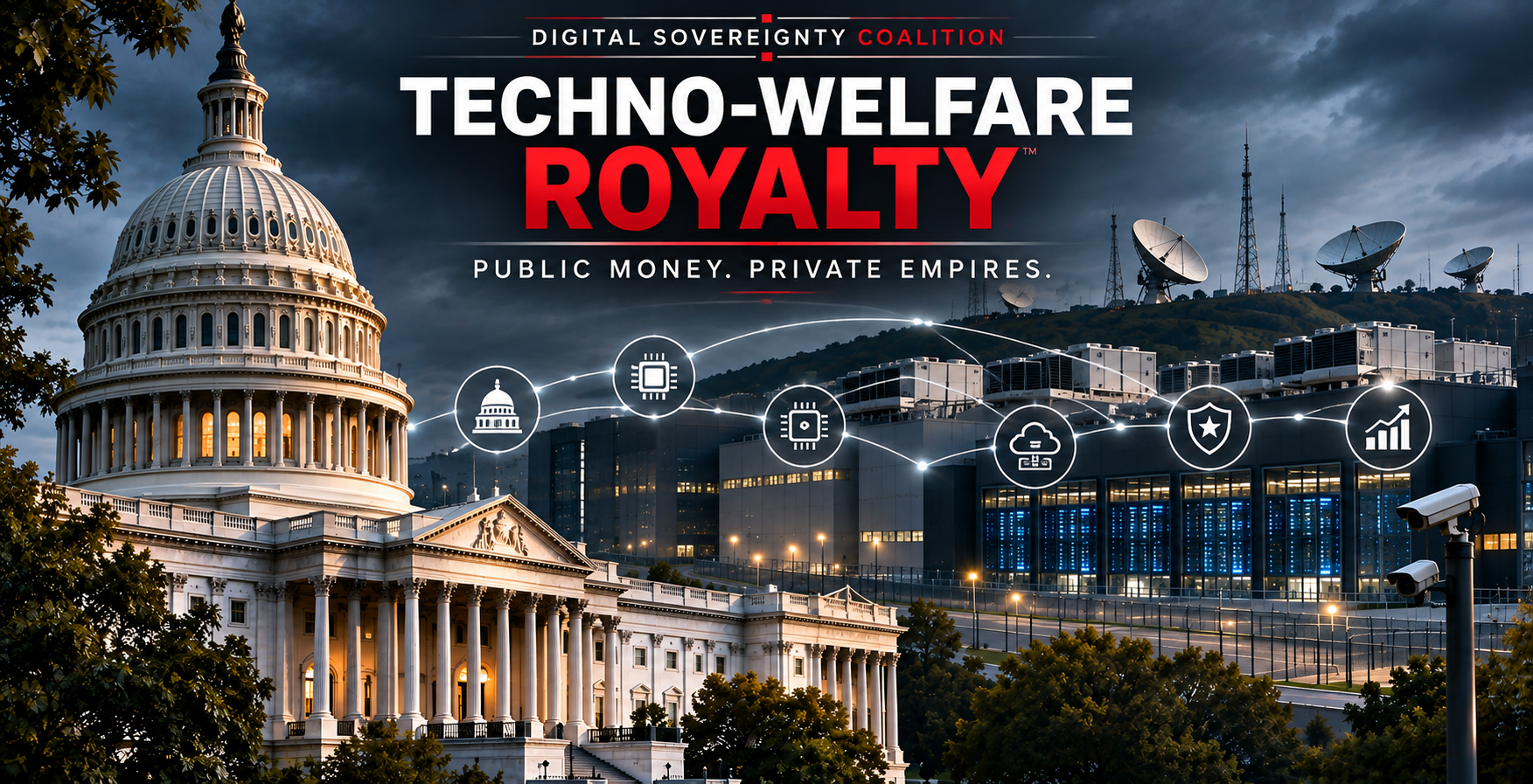
TECHNO-WELFARE ROYALTY
DSC INVESTIGATIONS / PUBLIC FINANCE & PRIVATE POWER
PUBLIC MONEY. PRIVATE EMPIRES.
WHO HOLDS THE POWER?
The modern technology economy is frequently celebrated as a triumph of private innovation and entrepreneurial independence.
Yet many of its most powerful enterprises operate within ecosystems supported by taxpayer-funded research, government procurement, public infrastructure, tax incentives, subsidies, defense expenditures, and favorable industrial policies.
Some develop technologies used by government itself. Others own infrastructure upon which public institutions and entire societies increasingly depend.
The resulting relationship raises questions that extend beyond economics.
Who finances technological power?
Who owns the infrastructure?
Who controls the systems?
Who bears the risks?
And when public institutions become dependent upon private technology, where does democratic authority ultimately reside?
01 — DEFINE THE PHENOMENON
WHAT IS TECHNO-WELFARE ROYALTY?
For this DSC investigation, TECHNO-WELFARE ROYALTY is an editorial term describing the relationship between concentrated private technological power and the public financial, institutional, and regulatory systems that help sustain it.
Public institutions finance technological development and purchase technological capabilities, while private corporations may retain ownership of the resulting platforms, infrastructure, intellectual property, and economic returns.
This relationship is not inherently improper.
Government procurement can deliver genuine public value. Public investment can accelerate innovation, support employment, protect national security, and create important technologies.
The constitutional question arises when these arrangements generate concentrated dependencies, inadequate public oversight, preferential access, limited competition, or private control over essential governmental functions.
This investigation distinguishes clearly between:
- 1Government contracts for goods and services
- 2Direct subsidies and grants
- 3Tax credits and financial incentives
- 4Government loans and loan guarantees
- 5Publicly financed research and development
- 6Public infrastructure supporting private industry
- 7Regulatory and procurement advantages
- 8Political contributions and lobbying
- 9Government personnel and advisory relationships
- 10Ownership of infrastructure used for public purposes
These categories are never combined into a misleading single figure described as corporate welfare.
02 — FOLLOW THE PUBLIC MONEY
THE PUBLIC FINANCING OF PRIVATE TECHNOLOGICAL POWER
A. THE CONTRACT
Public institutions purchase technology, infrastructure, software, intelligence capabilities, military systems, cloud services, and operational support.
This investigation examines competitive bidding, contract ceilings, actual expenditures, vendor concentration, renewals, and contract oversight.
B. THE SUBSIDY
Public resources support industrial development through tax incentives, grants, infrastructure commitments, and financial assistance.
This investigation examines recipient companies, statutory purposes, eligibility, measurable public benefits, and accountability.
C. THE RESEARCH PIPELINE
Publicly supported science and engineering contribute to commercially valuable technologies.
This investigation examines how research becomes proprietary technology and whether public-interest protections remain.
D. THE PUBLIC DEPENDENCY
Government agencies and public institutions integrate privately owned technologies into essential operations.
This investigation examines vendor lock-in, switching costs, interoperability, operational continuity, and institutional dependence.
E. THE POLITICAL RELATIONSHIP
Corporate leaders, investors, lobbyists, campaign contributors, and government officials interact within the policy and procurement ecosystem.
This investigation examines documented relationships without suggesting that a political contribution alone proves improper influence.
F. THE RETURN
Public money flows through government procurement and industrial programs into private companies.
This investigation examines where resulting revenues, intellectual property, ownership interests, economic benefits, and public obligations reside.
03 — THE TECHNO-WELFARE ROYALTY INDEX
THE PEOPLE. THE CORPORATIONS. THE PUBLIC RELATIONSHIPS.
This is an initial research roster, not a list of proven beneficiaries of improper public expenditure.
No entry on this roster asserts that the individual personally received public funds.
Where public financing benefits a corporation rather than an individual, the individual's specific ownership, management, investment, or governance relationship is itself a subject of investigation.
Additional subjects may be included only after supporting evidence is identified.
The directory expands as research progresses, without rebuilding the page.
04 — INDIVIDUAL INVESTIGATIVE CASE FILES
Every profile opens a dedicated case file using a consistent editorial template.
Every category in every case file currently returns the same finding: No verified finding currently documented. Each entry carries the RESEARCH PENDING — NOT YET VERIFIED label until primary records are verified. Where a category is later supported, the entry will distinguish allegations, investigations, official statements, and established findings, and will link to dated primary sources.
05 — FOLLOW THE MONEY: VISUAL INVESTIGATION
FROM TAXPAYERS TO TECHNOLOGICAL POWER
This diagram represents an investigative framework, not a proven causal chain for any company.
No connection on this diagram is presented as a documented relationship. Evidence linking will be attached to each documented connection as primary records are verified.
CONNECTION TYPES — LEGEND
Interactive filtering and connection-level evidence linking are pending development. This is a static prototype; no interactive controls are displayed.
06 — THE DEFENSE AND INTELLIGENCE ECONOMY
WHEN PUBLIC SECURITY DEPENDS ON PRIVATE TECHNOLOGY
Government procurement supports defense-oriented technology companies and their investors. This section examines that relationship.
SUBJECTS OF INVESTIGATION
INVESTIGATIVE QUESTIONS
- 01Who owns the technology?
- 02Who controls the operational infrastructure?
- 03What rights does the government retain?
- 04Can agencies independently audit critical systems?
- 05Are alternative vendors viable?
- 06What happens if a private company refuses service or changes acceptable-use conditions?
- 07What legal safeguards apply when AI systems contribute to public-sector decisions?
- 08What recourse exists when automated systems cause harm?
Contract ceilings, obligated funds, disbursements, exercised options, and company revenues are explained as distinct figures throughout this investigation. The maximum potential value of a contract is never presented as actual government expenditure.
07 — THE COMPUTATIONAL INFRASTRUCTURE ECONOMY
WHO PAYS FOR THE COMPUTATIONAL FUTURE?
This section examines the relationship between AI infrastructure expansion and public resources.
Privately controlled infrastructure can become essential to publicly funded research, defense programs, healthcare, education, and government operations. Companies are included in this section only where the evidence supports inclusion.
This analysis connects to DSC's Scarcity Regime Triangle — Energy, Hardware, and Software — and to the Convergence Threshold analysis of reinforcing dependencies.
08 — CORPORATE POWER AND THE POLITICAL SYSTEM
PUBLIC POLICY. PRIVATE INTERESTS.
This section examines the documented relationships among technology firms, investors, policymakers, lobbyists, and government institutions.
Relationships are examined across political parties and administrations. Political participation, lobbying, and government contracting can all be lawful. No unlawful conduct or preferential treatment is presumed, and specific evidence is identified before any causal claim is made.
When the same concentrated technological interests participate in shaping public policy while selling essential systems to government, are existing transparency and accountability mechanisms sufficient?
09 — PUBLIC RISK. PRIVATE REWARD?
WHO BENEFITS? WHO PAYS? WHO REMAINS ACCOUNTABLE?
A comparative public-interest analysis. For each documented example, both columns are examined.
POTENTIAL PUBLIC BENEFITS
- — Technological innovation
- — Employment and economic development
- — National security improvements
- — Improved public services
- — Scientific progress
- — Infrastructure development
- — Competition and domestic productive capacity
POTENTIAL PUBLIC COSTS AND RISKS
- — Vendor lock-in
- — Reduced competition
- — Inadequate transparency
- — Limited public governance
- — Subsidy inefficiency
- — Privacy risks
- — Surveillance expansion
- — Public exposure to financial or environmental costs
- — Concentration of critical infrastructure
- — Privatization of essential decision-making capabilities
Neither column is presumed to outweigh the other in any particular case. This section uses sourced findings rather than generalized accusations, and no example is presented until its documentation is verified.
10 — THE CONSTITUTIONAL QUESTION
WHEN PUBLIC CAPABILITY BECOMES PRIVATE POWER
This investigation connects to Digital Sovereignty Coalition's core constitutional concerns.
Democratic accountability
Public institutions must remain accountable for decisions involving publicly funded capabilities.
Due process
Automated systems used in consequential government decisions require appropriate legal safeguards.
Privacy
Public-private technological relationships must not circumvent civil-liberties protections.
Freedom of expression
Dependency on private communication infrastructure may raise questions about public speech and government authority.
Equal protection
Automated public systems must be assessed for discriminatory outcomes.
Separation of powers
Government use of privately developed systems must remain subject to lawful institutional oversight.
Public sovereignty
Essential public functions should not become effectively ungovernable because a private contractor controls critical infrastructure.
No specific constitutional violation is claimed without documented legal support.
11 — THE DSC RESPONSE
PUBLIC INVESTMENT SHOULD SERVE THE PUBLIC INTEREST
Digital Sovereignty Coalition presents a broader framework as an alternative to unchecked technological concentration.
These are proposed policy and institutional responses, not existing universal legal requirements. Innovation and constitutional accountability are compatible. DSC does not seek to eliminate private enterprise or government technology procurement; the objective is to strengthen accountability while preserving technological progress.
12 — THE SOURCE AND EVIDENCE REPOSITORY
AN EVIDENCE-FIRST CITATION ARCHITECTURE
PRIORITIZED SOURCE TYPES
- 01USAspending.gov
- 02Federal contract notices and agency procurement records
- 03SEC filings
- 04Federal and state subsidy disclosures
- 05Official budget and appropriations records
- 06FEC political contribution records
- 07Federal lobbying disclosures
- 08Corporate annual reports
- 09Government Accountability Office reports
- 10Inspector General reports
- 11Congressional hearings
- 12Court documents
- 13Patent databases
- 14Reputable investigative reporting
- 15Original company statements and documented responses
PRIMARY-SOURCE PORTALS
Links to general portals are research resources, not evidence supporting an individual allegation.
Every material factual claim on this page must carry a traceable citation before it is presented as established.
The maximum potential value of a contract is never equated with actual government expenditure.
RESEARCH AND CORRECTIONS POLICY: Case files and evidence are maintained in structured, maintainable content records. Verification dates reflect actual review dates, not automatic freshness labels. Historical findings are preserved when subsequent events change the situation. Factual findings are not changed automatically without reviewing supporting evidence.
13 — REFERENCE RESEARCH
THE AUTHORITARIAN STACK
This investigation references The Authoritarian Stack, a publication produced by a project led by Professor Francesca Bria with xof-research.org.
Its mapped relationships among government institutions, defense technology firms, venture capital, and political actors provide a potential foundation for DSC's independent investigation.
DSC attributes the underlying work to its authors and researchers, and clearly distinguishes their findings and analytical interpretations from DSC's independently verified conclusions.
The project's October 2025 network snapshot is treated as historical, not automatically current.
DSC creates original diagrams rather than reproducing the publication's interactive map, graphics, or network visualization, whose infographic license is more restrictive than its text license.
Underlying source claims are independently verified before being presented as DSC findings, and the publication's political or ideological classifications are not adopted as established factual judgments without attribution.
14 — THE PUBLIC FINANCES THE FUTURE. WHO CONTROLS IT?
Technological innovation is reshaping the foundations of modern society.
Public institutions finance research, purchase infrastructure, support industrial development, and increasingly depend upon privately owned technological systems.
These relationships can produce extraordinary public benefits.
They can also raise profound questions about concentration, accountability, and democratic control.
The question is not whether government and private enterprise should cooperate.
The question is whether the public retains meaningful authority over the technologies its resources help make possible.
Digital Sovereignty Coalition investigates that question in the interest of technological innovation, constitutional accountability, and the Plurality of Digital Sovereignty.
PUBLIC MONEY. PRIVATE EMPIRES. WHO HOLDS THE POWER?
DSC.NYC
RELATED DSC INVESTIGATIONS