DIGITAL SOVEREIGNTY COALITION | CONSTITUTIONAL & COMPUTATIONAL ANALYSIS
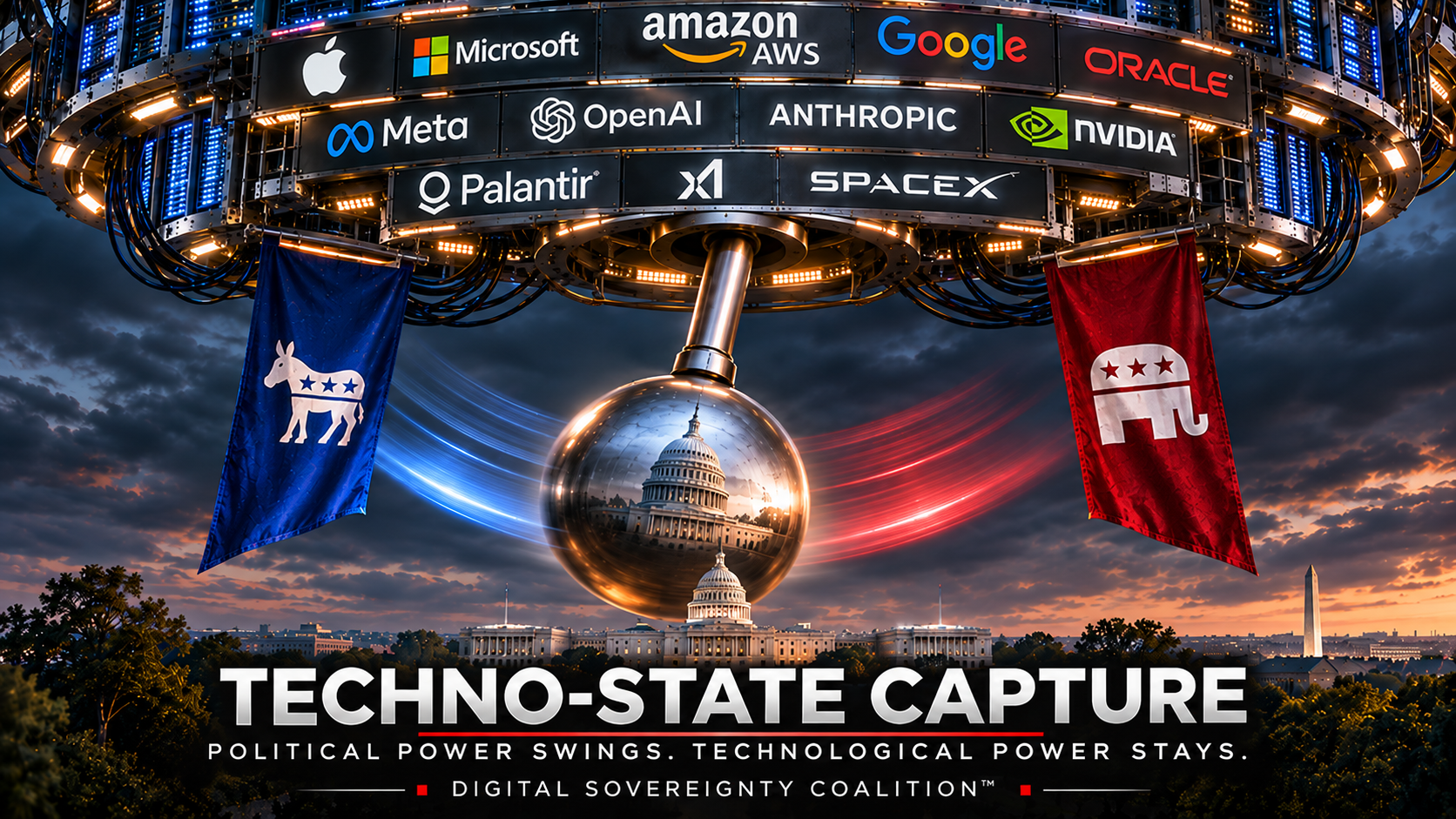
TECHNO-STATE CAPTURE
POLITICAL POWER SWINGS. TECHNOLOGICAL POWER STAYS.
When corporations become indispensable to the state, who ultimately governs?
SECTION 00
THE QUESTION OF POWER
Elections change governments.
Presidents enter and leave office. Congressional majorities shift. Political parties compete for authority, promise reforms, and pursue competing visions of the future.
But beneath these transitions, another form of power may remain remarkably stable.
The corporations that operate cloud infrastructure, develop artificial intelligence, manufacture advanced semiconductors, control digital communications, process financial transactions, and provide intelligence and defense technologies can maintain their positions across successive administrations.
Their products become embedded in the machinery of government, the operations of private industry, and the daily lives of citizens.
Their influence does not necessarily depend on the electoral success of any single political party.
Their infrastructure can outlast the administrations that authorize its adoption.
What happens when the institutions of democracy become dependent on technological systems that democratic institutions do not fully own, understand, or control?
This is the constitutional question at the center of Techno-State Capture.
SECTION 01
DEFINING TECHNO-STATE CAPTURE
Techno-State Capture is the process through which concentrated private technological power becomes so deeply embedded in government and society that it acquires enduring influence over public administration, institutional capabilities, and the practical exercise of state authority.
Unlike conventional regulatory capture, which concerns the influence of regulated industries over the agencies responsible for overseeing them, Techno-State Capture encompasses a broader relationship between corporate technological infrastructure and the institutions of government.
It may emerge through combinations of:
- Political contributions and electoral financing.
- Corporate lobbying and regulatory advocacy.
- Government procurement and long-term contracts.
- Public subsidies, tax incentives, and preferential access.
- Executive relationships and political patronage.
- Movement of personnel between government and industry.
- Proprietary technological standards and vendor lock-in.
- Dependence on private AI, cloud, data, and communications infrastructure.
- Corporate influence over the technological capabilities available to public institutions.
These mechanisms are not inherently unlawful or evidence of corruption.
Governments legitimately purchase technology. Corporations legitimately advocate for policies, compete for contracts, and participate in public debate.
The constitutional concern emerges when their combined effects weaken meaningful public oversight, restrict democratic choices, or make essential government functions difficult to operate independently of particular private interests.
The defining danger is not simply that corporations influence government. It is that government may lose the practical ability to govern without them.
SECTION 02
POLITICAL AGNOSTICISM: THE PERMANENCE OF CORPORATE INTEREST
Political parties compete to control government.
Corporations compete to secure markets, favorable operating conditions, technological advantages, and long-term commercial relationships.
These objectives sometimes overlap, but they are not identical.
A technology corporation may support one administration's infrastructure initiatives, lobby another administration on regulation, contribute to political organizations across party lines, and maintain government contracts throughout both.
Its relationships may be ideological, transactional, strategic, or some combination of the three.
The corporation's enduring interest may be less about which political party governs than about the commercial and institutional environment in which it operates.
This creates a potential asymmetry.
Political authority is periodically contested through elections. Infrastructural authority may accumulate across decades.
An administration may approve a proprietary AI system, cloud platform, or defense architecture that remains operational long after the administration itself has ended.
Subsequent governments may inherit contracts, technical dependencies, institutional knowledge gaps, switching costs, and security requirements that make replacing the system expensive or impractical.
The corporation's position may therefore survive changes in political leadership.
This does not mean all technology corporations are politically neutral. Some executives and companies openly align with particular candidates or ideological movements.
Political agnosticism is instead an investigative question: to what extent do corporate strategies, lobbying priorities, and government relationships adapt across administrations while preserving underlying commercial interests?
THE PENDULUM
The American political system moves between competing parties and elected leaders.
But what happens when the technological infrastructure supporting the state remains anchored to a comparatively small group of private providers?
The pendulum swings.
The infrastructure stays.
And the question becomes whether the fixed point is accountable to the people whose government depends upon it.
SECTION 03
THE ARCHITECTURE OF INFLUENCE
Techno-State Capture does not necessarily begin with the deployment of advanced technology.
It may begin with the relationships that shape which technologies governments purchase, which companies receive public support, and which rules govern their operation.
Political Money. Institutional Access. Structural Dependency.
03.1 — Campaign Contributions and Electoral Financing
Technology executives, investors, employees, political action committees, and affiliated political organizations participate in the financing of American elections.
These relationships may include direct contributions permitted by election law, super PAC expenditures, independent political advertising, and funding through organizations whose donors may not be fully disclosed.
Corporate treasury contributions to federal candidates are generally prohibited, but corporations can participate through other lawful political-financing structures.
The relevant questions are not limited to the amount of money contributed.
Who provided the money?
Through which legal entity or political committee?
Which candidates or political organizations benefited?
What policy positions did the contributors advocate?
And what government decisions followed?
A financial contribution does not establish an improper exchange.
But systematic analysis of contributions, meetings, lobbying, procurement, and regulatory outcomes can reveal relationships deserving public scrutiny.
03.2 — Corporate Lobbying
Lobbying is a lawful and established part of American government.
It is also a mechanism through which organizations with substantial financial resources can maintain sustained access to lawmakers, executive agencies, and regulatory institutions.
Technology corporations may advocate concerning artificial intelligence, antitrust enforcement, data privacy, taxation, semiconductor policy, defense procurement, export controls, intellectual property, and liability.
The constitutional issue is not whether corporations should be allowed to advocate.
It is whether concentrated financial and technical resources give certain private interests disproportionate influence over the rules governing technologies upon which the public increasingly depends.
Who writes the rules when the companies being regulated possess more technical knowledge, financial resources, and institutional continuity than the agencies overseeing them?
03.3 — The Revolving Door
Government officials, congressional staff, military personnel, regulators, lobbyists, and corporate executives may move between public service and private industry.
Such movement can provide valuable expertise.
It can also create conflicts of interest, privileged access, institutional familiarity, and incentives that require careful oversight.
DSC examines how these movements affect procurement decisions, regulatory enforcement, national-security policy, and public confidence in the independence of government.
03.4 — Presidential Projects, Political Patronage, and Executive Access
Political influence is not confined to election campaigns.
Corporate financial relationships may extend to inaugural funds, presidential-library projects, public celebrations, privately organized political events, sponsorships, and other initiatives associated with political leadership.
The White House ballroom fundraising, technology-industry inaugural contributions, and corporate sponsorships associated with national celebrations provide contemporary subjects for investigation.
These arrangements raise questions about transparency, donor access, conflicts of interest, and the separation of public authority from private financial relationships.
Their existence does not establish that government favors were exchanged.
The appropriate inquiry is whether contributions, access, and subsequent official decisions reveal documented conflicts, departures from established procedures, or other evidence of improper influence.
Access is not proof of capture. But access should not purchase immunity from scrutiny.
SECTION 04
FROM GOVERNMENT CONTRACTOR TO GOVERNMENT DEPENDENCY
Government contracting is not new.
What is changing is the nature of the systems being purchased.
An agency purchasing office furniture can generally replace its supplier without fundamentally changing its capacity to govern.
Replacing an AI platform integrated into intelligence analysis, a proprietary cloud environment supporting essential services, or a communications network embedded in military operations may be considerably more difficult.
These systems may require specialized personnel, proprietary interfaces, security certifications, extensive data migration, retraining, and operational restructuring.
As technological integration deepens, a vendor may become more than a supplier.
It may become part of the institution's operational architecture.
The Dependency Cycle
Public Contract → Technological Integration → Institutional Reliance → High Switching Costs → Increased Vendor Leverage → Further Integration
This cycle is not inevitable.
Open standards, interoperability, public technical capacity, competitive procurement, meaningful exit provisions, and independent oversight can reduce dependency.
But without such safeguards, public institutions may gradually surrender practical flexibility even while retaining formal legal authority.
The Constitutional Question
If elected officials possess the legal power to replace a technology provider but cannot realistically do so without disrupting essential public services, how meaningful is that authority?
Sovereignty requires more than the legal right to make a decision. It requires the practical capacity to carry that decision out.
SECTION 05
THE CORPORATE TECHNOLOGY STACK
Modern technological power is distributed across interconnected layers.
No single corporation necessarily controls the entire system.
Yet concentration within individual layers, combined with commercial partnerships and government contracts, can create dependencies extending across the broader technological environment.
COMPUTE AND SEMICONDUCTORS
Advanced processors, semiconductor manufacturing, computing capacity, and the physical infrastructure required to train and operate frontier AI.
CLOUD AND DATA INFRASTRUCTURE
Commercial cloud platforms, government hosting environments, databases, cybersecurity services, and data-processing infrastructure.
ARTIFICIAL INTELLIGENCE
Foundation models, AI agents, automated decision systems, predictive analytics, and machine-learning services.
INTELLIGENCE AND DEFENSE
Military software, intelligence analysis, surveillance systems, battlefield communications, autonomous platforms, and decision-support technologies.
COMMUNICATIONS AND SPACE
Satellite networks, telecommunications infrastructure, launch systems, and the private capabilities supporting essential government and civilian communications.
DIGITAL IDENTITY AND FINANCE
Identity verification, payment infrastructure, digital wallets, financial platforms, and technologies mediating access to public and private services.
CONSUMER AND SOCIAL INFRASTRUCTURE
Operating systems, smartphones, app ecosystems, social platforms, search engines, and the systems through which citizens communicate, receive information, and participate in digital society.
Companies including Apple, Microsoft, Amazon, Alphabet, Meta, NVIDIA, Oracle, Palantir, OpenAI, Anthropic, xAI, and SpaceX operate in different parts of this ecosystem.
Their business models, government relationships, regulatory positions, and approaches to public accountability differ substantially.
Their inclusion in this analysis does not imply coordinated misconduct.
The relevant question is how concentration and interdependence across these layers may affect democratic authority, public choice, and national resilience.
The danger is not necessarily one corporation controlling everything. It is the possibility that a small network of indispensable providers collectively occupies the infrastructure through which modern society functions.
SECTION 06
MILITARY AI: WHEN PRIVATE TECHNOLOGY MEETS STATE FORCE
The relationship between artificial intelligence companies and national-security institutions presents a particularly consequential constitutional challenge.
Military and intelligence agencies increasingly evaluate or deploy commercial AI capabilities for analysis, logistics, cybersecurity, planning, and other operational functions.
These systems may be developed by private corporations, hosted through commercial infrastructure, integrated by defense contractors, and operated under government contracts.
The resulting relationships raise difficult questions.
Who determines acceptable uses?
Who can suspend access?
Who audits the system?
Who bears responsibility for errors?
And who has the authority to establish limits when corporate safety policies conflict with government operational demands?
THE ANTHROPIC–PENTAGON DISPUTE
The dispute between Anthropic and the Pentagon over military AI safeguards provides a case study of competing public and private authority.
The controversy involved disagreements over restrictions concerning domestic surveillance and autonomous weapons, the government's procurement authority, and the consequences of refusing particular contractual conditions.
The Pentagon maintained that lawful military operations should not be subject to unacceptable restrictions imposed by private vendors.
Anthropic defended its safety limitations and challenged government actions taken against the company.
OpenAI's subsequent Pentagon relationship introduced additional questions concerning competition, alternative suppliers, and the consistency of safeguards across AI providers.
These developments do not establish that either corporation captured the government.
They demonstrate a structural tension: essential public capabilities may depend on technologies developed by corporations whose contractual obligations, commercial incentives, and safety policies do not always align with the government's demands.
THE TWO-SIDED DEPENDENCY
Private corporations can gain leverage when governments depend on their technology.
Governments can gain leverage when corporations depend on public contracts, regulatory approvals, and access to national-security markets.
Both forms of leverage require scrutiny.
Neither corporate executives nor military officials should be able to place the exercise of public power beyond constitutional accountability.
SECTION 07
THE TRANSACTIONAL STATE
The relationship between political financing and government decision-making deserves examination through evidence rather than assumption.
DSC proposes a continuing investigative record of corporate-government relationships across administrations.
Subjects include:
POLITICAL FINANCING
Campaign contributions, political action committees, independent expenditures, inaugural funds, and political sponsorships.
LOBBYING AND REGULATORY ADVOCACY
Lobbying expenditures, retained firms, policy objectives, agency contacts, legislative proposals, and regulatory proceedings.
EXECUTIVE ACCESS
Documented meetings, official advisory roles, public events, political relationships, and disclosed communications.
GOVERNMENT CONTRACTS
Contract awards, modifications, renewals, subcontracting relationships, procurement competition, and vendor concentration.
REGULATORY OUTCOMES
Enforcement actions, settlements, export licenses, rule changes, exemptions, and other official decisions.
INFRASTRUCTURAL ENTRENCHMENT
The extent to which public institutions become dependent on specific commercial systems and the practical costs of replacing them.
Contemporary Case Studies
The evidence record should examine, among other subjects:
- Technology-company contributions to presidential inaugurations and White House-related projects.
- Corporate sponsorships associated with federal celebrations and public events.
- Meta's regulatory relationships, political contributions, and litigation settlements.
- Elon Musk's political spending alongside the government relationships of SpaceX, Starlink, and his other businesses.
- NVIDIA's role in advanced computing and the relationship between semiconductor policy, export controls, and government interests.
- Anthropic, OpenAI, Palantir, and commercial cloud providers in defense and intelligence procurement.
- Corporate lobbying concerning AI regulation, competition, privacy, and federal procurement.
Each case must distinguish established facts, disputed allegations, official responses, and analytical conclusions.
A Record That Outlasts Administrations
This investigation should not be organized around a single president.
Its purpose is to identify recurring mechanisms across Republican and Democratic administrations, Congress, federal agencies, state governments, and municipalities.
A contribution made in one administration remains part of the historical record after that administration ends.
A procurement decision may continue shaping public infrastructure decades later.
The purpose is not to establish guilt through association. It is to make relationships between money, influence, public decisions, and technological dependency visible and independently examinable.
SECTION 07A
THE PRICE OF ACCESS
MONEY, POWER & CORPORATE ALLEGIANCE
Political influence is not always exercised through legislation, campaign advertising, or explicit demands. It can also operate through financial contributions, ceremonial access, public displays of allegiance, government procurement, regulatory discretion, and the cultivation of relationships between corporate executives and political leaders.
These relationships may be lawful. They may also create serious questions about conflicts of interest, institutional independence, public accountability, and the obligations of corporations whose technologies have become essential to government and society.
The question is not whether every contribution purchases a favor.
The question is whether democratic institutions can independently regulate, investigate, or reject corporations upon which they increasingly depend.
WHEN THE COMPANIES THAT GOVERNMENTS DEPEND ON ALSO FINANCE POLITICAL ACCESS, WHO REMAINS ACCOUNTABLE TO WHOM?
07A.1 — THE INAUGURAL ECONOMY: THE FINANCING OF POLITICAL ACCESS
This record examines the corporate and individual donations associated with the January 20, 2025 presidential inauguration of Donald Trump. It presents the reported record of contributions from technology corporations and technology executives, subject to primary-source verification.
- Amazon — reported $1 million corporate contribution.
- Meta — reported $1 million corporate contribution.
- Alphabet/Google — reported $1 million corporate contribution.
- Adobe — reported $1 million corporate contribution.
- Tim Cook — reported $1 million personal contribution.
- Sam Altman — reported $1 million personal contribution.
- Other technology companies or executives, including NVIDIA, Elon Musk, and Palantir executives, where verified by Federal Election Commission records or reliable reporting.
| Donor | Category | Reported amount | Source | Date verified |
|---|---|---|---|---|
| Amazon | Corporate contribution | $1 million (reported) | Reuters factbox (syndicated reporting) | Pending |
| Meta | Corporate contribution | $1 million (reported) | Reuters factbox (syndicated reporting) | Pending |
| Alphabet/Google | Corporate contribution | $1 million (reported) | Reuters factbox (syndicated reporting) | Pending |
| Adobe | Corporate contribution | $1 million (reported) | Reuters factbox (syndicated reporting) | Pending |
| Tim Cook | Personal executive contribution | $1 million (reported) | Reuters factbox (syndicated reporting) | Pending |
| Sam Altman | Personal executive contribution | $1 million (reported) | Reuters factbox (syndicated reporting) | Pending |
| — | Political committee contribution | Not asserted in the current record | No political-committee inaugural contributions are asserted in the current record. | Not applicable |
SOURCES: Reuters factbox on corporate pledges for the January 2025 inauguration (syndicated reporting). Figures are reported commitments pending verification against Federal Election Commission records. Evidentiary tier: DOCUMENTED FACT (reported), verification pending.
Personal contributions and corporate contributions are distinct categories, and this record keeps them separate throughout. Contribution records are independently verifiable through the Federal Election Commission, whose research resources are collected in Section 13.
The record distinguishes ordinary political participation, ceremonial access, lobbying, and efforts to influence governmental decision-making. These are different activities governed by different rules and carrying different accountability implications.
Legally permitted inaugural contributions do not, by themselves, establish corruption.
Questions to investigate
- Who contributed?
- How much?
- Was the donor an individual, corporation, foundation, or affiliated entity?
- Were contributions disclosed?
- Which donors subsequently participated in official White House events?
- Which donors had government contracts, enforcement matters, or regulatory decisions pending?
- Were any consequential decisions made afterward?
- What evidence, if any, connects the contribution to the decision?
07A.2 — THE BALLROOM AND THE PUBLIC TRUST
This record examines the private financing of the White House ballroom project and its implications for public institutions, corporate access, and government accountability.
An October 15, 2026 Washington Post investigation identified approximately $333 million in private donor commitments to the project. The investigation reported the following amounts:
- Apple — reported $25 million commitment.
- NVIDIA — reported $25 million commitment.
- Alphabet/Google — reported $22 million, connected to litigation settlement funds rather than an ordinary voluntary cash donation.
- Microsoft — reported $10 million commitment.
- Palantir — reported $10 million commitment.
- Lockheed Martin — reported $10 million commitment.
- Amazon — reported $5 million commitment.
- Meta — reported $5 million commitment.
- Cisco — reported $5 million commitment.
- T-Mobile — reported $5 million commitment.
| Company or donor | Reported commitment | Funding mechanism or status | Source | Date verified |
|---|---|---|---|---|
| Apple | $25 million | Reported private commitment | Washington Post, Oct. 15, 2026 | Pending |
| NVIDIA | $25 million | Reported private commitment | Washington Post, Oct. 15, 2026 | Pending |
| Alphabet/Google | $22 million | Reported as connected to litigation settlement funds, not an ordinary voluntary cash donation | Washington Post, Oct. 15, 2026 | Pending |
| Microsoft | $10 million | Reported private commitment | Washington Post, Oct. 15, 2026 | Pending |
| Palantir | $10 million | Reported private commitment | Washington Post, Oct. 15, 2026 | Pending |
| Lockheed Martin | $10 million | Reported private commitment | Washington Post, Oct. 15, 2026 | Pending |
| Amazon | $5 million | Reported private commitment | Washington Post, Oct. 15, 2026 | Pending |
| Meta | $5 million | Reported private commitment | Washington Post, Oct. 15, 2026 | Pending |
| Cisco | $5 million | Reported private commitment | Washington Post, Oct. 15, 2026 | Pending |
| T-Mobile | $5 million | Reported private commitment | Washington Post, Oct. 15, 2026 | Pending |
SOURCES: The Washington Post investigation into ballroom donor records, October 15, 2026; Public Citizen donor research; Reuters reporting on Senator Blumenthal's records request, November 5, 2026. Amounts are reported commitments pending verification against primary records. Evidentiary tier: DOCUMENTED FACT (reported), verification pending.
Every entry requires verification of the exact amount, the source entity, the contribution mechanism, and the payment status.
Pledges, commitments, installments, completed donations, and settlement-related funding are different transaction categories and are not presented interchangeably in this record.
Alphabet's reported contribution must be understood in the context of litigation settlement funds rather than characterized as an ordinary voluntary cash donation.
The named companies hold procurement, national-security, export-control, antitrust, and regulatory interests across the federal government. No entry in this record implies that a contribution secured an identifiable government benefit without evidence establishing that connection.
On November 5, 2026, Senator Richard Blumenthal requested records concerning technology-company ballroom contributions and related government decisions. The requested inquiry seeks to establish what was given, to whom, and which government decisions followed. A congressional request for records is an exercise of oversight. It is not, in itself, a finding of misconduct.
WHEN PRIVATE CORPORATIONS FINANCE THE PHYSICAL SPACES OF PUBLIC POWER, WHAT GUARANTEES THAT ACCESS TO GOVERNMENT REMAINS INDEPENDENT OF PRIVATE WEALTH?
07A.3 — WHO FINANCES THE SPECTACLE OF STATE POWER?
This record examines the corporate sponsors publicly identified by the United States Army for its 250th birthday celebration on June 14, 2025, which coincided with the military parade in Washington, D.C.
- General Dynamics
- USAA
- Lockheed Martin
- RTX
- Leidos
- BAE Systems
- Boeing
- Bell Textron
- Leonardo DRS
- General Electric Aerospace
- T-Mobile
| Sponsor | Sponsorship category | Source | Date verified |
|---|---|---|---|
| General Dynamics | Army-announced celebration sponsor | army.mil announcement | Pending |
| USAA | Army-announced celebration sponsor | army.mil announcement | Pending |
| Lockheed Martin | Army-announced celebration sponsor | army.mil announcement | Pending |
| RTX | Army-announced celebration sponsor | army.mil announcement | Pending |
| Leidos | Army-announced celebration sponsor | army.mil announcement | Pending |
| BAE Systems | Army-announced celebration sponsor | army.mil announcement | Pending |
| Boeing | Army-announced celebration sponsor | army.mil announcement | Pending |
| Bell Textron | Army-announced celebration sponsor | army.mil announcement | Pending |
| Leonardo DRS | Army-announced celebration sponsor | army.mil announcement | Pending |
| General Electric Aerospace | Army-announced celebration sponsor | army.mil announcement | Pending |
| T-Mobile | Army-announced celebration sponsor | army.mil announcement | Pending |
SOURCE: U.S. Army announcement of the 250th birthday celebration and its sponsors, June 2025 (army.mil). Sponsor identities are drawn from the Army's own announcement. Evidentiary tier: DOCUMENTED FACT (official announcement); sponsorship amounts are not publicly itemized in the announcement.
Sponsorship classifications are distinct. Presenting, platinum, gold, and other tiers identify different levels of support, and the Army's sponsor list identifies festival sponsors. Not every festival sponsor directly financed the parade itself.
Questions to investigate
- Who received the sponsorship funds?
- Which activities or events did the sponsorships support?
- Are sponsorship amounts publicly disclosed?
- Which sponsors maintain federal defense contracts?
- What procurement and conflict-of-interest safeguards apply?
- Can public funds and private sponsorships be separately accounted for?
WHEN COMPANIES SELL WEAPONS, SOFTWARE, AND SERVICES TO THE STATE, HOW SHOULD THEIR FINANCIAL SUPPORT FOR STATE CEREMONIES BE SCRUTINIZED?
07A.4 — CORPORATE ALLEGIANCE AND CIVIL LIBERTIES: THE TIM COOK RECORD
This is a central human-rights case study, and it receives the substantial, careful, documented treatment that central case studies require. The following chronological account covers Apple chief executive Tim Cook's publicly documented interactions with the Trump administration.
Event One — January 2025: The inaugural contribution
Tim Cook reportedly made a personal $1 million contribution to President Trump's second inauguration. The contribution was personal. It was not an Apple corporate inaugural contribution.
SOURCE: Reuters factbox on inauguration donations (syndicated reporting). Reported as a personal contribution; pending verification against Federal Election Commission records. Evidentiary tier: DOCUMENTED FACT (reported), verification pending.
View the documentary record at source
Event Two — August 6, 2025: The presidential gift
During a White House event announcing Apple's United States investment plans, Tim Cook presented President Trump with a custom engraved glass plaque mounted on a 24-karat gold base. The object is described here exactly as documented. It is not characterized as a solid-gold gift, and no monetary value is attributed to it.
SOURCE: govinfo Daily Compilation of Presidential Documents, August 6, 2025 (official record of the White House event announcing Apple's investment plans). Evidentiary tier: DOCUMENTED FACT (official record).
View the documentary record at source
The event sits within the broader context of Apple's domestic manufacturing commitments, tariff policy, and trade negotiations between the company and the administration.
Event Three — January 24, 2026: The White House screening and the Minneapolis killings
A private White House screening of Amazon MGM Studios' Melania documentary was held on January 24, 2026. Tim Cook and Amazon chief executive Andy Jassy were reported among the attendees.
The screening occurred hours after federal immigration agents fatally shot Alex Pretti, a 37-year-old intensive care nurse, in Minneapolis. Earlier that month, on January 7, federal immigration agent Jonathan Ross fatally shot 37-year-old Renée Good.
SOURCES: The Washington Post reporting on the White House screening and the Minnesota shootings, January 2026; contemporaneous reporting on the January 7 and January 24 events. Attendance is reported, not officially confirmed in primary records. Evidentiary tier: DOCUMENTED FACT for the deaths of Renée Good (January 7, 2026) and Alex Pretti (January 24, 2026) and for the dates as stated in this record. The fact of the deaths is not in dispute. DISPUTED MATTERS are limited to conflicting descriptions of the encounters, whether particular actions met legal standards for justified force, official interpretations of the video evidence, and allegations of individual or institutional responsibility — none of which is treated here as established absent an authoritative finding.
View the documentary record at source
The screening was reportedly scheduled before Alex Pretti's death. The administration has offered its account of the shootings, and the documented record includes disputed video evidence and calls for independent investigation.
The documented contrast examined here is between Tim Cook's attendance at the White House event and the public vigils mourning the shooting. No claim is made that Mr. Cook declined attendance at any specific memorial, and no such claim should be inferred from this record.
Event Four — January 27–28, 2026: The response
In the days that followed, Tim Cook sent an internal message to Apple employees expressing heartbreak over events in Minneapolis, calling for de-escalation, and describing a conversation with President Trump. His response is part of the documented record and is presented here fairly and completely. It is not omitted because it complicates a critical interpretation of his public actions.
SOURCE: CBS News reporting on Tim Cook's message to Apple employees, January 28, 2026. The message is characterized as reported; its full text has not been independently published in primary records. Evidentiary tier: DOCUMENTED FACT (reported).
View the documentary record at source
WHAT RESPONSIBILITY DOES A CORPORATE LEADER HAVE TO THE CIVIL LIBERTIES OF THE PUBLIC WHEN MAINTAINING ACCESS TO THE GOVERNMENT THAT REGULATES HIS COMPANY?
Nothing in this record claims that Tim Cook supported, ordered, approved, or was responsible for either shooting. The distinction examined here is between maintaining government relationships, endorsing specific government policies, and upholding publicly articulated corporate values.
07A.5 — THE TECHNOLOGY OF WITNESSING
THE DEVICE. THE WITNESS. THE STATE.
A smartphone can become a witness when the power of government is exercised against a citizen.
Its camera can preserve events that might otherwise be described solely through official statements. It can provide evidence, challenge competing narratives, and contribute to public accountability.
But the companies that manufacture these technologies also operate within political and commercial relationships with the governments their customers may be attempting to hold accountable.
This is not evidence that the manufacturer endorses the conduct being recorded. It is a revealing institutional tension: technology can empower the public while its corporate custodians pursue influence within the state.
On January 7, 2026, Renée Good was fatally shot by federal immigration agent Jonathan Ross in Minneapolis. Published video includes footage filmed on the agent's own cellphone. Additional footage shows Renée Good's wife, Rebecca Good, holding a smartphone while documenting or confronting the agents.
SOURCES: The Washington Post investigation, 'Moments before the ICE shooting,' January 2026; Oregon Public Broadcasting reporting on officer-perspective video, January 2026. Renée Good's death on January 7, 2026 is a DOCUMENTED FACT. The officer-perspective and witness-perspective recordings are separate recordings and are not attributed interchangeably; the manufacturer of the device held by Rebecca Good is not attributed. DISPUTED MATTERS are limited to the official interpretation of the videos and to questions of legal justification and responsibility, which remain subject to official accounts and any independent investigation.
View the documentary record at source
The manufacturer of the device held by Rebecca Good has not been reliably identified, and this record does not attribute it. The agent's footage and the witness's footage are separate recordings and are not attributed interchangeably.
The underlying observation does not depend on the manufacturer of any particular device. Personal technology enables citizens to document encounters with state power, preserve evidence, and challenge official accounts. That same technology may be manufactured by corporations whose executives cultivate political relationships with the officials overseeing the institutions being documented.
WHEN TECHNOLOGY BECOMES A WITNESS TO GOVERNMENT POWER, WHAT RESPONSIBILITIES DO ITS CORPORATE CUSTODIANS HAVE TO THE PEOPLE USING IT?
Renée Good and Alex Pretti are named in this record with gravity and respect. The investigation does not sensationalize their deaths, does not use disturbing imagery, and does not turn them into decorative political symbols.
07A.6 — WHEN A MEDIA DEAL BECOMES A GOVERNANCE QUESTION
This record examines Amazon MGM Studios' acquisition and distribution of the Melania documentary.
- Approximately $40 million reported for acquisition or licensing rights.
- Approximately $35 million reported in promotional spending.
- A reported combined commitment of approximately $75 million.
SOURCES: Reuters reporting on Amazon's licensing and promotional expenditures, January 30, 2026; The Washington Post reporting on the series announcement, November 6, 2026. Figures are reported commitments pending verification. Evidentiary tier: DOCUMENTED FACT (reported), verification pending.
What rights, distribution agreements, and additional productions the acquisition covered remains part of the verification record.
High commercial expenditure, political proximity, and questions about potential conflicts of interest do not, without additional evidence, establish bribery.
Categories kept distinct
- Documented financial transactions.
- Commercial justifications offered by Amazon or its representatives.
- Criticism and congressional concerns.
- Unresolved questions about benefits and political influence.
- Any findings by regulators, courts, or investigators.
Whether Amazon held government contracts, regulatory proceedings, antitrust litigation, or other significant federal matters during the relevant period is part of the open record. No claim is made here that the documentary transaction caused favorable regulatory decisions without a demonstrated connection.
Amazon chief executive Andy Jassy attended the January 24, 2026 White House screening.
WHEN A CORPORATION WITH EXTENSIVE GOVERNMENT BUSINESS FINANCIALLY SUPPORTS A PROJECT ASSOCIATED WITH A PRESIDENT'S FAMILY, HOW CAN THE PUBLIC ASSESS WHETHER THE TRANSACTION IS COMMERCIALLY INDEPENDENT?
07A.7 — POLITICAL RELATIONSHIPS ACROSS THE TECHNOLOGY STACK
Individual investigative records follow for the companies and executives whose documented transactions and government relationships form the current evidence base. Each record distinguishes established facts, company statements, contested interpretations, and investigative questions.
NVIDIA — JENSEN HUANG
- A reported $25 million commitment to the White House ballroom project.
- Concentration of the artificial-intelligence accelerator and semiconductor market.
- Advanced-chip export controls and United States–China technology competition.
- Government decisions affecting chip sales.
- Federal demand for artificial-intelligence computing capacity.
- Relationships among chip manufacturers, cloud providers, and military artificial-intelligence contractors.
No inference is drawn in this record that export-control or chip-sales decisions were purchased through donations.
META — MARK ZUCKERBERG
- Reported inaugural and ballroom contributions.
- Public engagement with the Trump administration.
- Federal antitrust proceedings and other regulatory matters.
- Political lobbying and expenditures.
- Content moderation policies and government interactions.
Changes in enforcement outcomes are distinct from evidence of improper political interference. No investigation is described here as having been secretly terminated in exchange for a donation without documentary support.
ELON MUSK — TESLA, SPACEX, STARLINK, X, xAI
- Political financing across the 2024 and 2026 election cycles.
- The scale of disclosed contributions to political action committees and political committees, with Federal Election Commission attribution.
- Relationships with the Trump administration, including periods of cooperation and conflict.
- SpaceX launch contracts, Starlink, and Starshield.
- Federal dependence on private launch and satellite communications.
- Potential conflicts among political activity, government responsibilities, and commercial contracts.
Not every political contribution is attributable to a single candidate or party. Attribution in this record follows Federal Election Commission records and current, date-specific reporting.
PALANTIR
- Reported ballroom contributions.
- Defense and intelligence contracts.
- Government data integration.
- Immigration and homeland-security applications where documented.
- Military decision-support and artificial-intelligence systems.
- The relationship between contractor dependence and meaningful government oversight.
No implication is drawn in this record that donations caused contract awards without evidence.
ANTHROPIC — THE PENTAGON DISPUTE
Section 06 records the dispute between Anthropic and the Pentagon over restrictions on autonomous weapons and domestic surveillance. The evidence base for that dispute includes: Defense Secretary Pete Hegseth's reported demands; the Pentagon's supply-chain-risk designation; Anthropic's legal challenge and stated position; subsequent government artificial-intelligence procurement relationships; and the distinction between commercial contract conditions, national-security requirements, and constitutional safeguards.
OPENAI AND OTHER PROVIDERS
- OpenAI's Pentagon agreement following the Anthropic dispute.
- OpenAI's publicly stated safeguards against mass domestic surveillance, autonomous weapons direction, and certain automated high-stakes decisions.
- The distinctions between OpenAI's contractual provisions and Anthropic's proposed restrictions.
- Subsequent Pentagon agreements involving other artificial-intelligence companies, including Google, Microsoft, NVIDIA, AWS, and SpaceX, where verified.
SOURCE: Reuters reporting on Pentagon agreements with leading artificial-intelligence companies, May 2026 (syndicated). Agreement terms beyond public statements are not in primary records. Evidentiary tier: DOCUMENTED FACT (reported) for the agreements' existence; DISPUTED CLAIM for characterizations of safeguards, which follow each company's own public statements.
OpenAI's stated safety commitments are represented here as stated. Nothing in this record claims that OpenAI accepted unrestricted military use.
WHEN THE GOVERNMENT CAN SUBSTITUTE ONE PRIVATE AI PROVIDER FOR ANOTHER, WHO SETS THE NON-NEGOTIABLE LIMITS ON THE TECHNOLOGY — CONTRACTORS, EXECUTIVE OFFICIALS, CONGRESS, COURTS, OR THE CONSTITUTION?
07A.8 — BEYOND DONATIONS: LOBBYING, CONTRACTS, AND DEPENDENCY
This investigation is not confined to one president or one political party. The longer-term architecture of corporate influence extends across administrations, and the analysis below addresses that architecture directly.
Political financing
Campaign contributions, political action committees, super political action committees, inaugural funds, political organizations, and relevant donor-advised entities.
Lobbying
Registered lobbying expenditures, legislative advocacy, agency engagement, and revolving-door concerns.
Government procurement
Federal contracts, subcontractors, procurement concentration, renewals, and sole-source or limited-competition contracts.
Regulatory power
Antitrust enforcement, telecommunications policy, export licenses, merger approvals, financial regulation, and agency oversight.
Technological dependency
Cloud computing, semiconductor supply chains, data infrastructure, satellites, artificial-intelligence systems, cybersecurity, and military technology.
Institutional capture risks
Situations in which government personnel, agencies, or elected officials may lack realistic technological alternatives to their contractors.
Distinctions of degree
- Political access.
- Corporate influence.
- Regulatory capture.
- State capture.
- Structural technological dependency.
- Techno-State Capture, as Digital Sovereignty Coalition's proposed analytical framework.
These terms are not interchangeable.
Corporations may support different political parties or administrations over time. A corporation's strategic interests can persist through electoral changes, even when its relationships with individual political leaders change.
THE QUESTION IS NOT WHICH PARTY CORPORATIONS SUPPORT. IT IS WHETHER THE PUBLIC RETAINS EFFECTIVE CONTROL OVER THE INSTITUTIONS THOSE CORPORATIONS SERVE.
07A.9 — FOLLOW THE MONEY. FOLLOW THE CONTRACTS. FOLLOW THE DECISIONS.
Techno-State Capture maintains a public-facing evidence register. For each major case study, the register records the following fields:
- Date — the exact documented date or a clearly labeled date range.
- Entity — the company, executive, donor, recipient, or agency.
- Transaction — the contribution, pledge, contract, gift, sponsorship, or other relationship.
- Amount — the verified figure, currency, and transaction status.
- Source — the primary document or reliable reporting.
- Government interest — the contract, regulatory matter, or policy relationship.
- Outcome — the verified subsequent event or decision.
- Evidentiary assessment — fact, disputed claim, inference, or hypothesis.
- Last reviewed — the date of verification.
The register is designed to expand without rewriting this analysis, and it is a static record with dated entries rather than a database that pretends to update itself. The standing public research resources are collected in Section 13 below.
Evidence standard
- DOCUMENTED FACT — supported by verifiable records or reliable reporting.
- DISPUTED CLAIM — a contested assertion, accurately attributed to its source.
- ANALYTICAL INFERENCE — an interpretation based on identified evidence.
- INVESTIGATIVE HYPOTHESIS — a proposition requiring additional verification.
Each case in this record includes counterevidence, official explanations, company responses, and material uncertainties. Correlation, coincidence, chronology, and appearance are never converted into proof of bribery or improper motive.
Last reviewed: November 9, 2026.
07A.10 — WHEN PUBLIC AUTHORITY DEPENDS ON PRIVATE POWER
These case studies return the investigation to the constitutional framework with which this page began. The documented examples bear on:
- First Amendment freedoms.
- Fourth Amendment privacy protections.
- Fifth Amendment due process.
- Democratic accountability.
- Legislative oversight.
- Judicial review.
- Procurement transparency.
- Civilian control of military capabilities.
- Public control over essential digital infrastructure.
- Individual digital sovereignty.
Constitutional protections constrain government action, not every private corporate decision. The limits of constitutional protections in private-sector contexts are part of this analysis, and no private corporate decision is presented here as state action without the legal predicate for it.
The consequences compound when a government increasingly relies on private corporations to provide the systems through which it observes, communicates, predicts, administers, and enforces.
A democratic government may lawfully purchase technologies from private corporations. The constitutional danger emerges when public institutions lose meaningful authority to audit, challenge, replace, or independently govern the systems upon which the exercise of public power depends.
No corporation should acquire immunity from public accountability simply because its infrastructure has become indispensable.
WHEN THE STATE DEPENDS ON PRIVATE TECHNOLOGY TO EXERCISE PUBLIC POWER, HOW DOES THE PUBLIC RETAIN CONTROL OF THE STATE?
Case-study sources
The sources below document the case studies in this section. Each was supplied for this investigation, is cited here as published reporting, and remains subject to the verification standard described above.
SECTION 08
THE RISK OF CONSTITUTIONAL DISPLACEMENT
The United States Constitution establishes a framework of divided governmental authority, representative institutions, judicial review, and protections against abuses of public power.
Private technology companies are not equivalent to constitutional branches of government.
They are not elected by the public.
Their executives are not ordinarily removable through elections.
Their internal decision-making processes are not subject to the same transparency, due-process, and public-accountability obligations imposed on government institutions.
Yet their technologies can become essential to the exercise of governmental power.
This creates the possibility of constitutional displacement: circumstances in which formal legal authority remains with public institutions while practical operational control becomes increasingly dependent on private technological systems.
The danger is especially serious when technological systems influence surveillance, policing, public benefits, military operations, identity verification, information access, or consequential administrative decisions.
The constitutional challenge is not merely whether these systems function effectively.
It is whether citizens retain meaningful rights to understand, challenge, appeal, and obtain remedies for decisions affecting their lives.
THE HUMAN AUTHORITY QUESTION
If an AI system recommends an action, a contractor maintains the system, a government agency executes the recommendation, and a citizen suffers harm, who is accountable?
The answer cannot be allowed to disappear into contractual complexity or technological opacity.
Public authority must remain answerable to the public, even when exercised through privately developed technology.
SECTION 09
THE SINGULARITY OF CONTROL
Techno-State Capture intersects with DSC's broader analysis of the Singularity of Control.
The Singularity of Control concerns the convergence of technological, economic, informational, and institutional power into increasingly concentrated systems of influence.
Techno-State Capture examines one possible institutional pathway through which such concentration may affect government itself.
As AI, cloud infrastructure, semiconductor supply chains, communications networks, financial systems, and defense technologies become increasingly interconnected, dependency in one domain can reinforce dependency in another.
A government may retain formal sovereignty while becoming operationally reliant on systems distributed among a small number of powerful private providers.
This outcome is neither inevitable nor uniform across all sectors.
But it is a risk that democratic institutions must be capable of identifying before dependencies become difficult to reverse.
The constitutional danger is not simply that technology becomes powerful. It is that technological power becomes indispensable without becoming adequately accountable.
SECTION 10
THE POINT OF NO RETURN
At what point does technological dependence become institutional captivity?
There is no single universal threshold.
The answer depends on the system, the availability of alternatives, the costs of transition, the distribution of technical expertise, and the consequences of interruption.
DSC proposes examining several indicators:
REPLACEMENT CAPACITY
Can the government replace a provider without unacceptable disruption?
TECHNICAL INDEPENDENCE
Does the public institution possess the expertise needed to understand and supervise the system?
DATA PORTABILITY
Can information be securely transferred to another provider or returned to public control?
OPERATIONAL CONTINUITY
Can essential services continue if the provider withdraws, fails, changes its terms, or becomes unavailable?
DEMOCRATIC OVERSIGHT
Can legislatures, inspectors general, courts, and independent auditors meaningfully evaluate the system?
PUBLIC REMEDY
Can affected individuals challenge decisions and obtain effective relief?
COMPETITIVE ALTERNATIVES
Do viable independent suppliers, public options, and interoperable technologies exist?
The accumulation of weaknesses across these indicators may signal an emerging loss of practical sovereignty.
A state that cannot replace, inspect, or independently operate essential technological systems may retain legal authority while losing meaningful freedom of action.
SECTION 11
WHAT DEMOCRATIC SOVEREIGNTY REQUIRES
Preventing Techno-State Capture does not require rejecting technological innovation or prohibiting private-sector participation in government.
It requires institutions capable of governing technology without becoming captive to it.
DSC advocates examining a constitutional and public-interest framework built around the following principles.
1. Public Authority Must Remain Public
Essential governmental decisions must remain subject to lawful human authority, democratic oversight, and enforceable accountability.
2. Transparency of Political and Financial Influence
Campaign financing, lobbying, government procurement, and relevant conflicts of interest should be subject to meaningful disclosure and independent examination.
3. Technological Interoperability
Public institutions should prioritize open standards, portability, and architectures that reduce unnecessary dependence on single vendors.
4. Independent Auditing and Oversight
High-impact government AI and automated decision systems should be subject to appropriate technical, legal, and constitutional review.
5. Procurement Independence
Government contracts should contain meaningful provisions for oversight, continuity, data control, competitive replacement, and orderly exit.
6. Protection of Civil Liberties
Privacy, due process, freedom of expression, equal protection, and other constitutional guarantees must remain enforceable regardless of the technologies involved.
7. Distributed Technological Authority
No single corporation, political administration, or concentrated network of private providers should become an unaccountable gatekeeper for essential public capabilities.
8. Public Technical Capacity
Governments must retain sufficient independent expertise to evaluate, supervise, and, when necessary, replace the systems upon which they rely.
These principles do not eliminate the need for private innovation.
They establish the conditions under which innovation can coexist with democratic sovereignty.
SECTION 12
THE DSC RESPONSE: PLURALITY OF DIGITAL SOVEREIGNTY
Digital Sovereignty Coalition advances the Plurality of Digital Sovereignty as an alternative to the concentration of technological authority.
The objective is not to replace one dominant technological institution with another.
It is to establish conditions under which individuals, communities, public institutions, and independent organizations retain meaningful agency over the systems shaping their lives.
Through the proposed Civic Machina framework and Civic Commons architecture, DSC is exploring public-interest approaches to accountable AI, distributed infrastructure, civic participation, privacy, and computational self-determination.
These initiatives are proposed alternatives and developing frameworks, not claims that a complete operational replacement for existing national infrastructure already exists.
Their purpose is to help establish a different relationship between technological capability and public authority.
Technology should expand the capacity of democratic societies to govern themselves—not diminish their ability to do so.
SECTION 13
FOLLOW THE MONEY. FOLLOW THE CONTRACTS. FOLLOW THE INFRASTRUCTURE.
Techno-State Capture must be investigated through verifiable evidence.
DSC encourages journalists, researchers, civic organizations, and citizens to examine the relationships among political financing, lobbying, public procurement, regulatory decisions, and technological dependency.
PUBLIC RESEARCH RESOURCES
These resources provide starting points, not definitive proof of misconduct.
Financial relationships should be evaluated alongside procurement records, agency decisions, applicable law, independent reporting, and responses from the organizations involved.
HOW TO READ THE EVIDENCE
Every DSC case study should distinguish:
- DOCUMENTED FACT — Supported by identifiable records or reliable reporting.
- DISPUTED CLAIM — An allegation or interpretation whose accuracy is contested or unresolved.
- ANALYTICAL INFERENCE — A conclusion drawn from available evidence, with its reasoning and limitations identified.
- INVESTIGATIVE HYPOTHESIS — A proposition requiring further evidence before it can be established.
Dates, original sources, corrections, and relevant responses should accompany substantive claims.
SECTION 14
THE QUESTION THAT OUTLASTS ELECTIONS
Democracy depends on more than the ability to choose political leaders.
It depends on the ability of those leaders—and the institutions they serve—to exercise public authority independently, lawfully, and accountably.
A government may change hands without changing the infrastructure upon which it depends.
A corporation may lose a political ally without losing its contracts.
A technological system may survive multiple administrations, becoming more deeply embedded with each passing year.
And citizens may discover that decisions affecting their rights, opportunities, and freedoms are increasingly mediated by systems they cannot inspect, contest, or replace.
None of this means that democratic sovereignty has already been lost.
It means that sovereignty must be examined not only in terms of law and political office, but also in terms of technological capability, institutional dependency, and practical control.
The question is not simply who wins the next election.
The question is whether the next elected government—and the people who elect it—will retain meaningful control over the technological systems through which the country operates.
SECTION 15
WHEN PRIVATE VULNERABILITIES BECOME PUBLIC RISKS
Strategic Infrastructure. Concentrated Authority. National Security.
CASE FILE 11 — EXECUTIVE CONCENTRATION & STRATEGIC EXPOSURE
Modern governments increasingly depend on privately controlled technologies for artificial intelligence, advanced computing, communications, defense, and critical infrastructure.
These dependencies create a fundamental governance challenge.
When strategically essential technological capabilities are concentrated within a small number of corporations—and consequential authority within an even smaller number of executives—corporate vulnerabilities may become matters of national security.
Potential exposure extends beyond conventional cybersecurity. It can include foreign intelligence targeting, conflicts of interest, compromised access, undisclosed relationships, leadership instability, commercial pressure, and the influence of private interests over public policy.
These risks do not establish misconduct by any particular individual or corporation. They reveal a structural question about the distribution of power and responsibility.
A government may retain formal constitutional authority while becoming operationally dependent on technologies, infrastructure, expertise, and decisions it does not independently control.
The challenge is not merely whether corporate leaders can be trusted.
It is whether democratic institutions should be required to depend on personal trust where enforceable public accountability ought to exist.
THE STRUCTURAL VULNERABILITY
A. CONCENTRATION OF STRATEGIC CAPABILITY
Advanced AI hardware, computational infrastructure, cloud services, and specialized technical expertise may be controlled by relatively few private actors, creating dependencies that are difficult to replace or independently verify.
B. EXECUTIVE-LEVEL EXPOSURE
Individuals with privileged access to strategically important technologies, corporate decisions, and government relationships may become targets of intelligence collection, coercion, manipulation, or influence.
Exposure is a potential security risk—not evidence of compromise.
C. PUBLIC DEPENDENCE ON PRIVATE JUDGMENT
When government operations or strategic policies depend heavily on corporate cooperation, decisions made within private institutions can acquire consequences traditionally associated with public authority.
D. ACCOUNTABILITY WITHOUT EQUIVALENT AUTHORITY
Public institutions may bear responsibility for national security and constitutional governance without possessing sufficient technical independence, transparency, or oversight capabilities to discharge those responsibilities effectively.
WHO SAFEGUARDS THE PUBLIC INTEREST WHEN NATIONAL SECURITY DEPENDS ON PRIVATE POWER?
The constitutional challenge is not to eliminate private innovation. It is to ensure that technological indispensability does not become immunity from oversight, democratic accountability, or the rule of law.
CONNECTION TO THE CONSTITUTION BEFORE CAPABILITY FRAMEWORK
This analysis connects to the existing Constitution Before Capability framework as analytical cross-references, not as unsupported factual conclusions:
- The Scarcity Regime Triangle — concentration across energy, hardware, and software.
- The Convergence Threshold — the point at which technological, economic, and political dependencies reinforce one another.
- The Singularity of Control — the systemic risks associated with concentrating consequential capabilities and decision-making authority.
- The Plurality of Digital Sovereignty — distributed capacity, institutional independence, meaningful oversight, and enforceable accountability as structural safeguards.
POLITICAL POWER SWINGS. TECHNOLOGICAL POWER STAYS.
BUT CONSTITUTIONAL AUTHORITY MUST REMAIN WITH THE PEOPLE.
Digital Sovereignty Coalition
DSC.NYC
Techno-State Capture is an analytical framework examining risks to democratic governance arising from concentrated technological power. The inclusion of any corporation, government institution, or individual does not constitute a finding of wrongdoing, unlawful coordination, or improper influence. Specific allegations require independently verifiable evidence and appropriate consideration of responses and contrary findings.
Continue the Investigation