A DIGITAL SOVEREIGNTY COALITION INVESTIGATION — EVIDENCE-LABELED REPORTING
The Architecture of AI Power — Who Owns the Infrastructure of Intelligence?
THE FUTURE AT STAKE
WHO OWNS THE INFRASTRUCTURE OF INTELLIGENCE?
The Capitol in this artwork represents democratic governance and institutional accountability across the AI ecosystem — not evidence of a specific commercial relationship.
Artificial intelligence is not a single technology, company, or industry. It is an interconnected system of physical resources, advanced manufacturing, computational infrastructure, intelligence systems, and applications. Across these domains, capital, data, labor, ownership, and institutional authority determine who gains access, who becomes dependent, and who exercises power.
This investigation follows the infrastructure itself — from power plants and fabrication lines to hyperscale data centers, foundation models, and the agentic systems now being wired into commerce and government. It asks a structural question rather than a personality question: not who is the most visible figure in artificial intelligence, but what arrangements of ownership, financing, and dependency make any single actor powerful at all.
The framework is DSC's own. It treats artificial intelligence as an industrial system with five interlocking domains, examined under three cross-cutting systems — capital and ownership, data and human participation, and governance and democratic accountability. Where the evidence is documented, it is labeled. Where it is contested or unknown, that is stated.
SECTION 01
FIVE DOMAINS OF INDUSTRIAL CAPABILITY
Every capability attributed to artificial intelligence ultimately rests on physical and institutional infrastructure. This investigation divides that infrastructure into five domains — not because the boundaries are clean, they are not — but because each domain concentrates power differently, and the differences matter.
A bottleneck in any one domain can constrain every domain above it. That is the first reason to map the architecture: the chain is only as resilient as its most concentrated link.
ENERGY & RESOURCES
REPORTED — Data-center electricity demand is rising fast enough to reshape utility planning in multiple regions, with new facilities competing for grid capacity, water, and land. DSC ANALYSIS — Energy is the domain where AI's physical footprint is least deniable: compute is a load, and loads must be sited, powered, and cooled. Whoever controls siting approvals, interconnection queues, and long-term power contracts holds a quiet but decisive gate over the rest of the stack.
SEMICONDUCTORS & MANUFACTURING
REPORTED — The most advanced logic fabrication is concentrated in Taiwan, and the equipment that makes leading-edge chips possible is concentrated in a single supplier's extreme-ultraviolet lithography systems. DSC ANALYSIS — Design, fabrication, equipment, packaging, and memory are distinct chokepoints, each with its own geography and its own politics. DSC's ASML investigation examines the equipment layer in depth.
COMPUTATIONAL INFRASTRUCTURE
REPORTED — Training and serving frontier models depends on specialized accelerators and hyperscale data centers supplied and operated by a small set of firms. DSC ANALYSIS — This is the layer where compute concentration is most visible: one company's accelerators anchor the market, and a handful of cloud operators control access to capacity. DSC's NVIDIA investigation examines this layer in depth.
MODELS, DATA & INTELLIGENCE SYSTEMS
REPORTED — Frontier-scale training runs remain concentrated among a small number of well-capitalized laboratories, and access to high-quality data is increasingly negotiated through licensing and restriction. DSC ANALYSIS — Intelligence systems are the most visible layer of the stack, but their dependency on the layers beneath is easy to underestimate: a model is only as reliable as the compute, energy, and data supply chains behind it.
APPLICATIONS & AGENTIC SYSTEMS
DSC ANALYSIS — The newest domain: software that does not merely answer but acts — booking, purchasing, filing, negotiating. As agentic systems become intermediaries between people and essential services, they inherit the dependencies of every layer beneath them and add a new one: control of the interface through which citizens encounter AI at all.
SECTION 02
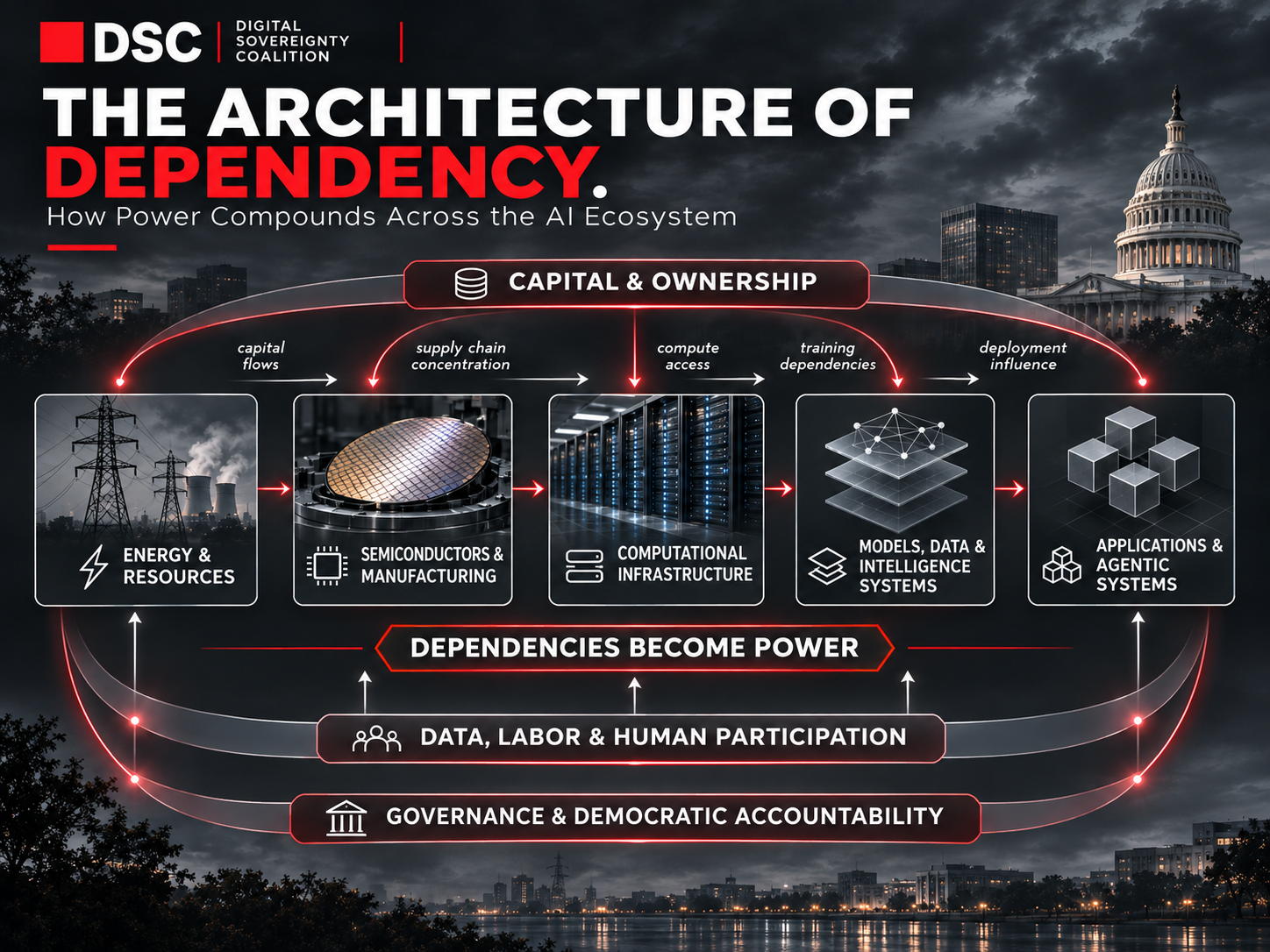
THE ARCHITECTURE OF DEPENDENCY
How Power Compounds Across the AI Ecosystem
Editorial illustration — structural diagram, not a record of verified transactions.
Technological capability does not exist in isolation. Each domain of the AI economy depends on resources, institutions, and relationships extending beyond its own boundaries. Ownership, financing, human participation, and governance operate across the entire system.
Read the diagram as a system, not an org chart. Energy constrains fabrication; fabrication constrains compute; compute constrains models; models constrain applications. The three cross-cutting systems — capital and ownership, data and labor, governance and accountability — do not sit at one layer. They reach through all five domains at once, which is precisely why dependency in them compounds.
DEPENDENCIES CAN BECOME SOURCES OF POWER.
Not every dependency creates control. A dependency becomes leverage under identifiable conditions: when the dependent party has no practical substitute; when switching costs are high enough to make exit unrealistic; when the supplier occupies a chokepoint that others must pass through; and when the relationship is opaque enough that the public cannot see it, let alone contest it.
INVESTIGATIVE HYPOTHESIS — Where those conditions hold simultaneously across multiple domains, dependency stops being a market position and starts functioning as governing power without a mandate. Testing that hypothesis domain by domain is the work of the sections that follow.
THE ARCHITECTURE, AS STRUCTURE — ACCESSIBLE VERSION
ENERGY & RESOURCES — depends on the domains beneath it.
SEMICONDUCTORS & MANUFACTURING — depends on the domains beneath it.
COMPUTATIONAL INFRASTRUCTURE — depends on the domains beneath it.
MODELS, DATA & INTELLIGENCE SYSTEMS — depends on the domains beneath it.
APPLICATIONS & AGENTIC SYSTEMS — depends on the domains beneath it.
CAPITAL & OWNERSHIP — Who funds each domain, who owns the result, and where contractual dependency substitutes for ownership.
DATA, LABOR & HUMAN PARTICIPATION — Whose data trains the systems, whose labor maintains them, and who participates in — or is excluded from — building them.
GOVERNANCE & DEMOCRATIC ACCOUNTABILITY — Which laws, regulators, and constitutional constraints reach each domain — and which they do not.
SECTION 03
WHO FINANCES INTELLIGENCE?
The Capital, Ownership, and Public Subsidy Behind the AI Economy
Editorial illustration — visual argument, not a record of verified financial relationships.
REPORTED — The capital behind the AI economy flows through several distinct channels at once: venture capital and growth equity chasing frontier laboratories; private credit and infrastructure finance underwriting data centers; strategic corporate investment from the same hyperscalers that sell compute; sovereign wealth funds from multiple jurisdictions; government contracts; and public subsidy programs for domestic semiconductor manufacturing such as the CHIPS and Science Act.
The channels differ in the leverage they create, not merely in their size:
Equity investment — ownership, board influence, and information rights.
Contractual dependency — compute credits, cloud commitments, and revenue-share arrangements that bind startups to suppliers without transferring ownership.
Debt and infrastructure finance — data centers financed like utilities, with lenders attached to physical assets.
Public subsidy and procurement — taxpayer money flowing in through grants, tax credits, and government contracts.
Sovereign wealth — state-linked capital from multiple jurisdictions participating in private AI markets.
DSC ANALYSIS — The central question is not whether AI is well financed — it visibly is — but what forms of leverage financing can create. An investor who supplies the capital, the compute the capital is spent on, and the distribution channel the resulting product needs, occupies three positions at once. Ownership is only the most visible of them.
PRIMARY SOURCE — Distinguish carefully between ownership and contractual dependency. A company can be formally independent while its compute, its distribution, and its next funding round all depend on a single counterparty's continued goodwill. Formal ownership charts understate concentration; contract terms, not cap tables, often carry the operating leverage.
THE CENTRAL QUESTION
WHO FINANCES ARTIFICIAL INTELLIGENCE, AND WHAT FORMS OF ECONOMIC OR INSTITUTIONAL LEVERAGE CAN FINANCING CREATE?
SECTION 04
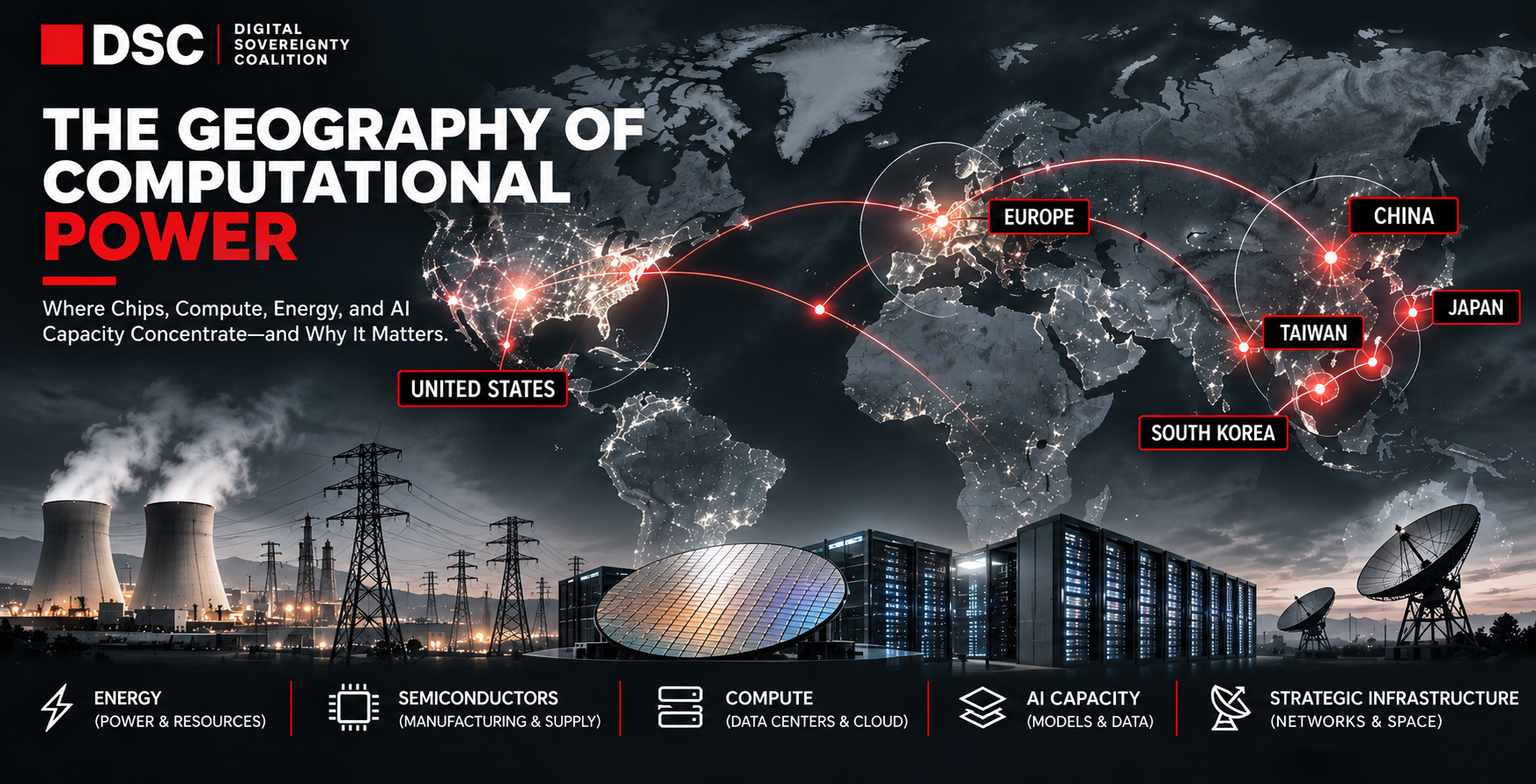
THE GEOGRAPHY OF COMPUTATIONAL POWER
Where Chips, Compute, Energy, and AI Capacity Concentrate — and Why It Matters
CONCEPTUAL ILLUSTRATION — NOT A GEOSPATIAL DATASET.
REPORTED — The geography of AI capability is sharply uneven. The United States leads in frontier model development and hyperscale cloud infrastructure. Taiwan fabricates the large majority of the world's most advanced logic chips. The Netherlands supplies the extreme-ultraviolet lithography equipment on which leading-edge fabrication depends. South Korea and Japan hold critical positions in memory and manufacturing materials. China is racing to build a self-sufficient stack under export-control pressure. The Gulf states are converting energy wealth into compute. And most of the world's population lives in regions with little advanced computing capacity at all.
Concentration looks different at each layer of the stack:
1.Semiconductor design — concentrated in a handful of firms headquartered largely in the United States.
2.Semiconductor manufacturing — concentrated in Taiwan, with emerging capacity in the United States, Japan, and elsewhere.
3.Manufacturing equipment — dominated by a small number of suppliers, most critically in lithography.
4.Advanced packaging and memory — concentrated in East Asia.
5.Energy infrastructure — local by nature; every data center inherits its grid.
6.Hyperscale computing — concentrated among a few operators with global footprints.
7.Frontier model development — concentrated in a small set of laboratories.
8.Public research capacity — unevenly distributed across and within nations.
DSC ANALYSIS — Interdependence is not inherently vulnerability. Deep supply chains have made the global economy more capable, not less. The distinguishing question is whether a dependency is reciprocal — each side needs the other — or asymmetric, where one side can exit cheaply and the other cannot. Asymmetric dependencies in critical infrastructure are where digital sovereignty is won or lost.
THE CENTRAL QUESTION
CAN NATIONS EXERCISE MEANINGFUL DIGITAL SOVEREIGNTY WHEN ESSENTIAL COMPUTATIONAL CAPABILITIES DEPEND ON INFRASTRUCTURE BEYOND THEIR CONTROL?
SECTION 05
WHO GETS TO BUILD THE FUTURE?
Capital, Access, and the Unequal Path to the AI Economy
Editorial illustration — visual argument, not a demographic dataset.
REPORTED — Access to the AI economy is structured long before anyone writes a line of code. It is structured by who can raise venture capital; who can afford advanced computing; who has broadband; who can reach technical education and research laboratories; and who holds the institutional sponsorship — universities, corporations, and professional networks — that converts talent into participation.
REPORTED — These disparities track documented inequalities of geography, wealth, race, ethnicity, gender, disability, and institutional access. Black, Latino, Asian, Indigenous, rural, and low-income communities remain underrepresented in technical AI development relative to their share of the population — while being overexposed to AI systems as subjects of prediction, scoring, and surveillance. Rural broadband gaps and under-resourced school systems compound the pattern locally. No community is homogeneous, and none of these conditions is fixed; they are structural, which means they can be changed.
Indigenous nations assert a distinct position: data sovereignty. REPORTED — Principles such as the CARE framework — collective benefit, authority to control, responsibility, and ethics — articulate governance of data about peoples, lands, and resources as an inherent right of tribal nations, not a courtesy extended by platforms.
DSC ANALYSIS — Unequal participation matters for reasons beyond fairness. The people who build AI decide what it optimizes for, what it sees, and what it ignores. This investigation does not claim that demographic representation alone determines a system's social impact — technical design, incentives, and oversight matter independently — but a field whose builders do not resemble the governed is structurally less likely to anticipate harms to the governed.
THE CENTRAL QUESTION
IF ACCESS TO CAPITAL, EDUCATION, AND COMPUTATION IS UNEQUAL, WHO GETS TO DECIDE WHAT ARTIFICIAL INTELLIGENCE IS BUILT TO SERVE?
SECTION 06
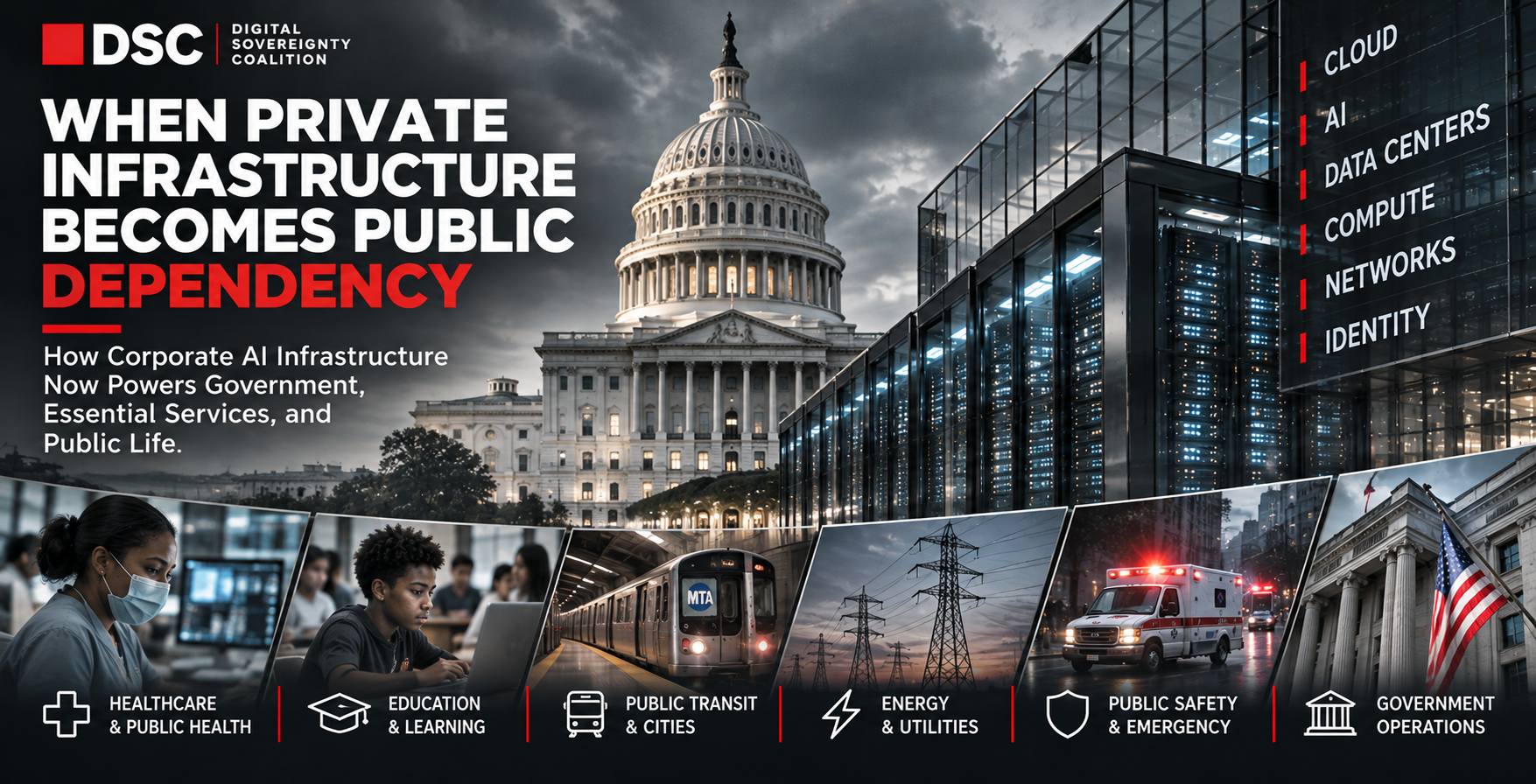
WHEN PRIVATE INFRASTRUCTURE BECOMES PUBLIC DEPENDENCY
How Corporate AI Infrastructure Powers Government, Essential Services, and Public Life
Editorial illustration — visual argument, not a record of verified government contracts.
REPORTED — Governments at every level now run essential services through systems they do not own: healthcare administration, education platforms, transit and city operations, energy management, public safety, and core government operations increasingly depend on commercial cloud and AI infrastructure.
Healthcare & Public Health
Education & Learning
Public Transit & Cities
Energy & Utilities
Public Safety & Emergency Services
Government Operations
DSC ANALYSIS — Precision matters here. Public ownership, private ownership, commercial service provision, public procurement, public-private partnerships, and operational dependency are different arrangements with different accountability structures. Government retains regulatory authority over private infrastructure, and constitutional obligations bind government actors regardless of who builds the system. Private provision of public infrastructure is not inherently unlawful or unconstitutional — but dependency changes the questions citizens can practically ask.
The characteristic risks of operational dependency are identifiable:
Vendor lock-in that outlives the officials who approved the contract.
Service interruption propagating from a private outage into a public emergency.
Constrained interoperability that makes exit costly long after problems appear.
Contractual opacity that shields terms from public scrutiny.
Oversight gaps where accountability depends on information agencies cannot obtain.
CONSTITUTION BEFORE CAPABILITY.
DSC ANALYSIS — Advanced technical capability must remain subject to democratic accountability, lawful oversight, civil rights protections, and meaningful institutional remedies. Capability that arrives faster than accountability is not modernization; it is a transfer of governing discretion to parties no one elected.
THE CENTRAL QUESTION
WHAT HAPPENS WHEN PUBLIC INSTITUTIONS BECOME DEPENDENT ON TECHNOLOGICAL SYSTEMS THEY DO NOT OWN, CANNOT FULLY INSPECT, AND MAY STRUGGLE TO REPLACE?
SECTION 07
THE SCARCITY REGIME TRIANGLE
Energy, Hardware, Software — and the Difference Between Physical and Manufactured Scarcity
DSC ANALYSIS — DSC's Energy–Hardware–Software framework holds that constraint in the AI economy concentrates at three vertices: the energy that powers computation, the hardware that performs it, and the software stack that directs it. Scarcity at any vertex disciplines every participant downstream of it.
The triangle matters because not all scarcity is physical. REPORTED — Genuine constraints exist: leading-edge fabrication capacity, advanced packaging, and grid interconnection are real bottlenecks with real lead times. But scarcity is also manufactured: allocation decisions, export-control regimes, exclusive supply agreements, and deliberate underinvestment can reproduce the effects of physical scarcity without any physical limit.
INVESTIGATIVE HYPOTHESIS — The exercise of power in the AI economy can be read as the management of scarcity — deciding which constraints are relieved, for whom, and on what terms. A regime that controls scarcity at even one vertex holds leverage over every actor that cannot substitute around it.
SECTION 08
THE SINGULARITY OF CONTROL
When Concentration Aligns Across Domains
DSC ANALYSIS — The preceding sections describe concentration in individual domains. This section asks about the compound case: the conditions under which ownership, investment, technical dependency, and institutional leverage could align in the same hands or the same network.
The identifiable conditions of compound concentration:
Ownership or decisive influence across more than one domain.
Position on both sides of a market — supplier, customer, and competitor simultaneously.
Financial dependencies that make counterparty defection economically irrational.
Contractual lock-ins that survive leadership changes and procurement cycles.
Institutional access that shapes the rules under which everyone else competes.
INVESTIGATIVE HYPOTHESIS — The meaningful unit of power in AI may not be the company but the network: overlapping boards, shared investors, reciprocal dependencies, and aligned incentives that no single antitrust docket is designed to see.
SECTION 09
THE CIVIC RESPONSE
Plurality, Civic AI, and Civic Machina
DSC ANALYSIS — The Plurality of Digital Sovereignty is DSC's answer to concentrated architecture: sovereignty is not one actor replacing another, but a distribution of capability — civic, municipal, cooperative, and individual — such that no single failure can capture the whole.
Civic AI is the principle that artificial intelligence can be built to serve democratic participation: transparent about its limits, accountable to its communities, and subordinate to constitutional authority. It is a design commitment before it is a product category.
Civic Machina is DSC's proposed conceptual architecture for operationalizing these commitments — a civic capability, not a commercial one. Distinguish proposals from operational capabilities: what DSC proposes is a framework under development and public debate, not a deployed system, and it should be evaluated as such.
The civic response mirrors the dependency analysis: if dependency compounds across domains, so must the response. Energy policy, industrial policy, procurement law, education, and constitutional oversight are one problem seen from five directions.
SECTION 10
EVIDENCE, SOURCING, AND FURTHER INVESTIGATIONS
How to Read This Investigation
This investigation applies DSC's evidence-labeling discipline throughout. Statements are marked by their epistemic status so readers can weigh them accordingly:
LIMITATIONS — This investigation is a structural framework, not a comprehensive audit. It does not attempt a complete census of AI infrastructure, it does not assert financial amounts or ownership percentages beyond documented public records, and several of its research questions remain open. Where DSC's affiliated investigations have verified specific findings, they are linked below; this page supplies the connective architecture, not duplicate case files.
PRIMARY SOURCE — official records: statutes, regulations, court filings, procurement documents, and company disclosures.
COMPANY STATEMENT — claims made by the companies under examination, evaluated rather than accepted.
REPORTED — factual assertions supported by credible independent reporting.
DSC ANALYSIS — synthesis and interpretation by Digital Sovereignty Coalition.
INVESTIGATIVE HYPOTHESIS — an open question DSC is investigating; not an established finding.