NEO-MEDIA · AREA 5
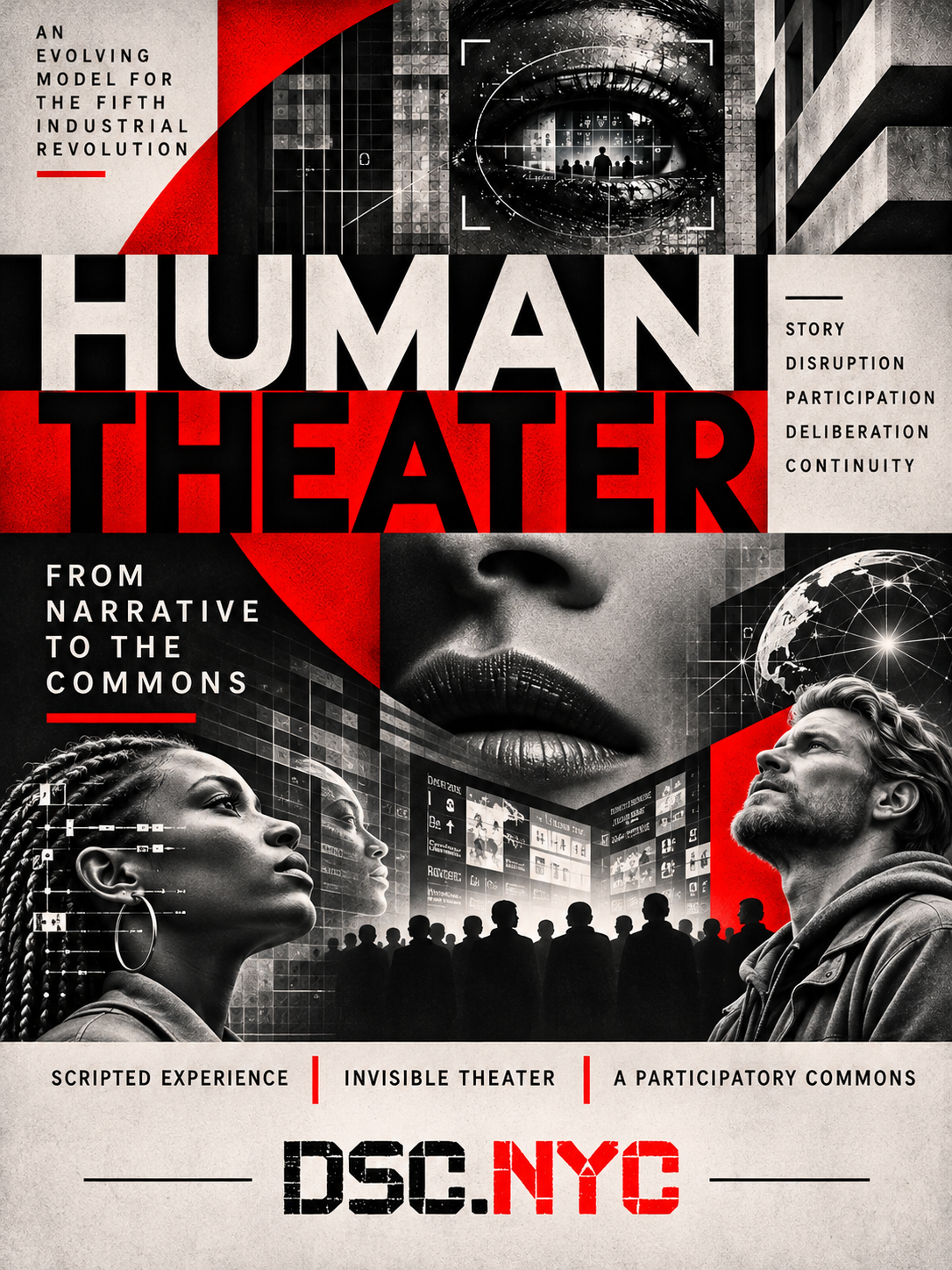
HUMAN THEATER
WHERE CIVIC RESEARCH MEETS HUMAN EXPERIENCE.
HUMAN THEATER is Digital Sovereignty Coalition's developing cultural and participatory theater initiative, connecting civic research with artistic exploration, public dialogue, and shared human experience.
Its developing methodology begins with scripted narrative, draws upon established theatrical techniques including Invisible Theater, and explores the transition from conventional performance into a participatory Commons.
As the experience unfolds, techniques associated with Invisible Theater may emerge — gradually challenging conventional distinctions between audience members and performers. The theatrical experience ultimately transitions toward the Commons, an environment in which audience members are invited to participate in discussion, examine conflicting perspectives, and consider the consequences of the choices presented.
Participation is voluntary. The objective is not to manufacture consensus, direct political outcomes, or manipulate audiences into predetermined positions. It is to create conditions for meaningful inquiry.
As AI-generated performances become increasingly sophisticated, live theater offers a fundamentally different artistic and social experience.
Performers and audiences share physical space, time, vulnerability, spontaneity, and the possibility of direct human interaction.
Synthetic media may reproduce the appearance of human performance, but it does not literally reproduce the shared physical presence of human performers and audiences.
This distinction does not make one medium inherently superior. It establishes the importance of preserving spaces where human expression and participation remain central.
Live theater can also support civic dialogue, shared reflection, and participatory storytelling.
SCRIPTED NARRATIVE → INVISIBLE THEATER TECHNIQUES → PARTICIPATORY COMMONS → CONTINUED CIVIC ENGAGEMENT
SECTION I
WHAT THEATER PRESERVES
Live performance is defined by its irreproducibility. Each performance is singular — shaped by the specific people present, the specific moment, and the specific conditions of that encounter.
This is not a limitation. It is the condition that makes live theater meaningful in a way that recorded or synthetic media cannot replicate.
The audience is not a passive receiver. Their presence, attention, and response are part of the performance. The relationship between performer and audience is mutual and real.
As synthetic media becomes more sophisticated, the cultural value of this irreproducibility may increase rather than diminish. The rarity of genuine shared human presence becomes more significant when alternatives are abundant.
SECTION II
THEATER & CIVIC LIFE
Theater has historically served civic functions beyond entertainment. It has been a space for examining difficult questions, representing marginalized perspectives, and creating shared experiences of moral complexity.
These functions are not incidental. They reflect theater's capacity to create conditions for genuine human reflection — conditions that are difficult to replicate in algorithmically curated media environments.
Participatory and community-based theater forms extend this further, inviting audiences into the creative process itself. The boundary between performer and participant becomes permeable.
In a media environment increasingly shaped by synthetic content and personalized distribution, spaces for unmediated human encounter and collective reflection carry particular civic significance.
SECTION III
COMMONS ZERO: PREDICTIVE DISSENT
COMMONS ZERO: PREDICTIVE DISSENT is an independent theatrical production in development by BLKMKT Theater, separate from Digital Sovereignty Coalition.
COMMONS ZERO: PREDICTIVE DISSENT is an independently developed creative property — an original theatrical work created by Everett Kelsey and developed through BLKMKT THEATER — that examines the societal consequences of artificial intelligence, robotics, surveillance, predictive technologies, and the increasing concentration of technological power.
The narrative provides the dramatic foundation. Human Theater provides the developing framework for exploring how the narrative might evolve into participatory civic inquiry. The Commons provides a potential environment for continued engagement beyond the dramatic performance.
CZPDT is an independently developed creative property. BLKMKT THEATER is the proposed independent creative-development and theatrical production identity. Digital Sovereignty Coalition contributes the civic research, ethical framework, and public-education perspective. Human Theater is a developing interdisciplinary initiative within DSC's broader civic and media research environment.
SECTION IV
INDEPENDENT CREATION. SHARED INQUIRY.
HUMAN THEATER and BLKMKT THEATER occupy distinct but complementary roles.
HUMAN THEATER is part of Digital Sovereignty Coalition's civic research and public education ecosystem. BLKMKT THEATER is an independent creative production entity operating outside DSC.
COMMONS ZERO: PREDICTIVE DISSENT, an original theatrical work created by Everett Kelsey and developed through BLKMKT THEATER, explores constitutional, technological, and human questions that also inform DSC's civic investigations.
The relationship is reciprocal. Research developed through DSC.NYC may inform the questions explored through theatrical storytelling. In turn, creative development, performance, and future audience dialogue may generate new questions for civic research.
This relationship does not make CZPDT a DSC-owned or DSC-produced theatrical work. Neither institution automatically controls the other's intellectual property, editorial decisions, or production activities.
SECTION V
RELATED DSC INITIATIVES
DSC's proposed Living Commons framework is designed to support public dialogue, collective inquiry, civic education, and democratic engagement — conceived as a flexible framework that may operate across universities, community organizations, public forums, cultural institutions, and future digital civic environments, beyond any single artistic medium. HUMAN THEATER represents one potential setting in which Living Commons methodologies may be explored through theatrical experiences and audience participation. The two initiatives share an interest in human agency, democratic accountability, and meaningful participation, but retain distinct purposes — neither owns, governs, or encompasses the other.
CIVIC FIREWALL is a separate, forthcoming DSC podcast focused on long-form civic inquiry. HUMAN THEATER may explore related questions through cultural and participatory experiences. The two initiatives remain independent: involvement in one does not imply participation in the other.
CIVIC FIREWALL →SECTION VI
FROM THE STAGE TO THE COMMONS
Developing Human Theater Through Interdisciplinary Research and Creative Experimentation
The challenges presented by emerging technologies do not belong to any single academic discipline. Artificial intelligence, predictive systems, robotics, surveillance, and increasingly autonomous technologies raise questions that are simultaneously technical, philosophical, constitutional, cultural, and deeply human.
Human Theater explores whether immersive dramatic storytelling can bring these questions into a shared environment where individuals are invited not merely to observe their consequences, but to examine them together.
Its developing methodology begins with scripted narrative, draws upon established theatrical techniques including Invisible Theater, and explores the transition from conventional performance into a participatory Commons.
Within this environment, audiences may encounter competing perspectives, examine ethical and civic dilemmas, and participate voluntarily in the broader inquiry initiated by the story.
The objective is not to tell audiences what to think. It is to create an experience that encourages them to think, question, challenge, and participate.
THEATRICAL FOUNDATIONS — FROM AUGUSTO BOAL TO HUMAN THEATER
A
Theatrical Foundations
Human Theater does not emerge in an artistic vacuum.
Its developing methodology acknowledges a significant tradition of participatory theatre, particularly the work of Brazilian theatre practitioner Augusto Boal (1931–2009), whose Theatre of the Oppressed challenged conventional distinctions between performers and audiences.
Developed beginning in the twentieth century’s latter decades and influenced by educator Paulo Freire, Theatre of the Oppressed explored how theatrical experiences could become environments for examining social conditions, power relationships, and possibilities for collective action.
Central to Boal’s approach was the concept of the spect-actor: an audience member who moves beyond passive observation to participate actively in the dramatic process.
Rather than simply witnessing a conflict unfold, participants could explore alternative responses, test decisions, and confront the circumstances shaping the experiences represented onstage.
Boal’s theatrical practices included several approaches particularly relevant to Human Theater.
FORUM THEATRE
A participatory dramatic process in which audiences may intervene in theatrical scenarios, explore alternative choices, and examine the consequences of different actions.
INVISIBLE THEATRE
A technique in which rehearsed dramatic situations unfold within everyday environments without initially being identified to observers as theatrical performances, prompting spontaneous responses to situations presented as real.
LEGISLATIVE THEATRE
An approach extending participatory theatre toward public deliberation and the development of legislative proposals, connecting dramatic experimentation with institutional and civic processes.
These techniques belong to an established theatrical tradition. Human Theater acknowledges their historical development rather than claiming their invention.
Reference: Augusto Boal, Theatre of the Oppressed. See also: https://en.wikipedia.org/wiki/Theatre_of_the_Oppressed
B
From Participatory Theatre to Technological Self-Determination
Human Theater proposes to explore how established participatory theatrical methods might be adapted to the emerging conditions of the Fifth Industrial Revolution.
Artificial intelligence, predictive governance, autonomous systems, computational identity, digital surveillance, and the increasing concentration of technological power create dilemmas that are often difficult to understand through conventional public discourse alone.
These systems increasingly influence decisions about employment, opportunity, access to services, personal identity, political participation, and individual freedom.
Human Theater explores whether immersive narrative experiences can make these otherwise abstract structures more understandable through human characters, dramatic conflicts, and shared participation.
Where Theatre of the Oppressed examined power relationships and opportunities for social transformation, Human Theater proposes to examine how people might better understand and exercise agency within technological systems that increasingly shape their lives.
Its proposed methodology brings together scripted storytelling, interdisciplinary research, selected participatory theatrical practices, and an evolving civic Commons.
The Commons is envisioned as a setting in which audiences may examine the constitutional, ethical, technological, and human questions raised by the narrative.
Its purpose is not to impose conclusions.
It is to create opportunities for people to question systems of power, examine competing perspectives, and consider what meaningful human agency requires in an increasingly algorithmically governed society.
C
The Ethics of Participation
Human Theater also recognizes that participatory performance raises important ethical questions.
Some historical forms of Invisible Theatre deliberately concealed the theatrical nature of an event from those who encountered it.
Human Theater’s development must therefore confront questions of informed consent, transparency, audience autonomy, and the ethical boundaries of immersive participation.
Surprise, dramatic disruption, and audience engagement must not become justifications for coercion, humiliation, exploitation, or manipulation.
Any application of theatrical techniques that deliberately obscures the distinction between staged performance and real events requires particular scrutiny.
Human Theater’s developing approach should protect the voluntary nature of participation, provide appropriate safeguards, and ensure that audiences retain meaningful agency over their involvement.
This commitment reflects a broader principle guiding Digital Sovereignty Coalition:
PARTICIPATION IS NOT CONSENT.
The distinction is fundamental. Human Theater seeks to investigate systems of technological power without reproducing the coercive or manipulative practices it examines.
D
An Evolving Methodology
Human Theater remains an experimental framework, not a completed or academically validated theatrical methodology.
Its proposed contribution lies in the interdisciplinary relationship between immersive storytelling, emerging technologies, democratic accountability, constitutional rights, and sustained civic inquiry.
Its foundational creative exploration, COMMONS ZERO: PREDICTIVE DISSENT, provides one potential environment in which these questions may be investigated through dramatic development and theatrical experimentation.
The narrative initiates the inquiry.
Participation expands the conversation.
The Commons creates the possibility of continuing that inquiry beyond the performance.
AN INTERDISCIPLINARY DEVELOPMENT MODEL
Human Theater is being explored as a collaborative research and creative-development initiative bringing together perspectives from:
- Performing Arts & Creative WritingDramatic structure, character development, performance, audience interaction, and experiential design.
- Political ScienceDemocratic governance, constitutional protections, national security, surveillance, and civil liberties.
- PhilosophyArtificial intelligence ethics, consent, free will, human autonomy, and moral responsibility.
- Computer ScienceArtificial intelligence, predictive systems, interactive environments, and emerging technological capabilities.
- Media Studies & CommunicationDigital culture, information ecosystems, narrative influence, multimedia storytelling, and public engagement.
Through student research, faculty engagement where available, creative workshops, and interdisciplinary experimentation, the initiative seeks to examine how theatrical experiences might support civic understanding and dialogue. The development model remains exploratory.
COMMONS ZERO: THE FOUNDATIONAL PROJECT
COMMONS ZERO: PREDICTIVE DISSENT provides the foundational narrative for exploring this approach.
Set against the accelerating transformation of society by artificial intelligence and emerging technologies, the project follows characters confronting questions of individual freedom, technological dependency, corporate power, surveillance, and democratic accountability.
Rather than ending exclusively with the resolution of the dramatic narrative, the proposed experience explores how the story might become an entry point into a participatory Commons.
The Commons is not an obligation imposed upon an audience. It is an invitation to continue the inquiry.
DIGITAL SOVEREIGNTY
Meaningful individual and collective agency over our digital lives.
CONSTITUTION BEFORE CAPABILITY
The principle that technological advancement must remain accountable to constitutional rights, democratic institutions, and human freedom.
Together, these principles provide a civic foundation for exploring the relationship between technological progress and human self-determination.
UNIVERSITY COLLABORATION & FUTURE DEVELOPMENT
Human Theater is exploring opportunities for interdisciplinary academic collaboration that bring together students, faculty, researchers, and creative practitioners.
The aspiration is to establish a development model that investigates the intersection of immersive storytelling, emerging technologies, and civic participation.
Such collaborations could support narrative research, theatrical experimentation, audience-engagement design, and exploratory workshops.
The longer-term ambition is to develop a methodology capable of informing future theatrical productions, educational experiences, and community-based civic dialogue.
These opportunities remain exploratory. No formal institutional partnerships or production commitments are implied.
THE NARRATIVE BEGINS THE INQUIRY. THE COMMONS CARRIES IT FORWARD.
RESEARCH INFORMS THE STAGE. THE STAGE DEEPENS THE INQUIRY.
HUMAN THEATER IS NOT A RETREAT FROM THE FUTURE. IT IS A REMINDER OF WHAT THE FUTURE MUST PRESERVE.
CONTINUE EXPLORING NEO-MEDIA