THE FUTURE AT STAKE / CORNERSTONE INVESTIGATION
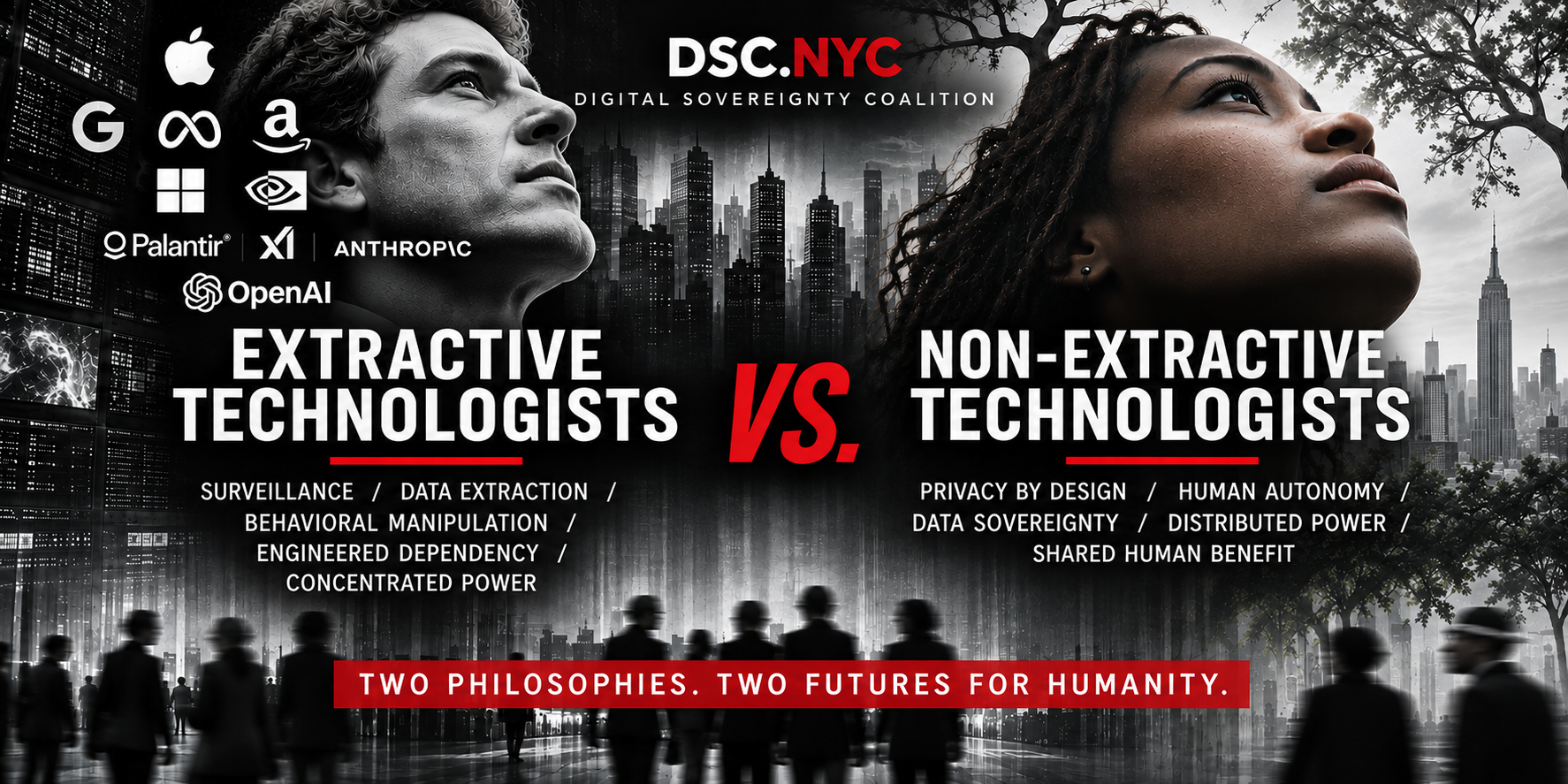
THE FUTURE AT STAKE · CORNERSTONE INVESTIGATION
EXTRACTIVE VS.
NON-EXTRACTIVE
TECHNOLOGISTS
Two Philosophies. Two Futures for Humanity.
TWO PHILOSOPHIES. TWO FUTURES FOR HUMANITY.
Humanity stands at a technological crossroads.
Artificial intelligence, computational infrastructure, predictive systems, robotics and increasingly autonomous digital agents possess extraordinary potential to improve the human condition. They could accelerate scientific discovery, expand educational opportunity, improve healthcare, strengthen democratic institutions and liberate human beings from generations of unnecessary labor.
But technological capability does not determine technological morality.
The same intelligence that can empower humanity can be used to monitor it. The same infrastructure that can connect communities can render them dependent. The same predictive systems that can prevent harm can be deployed to anticipate, manipulate and restrict human behavior.
The distinction lies not simply in what technology can accomplish, but in the philosophy governing its development, ownership, deployment and accountability.
Digital Sovereignty Coalition identifies two competing technological philosophies:
Extractive Technologists and Non-Extractive Technologists.
One treats humanity primarily as a source of value to be captured.
The other recognizes humanity as the rightful beneficiary of technological advancement.
These are not immutable categories of people. They are competing approaches to innovation, power, ownership and responsibility. Individuals and institutions may embody elements of both, and their conduct may change over time.
The future will be shaped by which philosophy becomes embedded within the infrastructure of civilization.
WHAT IS AN EXTRACTIVE TECHNOLOGIST?
An Extractive Technologist is an individual, institution or organization whose technological practices systematically capture value from human beings, communities or public resources while disproportionately concentrating the resulting wealth, intelligence or power.
Extraction can take many forms.
It may involve personal information, behavioral patterns, intellectual property, creative labor, biometric identifiers, emotional vulnerabilities, attention, public infrastructure or natural resources.
It becomes particularly concerning when the people generating that value lack meaningful knowledge, consent, compensation, control or recourse.
The defining characteristic is not profitability.
It is the imbalance between what is taken, what is returned and who retains control.
A technology company can provide genuinely useful products while simultaneously operating extractive business models. Innovation and exploitation are not mutually exclusive.
The existence of a benefit does not automatically legitimize the conditions under which that benefit is provided.
WHAT IS A NON-EXTRACTIVE TECHNOLOGIST?
A Non-Extractive Technologist develops and deploys technology according to principles that prioritize human dignity, autonomy, privacy, reciprocity and accountable innovation.
Non-extractive technology does not prohibit commercial enterprise, investment, intellectual property or financial success.
It rejects the proposition that technological advancement requires the systematic surrender of human rights.
A non-extractive technological philosophy recognizes that data may be necessary to deliver a service. Computational resources must be financed. Developers deserve compensation. Enterprises must remain economically sustainable.
But these necessities do not justify unlimited collection, indefinite retention, opaque behavioral manipulation or the engineering of dependency.
Non-extractive technologists build systems that remain accountable to the people they serve.
Comparative Framework
THE DISTINCTION IN PRACTICE
DIMENSION
EXTRACTIVE
NON-EXTRACTIVE
Data collection
Maximize collection; retain indefinitely
Collect only what is necessary; delete when no longer needed
Consent
Buried in terms of service; opt-out by default
Informed, meaningful, and revocable
Behavioral design
Engineered to maximize engagement and dependency
Designed to serve the user's genuine interests
Power concentration
Accumulate intelligence, infrastructure and market control
Distribute capability; resist monopoly formation
Accountability
Resist regulation; capture oversight institutions
Subject to democratic governance and independent audit
Labor
Externalize costs; exploit gig and ghost labor
Compensate fairly; recognize human contribution
Public infrastructure
Privatize public goods; extract rent from civic systems
Strengthen public infrastructure; share civic benefit
TWO PHILOSOPHIES.
TWO FUTURES FOR HUMANITY.
The question is not whether technology will shape the future. It will. The question is which philosophy will govern the technology that shapes it — and whether the people most affected by that technology will have any say in the answer.