00
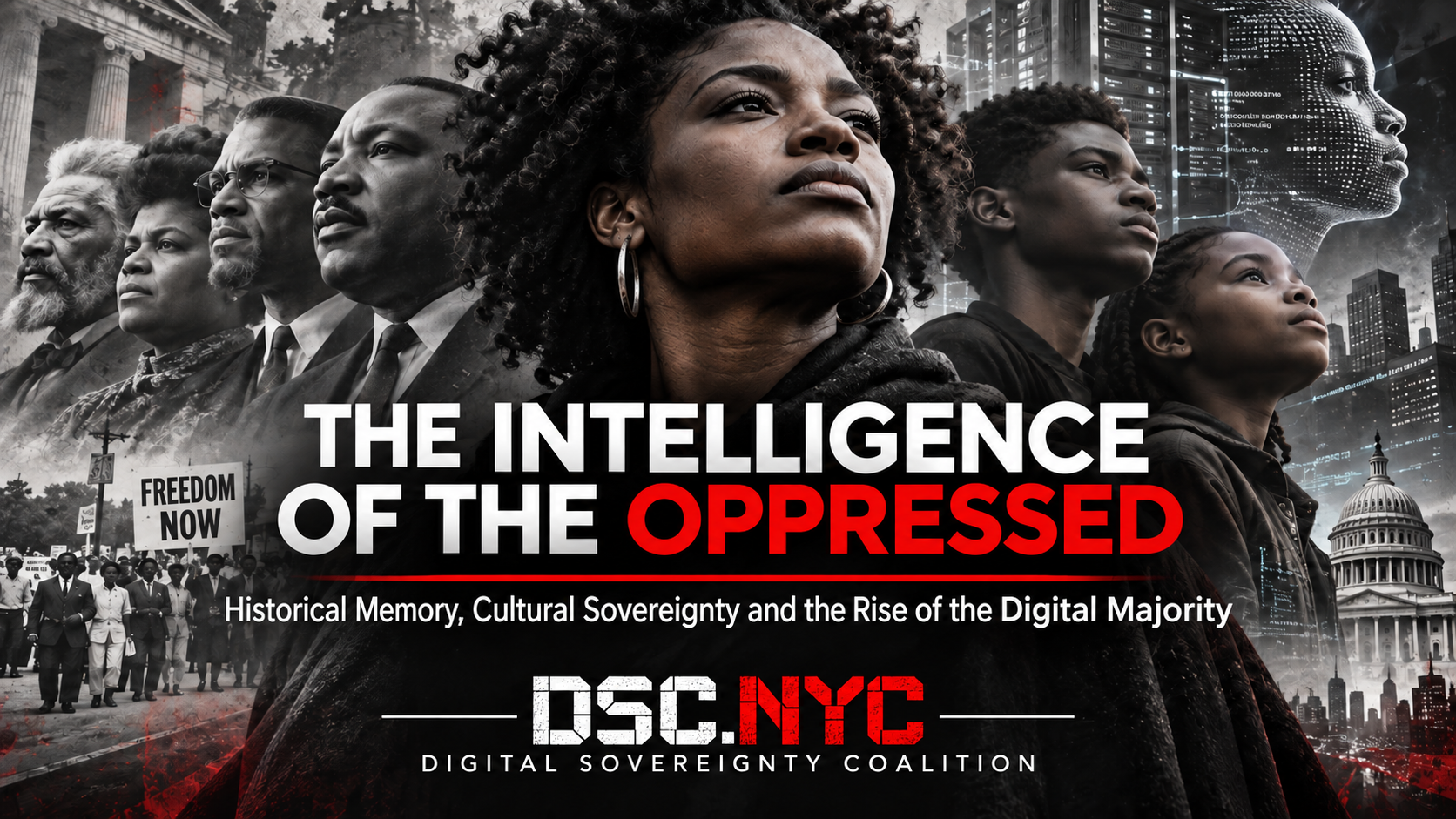
The Intelligence of the Oppressed
The ability to collect information is not equivalent to the ability to understand experience.
A society may possess extraordinary computational capacity and still misunderstand the people it governs. The ability to collect information is not equivalent to the ability to understand experience. A system can record a person's movements, purchases, associations and expressions while remaining ignorant of the historical conditions that make those actions intelligible. This distinction between observation and understanding is the starting point of this investigation.
Digital Sovereignty Coalition proposes Collective Experiential Intelligence (CEI) as a framework for examining the knowledge communities develop through lived experience, intergenerational memory, collective inquiry and institutional encounters. Historically oppressed populations are an especially important case because they have often had to study the operation of power as a condition of survival. Their knowledge is neither biological nor infallible. It is learned, disputed, transmitted and continually revised. The framework describes a capacity that may emerge under particular circumstances, not a hierarchy of human intelligence.
The African American experience provides a historical anchor. Du Bois's analysis of double consciousness and Ida B. Wells's investigative work illustrate different ways of understanding a society from a position that its dominant institutions frequently misunderstood or misrepresented [E01–E02]. One concerns the relationship between self-understanding and the social gaze; the other demonstrates the power of counter-evidence. Together they suggest that people subjected to institutional classification can also become investigators of the institutions classifying them.
The computational age introduces an asymmetry. Communities can disseminate their knowledge through digital networks, yet the networks can retain the resulting traces, rank their visibility and use them for commercial or administrative purposes. The possibility of extracting the knowledge of resistance while limiting the agency of its producers is the central problem. This is not a claim that every platform or government pursues that outcome. It is a hypothesis about what becomes possible when informational, economic and institutional power converge.
The inquiry proceeds from memory to agency: historical memory supports experiential intelligence; experiential intelligence can inform cultural sovereignty; communication can extend it into networked consciousness; collective deliberation can turn awareness into political agency; and durable rights and infrastructure can secure computational self-determination. None of these transitions is automatic. Each requires institutions, resources and the freedom to disagree.
Knowledge as a relationship, not a possession
The central unit of analysis should be the relationship between a knowing subject and the institution that acts upon that subject. Consider three different records of a disputed public decision: the administrative file, the affected person's account, and an independent reconstruction of the event. None is necessarily complete. The administrative file can establish what the agency recorded but not everything that occurred. Testimony can identify an omitted event but may require corroboration. An independent reconstruction can connect sources but depends on access and interpretive choices. Collective Experiential Intelligence (CEI) emerges when these differences become available for disciplined comparison rather than being resolved automatically in favor of the most powerful record keeper.
This distinguishes CEI from a claim about intelligence quotients or a general aptitude for reading people. A person may become highly knowledgeable about housing discrimination while having little knowledge of criminal procedure. Knowledge can be acquired through direct experience, instruction, archives or sustained attention to other people's testimony. The distinctive concern here is the loss of knowledge when institutional arrangements deny affected people the means to preserve, compare and act upon it. The proposed framework has four dimensions: acquisition, transmission, corroboration and agency. An archive without an audience may support transmission but not agency; a viral testimony may achieve visibility without corroboration. Neither is sufficient by itself.
A research program should compare institutions with similar decision functions but different channels for affected-party feedback. Researchers could examine whether independently verified complaints lead to changes in policy, whether correction rates differ by social position, and whether the institution communicates those changes to the people affected. Such a study would measure the conditions under which situated knowledge improves decisions, not rank populations by presumed intelligence. Consent, anonymity and community governance would be necessary, especially where testimony involves immigration status, policing or employment.
01
Privilege as an Epistemic Blindfold
Privilege can be understood in two registers. The familiar register concerns advantages: access to housing, education, capital, safety or institutional credibility. The second concerns exposure to knowledge. When a person is reliably protected from a particular harm, that person may receive fewer signals about how the harm operates. An institution may similarly mistake a favorable aggregate performance measure for universal fairness when people bearing the costs have little influence over the metric.
DSC calls this proposed mechanism the epistemic blindfold. It is relational, not a moral diagnosis of everyone occupying an advantaged position. Someone may be well positioned to understand one injustice and poorly positioned to understand another. Material advantage can also provide time, education and resources for investigation. Marginalization can generate insight but can equally produce exhaustion, uncertainty or enforced silence. The proposition is therefore conditional: insulation from consequences may weaken opportunities to detect those consequences unless deliberate practices correct the gap.
Standpoint epistemology supplies an important antecedent. Its variants examine how social position shapes inquiry and how critical reflection can expand the range of evidence available to a researcher. The DSC framework draws on this tradition while avoiding two errors: the claim that marginalized people are automatically more reliable knowers, and the claim that social position is irrelevant to what a person is likely to observe. The relevant question is not who is right by virtue of identity, but what evidence is available from different positions and how it can be compared and tested.
Institutional design can correct for the epistemic blindfold without requiring any individual to become a perfect knower. Feedback mechanisms, independent audits, complaint channels, and the inclusion of affected people in governance can supply information that insulated decision-makers are unlikely to generate on their own. The goal is not to replace expertise with grievance but to ensure that the evidence base for consequential decisions includes the experience of people who bear their costs.
Standpoint, evidence and institutional correction
Standpoint epistemology has generated substantial philosophical debate. DSC does not adopt any single version of the theory. The relevant claim is narrower: people who regularly encounter a particular institutional practice may accumulate observational evidence about it that people who rarely encounter it do not. This is an empirical proposition, not a metaphysical one. It can be tested by examining whether affected-party testimony, when systematically collected and corroborated, identifies patterns that administrative records miss.
The Church Committee's investigation of domestic intelligence abuses provides a historical illustration [E11]. The committee's findings documented surveillance practices that had not been visible in official accounts. The investigation required testimony from people who had been subjected to those practices, combined with documentary evidence and independent analysis. Neither testimony alone nor documents alone would have been sufficient. The combination produced a more complete account than either could supply separately.
An institutional correction program should identify the decisions most likely to be affected by the epistemic blindfold, establish channels for affected-party input that are accessible and protected from retaliation, and create review processes that compare administrative records with independent accounts. It should not assume that every complaint is accurate or that every institutional record is false. The objective is to improve the evidence base, not to replace one form of authority with another.
02
The African American Historical Experience
The African American historical experience provides the primary empirical anchor for this investigation. It is not the only relevant case, and the framework developed here is intended to apply more broadly. But the depth and documentation of this experience, and the intellectual traditions it has generated, make it an indispensable reference point.
Du Bois's concept of double consciousness describes the experience of perceiving oneself through the eyes of a society that regards one as a problem [E01]. This is not merely a psychological burden. It is also an epistemic condition: a person who must navigate two frameworks simultaneously may develop a more complex understanding of how social categories operate than a person who inhabits only one. The insight is not that double consciousness is desirable or that its costs are acceptable. It is that the experience of being classified can generate knowledge about the classifying institution.
Ida B. Wells's investigative journalism demonstrated a different dimension of this knowledge [E02]. Her documentation of lynching challenged the official narratives that justified it. She collected evidence, identified patterns, and published findings that contradicted the accounts of the institutions responsible for the violence. Her work illustrates the capacity of people subjected to institutional harm to become investigators of that harm — and the risks they face in doing so.
The history of African American intellectual and cultural production is not reducible to a response to oppression. It encompasses aesthetic traditions, philosophical contributions, scientific achievements and political thought that have their own internal logic and value. The claim here is not that adversity produces intelligence but that the experience of navigating hostile institutions can generate specific forms of knowledge about how those institutions operate. That knowledge has value beyond the communities that produced it.
Historical memory as civic resource
Historical memory is not simply the past. It is an active resource for interpreting the present. Communities that have experienced systematic institutional harm may develop frameworks for recognizing patterns that communities without that experience are less likely to identify. This is not a claim about biological inheritance or cultural determinism. It is a claim about the transmission of knowledge through education, narrative, archive and practice.
The preservation of historical memory requires institutions: archives, schools, community organizations, publications and oral traditions. These institutions are vulnerable to underfunding, suppression and neglect. When they are weakened, the knowledge they transmit is at risk. The computational age introduces new possibilities for preservation and new risks of loss. Digital archives can make historical records more accessible; they can also be subject to platform decisions about what to host, index and recommend.
A democratic approach to historical memory should support the institutions that preserve it, ensure that communities have meaningful control over their own archives, and resist the reduction of complex historical experience to simplified data categories. The goal is not to freeze history but to ensure that the people most affected by it have the resources to interpret and transmit it.
03
The Intellectual Architecture of Resistance
Resistance to institutional power requires more than individual courage. It requires intellectual infrastructure: frameworks for understanding what is happening, languages for communicating it, institutions for preserving and transmitting knowledge, and networks for coordinating action. The African American intellectual tradition has developed such infrastructure over generations, in conditions of systematic suppression.
The tradition includes philosophical analysis of the conditions of freedom and dignity, historical documentation of institutional violence and resistance, legal argument for constitutional rights, cultural production that preserves memory and imagines alternatives, and political theory of collective action. These are not separate domains. They are interconnected dimensions of a sustained effort to understand and transform the conditions of life.
The computational age does not make this infrastructure obsolete. It changes the conditions under which it operates. Digital networks can extend the reach of intellectual work and connect communities across geography. They can also subject that work to surveillance, algorithmic ranking and commercial extraction. The challenge is to use the new infrastructure without surrendering the intellectual independence that makes it valuable.
DSC proposes that the right to intellectual infrastructure is a component of digital rights. This includes the right to access knowledge without comprehensive behavioral surveillance, the right to communicate without compelled disclosure of identity, the right to preserve and transmit cultural memory without platform permission, and the right to participate in the governance of the systems that affect intellectual life.
From individual insight to collective knowledge
Individual insight becomes collective knowledge through processes of communication, corroboration and institutionalization. A person who observes an injustice may share that observation with others who can confirm, qualify or challenge it. Over time, a body of shared knowledge can develop that is more reliable than any individual account. This process requires trust, communication channels, shared frameworks and institutions that can preserve and transmit what has been learned.
The history of civil rights organizing illustrates this process. The SNCC's documentation of voter suppression, the NAACP's legal strategy, the Southern Christian Leadership Conference's mobilization of church networks, and the intellectual work of scholars and journalists all contributed to a collective understanding of the conditions of racial domination and the possibilities for change. No single institution or individual produced this understanding. It emerged from sustained collective inquiry.
Digital networks can support similar processes of collective knowledge production. They can also fragment them, subject them to surveillance and redirect them toward commercial ends. The design of digital infrastructure is therefore not a neutral technical question. It is a question about the conditions under which collective knowledge can be produced, preserved and acted upon.
04
From Historical Suffering to Cultural Innovation
Cultural production can perform epistemic work. A song may preserve historical memory, a novel may communicate experiences inaccessible to administrative records, and a performance may reveal the social rules that govern public behavior. Culture can also enable people to imagine institutions and identities beyond the ones imposed on them. Such works are not merely entertainment or evidence of adversity. They possess aesthetic and intellectual value in their own right.
The international circulation of African American culture illustrates the distinction between influence and control. An artist may change the vocabulary or aesthetic of an entire industry while retaining limited bargaining power over distribution. Audiences may embrace a cultural form without understanding the social conditions of its creators. The popularity of a work does not necessarily translate into equitable compensation, legal recognition or political solidarity.
Computational systems complicate these relationships. Digitized works can be copied, indexed, recommended and potentially included in training datasets. Their circulation may create opportunities for discovery and collaboration; it may also weaken attribution or bargaining power. No general conclusion about legality follows from the fact of digitization. Copyright, contractual permissions, public-domain status and fair use must be examined separately [E07].
A cultural sovereignty policy should therefore support creators without freezing culture into racial or national ownership categories. Communities need archives that preserve provenance, institutions that recognize contributors, fair contractual practices and the ability to set appropriate boundaries around sensitive knowledge. Exchange and borrowing can be legitimate and productive; extraction occurs when an actor takes disproportionate value or control while systematically undermining the agency of the source community.
Culture is not a dividend paid by oppression
The claim that adversity produces creativity risks making the harm appear necessary. An alternative explanation is that people create despite restrictive conditions, drawing on aesthetic traditions, available materials, collaboration and imaginative freedom. A musician's creative achievements should not be reduced to a response to discrimination. To do so would deny the artist the ordinary human capacity for invention and would obscure the cultural work that could have flourished in the absence of injustice.
A cultural economics study should follow a particular work through its life cycle: composition, recording, distribution, licensing, performance, adaptation and preservation. At each stage ask who owns the relevant rights, who provides labor, who receives payment and who has the power to refuse a new use. Recognition and compensation are distinct outcomes. A creator may be widely credited yet have little bargaining power; a work may generate substantial licensing revenue while its original community has little control over contextual presentation. Claims of extraction need evidence of actual contractual or governance asymmetry, rather than assumptions based on the identity of the audience.
The computational extension is a further stage in that life cycle. A digital recording can become training material, a search result, a recommendation signal or a source of stylistic imitation. These uses have different technical and legal properties. A useful research design would compare documented licensing arrangements with unlicensed collection and with genuinely public-domain material. It would distinguish a lawful use from an ethically contested use and both from an adjudicated infringement. The aim is not to stop cultural exchange, but to make the conditions of exchange intelligible and contestable.
05
Cultural Reclamation and the Right to Authorship
Reclamation is the effort to restore the visibility, context and authority of people whose contributions have been obscured. It includes recovering historical records, challenging misleading attribution, documenting creators and negotiating the terms of cultural circulation. Reclamation is not a claim that every expression belongs permanently to one community or that shared artistic traditions should cease to evolve.
Digital networks offer mechanisms for tracing provenance. A researcher can compare archival recordings, photographs, contemporaneous publications and oral testimony. A creator can publish documentation of a work's development and challenge a misleading attribution. But the same systems may reward short, decontextualized fragments that circulate more rapidly than corrections. A record's visibility can depend on ranking and monetization choices made by intermediaries.
DSC distinguishes four dimensions of authorship: factual attribution, legal entitlement, economic participation and interpretive authority. These dimensions overlap but do not coincide. A person may be the documented originator of a practice without holding an enforceable copyright in the practice itself. A community may have ethical claims regarding cultural context that exceed the protections of conventional intellectual property law. Conversely, attribution does not automatically authorize unrestricted control over all downstream uses.
The U.S. Copyright Office's AI initiative examines copyrightability and training-related issues, illustrating why these questions require careful legal analysis rather than blanket assertions [E07]. Indigenous data governance provides an additional, distinct model of collective authority [E08]. Its principles should be learned from, not appropriated as if they were interchangeable with ordinary individual copyright.
A practical reclamation infrastructure would combine provenance records, creator-controlled licensing, community archives and dispute resolution. It would avoid requiring every cultural contribution to be registered in a centralized identity database. The objective is not to make culture permanently traceable to every person who touches it; it is to give creators meaningful options for attribution, compensation, privacy and collective decision-making.
Reclamation, provenance and contested authority
Cultural reclamation concerns the recovery of attribution and context, not the assignment of ownership over every shared expression. A provenance record should identify the creator where known, dates and uncertainties, the chain of custody, and the conditions under which material may be reproduced. For collective traditions it may be impossible to identify a single author; authority may instead reside in a community or in a particular legal institution. The archive should represent that ambiguity honestly rather than invent an individual owner for administrative convenience.
The US Copyright Office's artificial intelligence research includes an analysis of generative AI training [E07]. Its legal analysis is not a blanket ruling that all training is infringement or all training is permitted. Copyright, contract, privacy and community governance address distinct interests. The question of whether an AI model reproduces protected expression is different from the question of whether people had meaningful influence over the collection of their cultural material. DSC can propose higher ethical standards than the current legal minimum while acknowledging the distinction.
A non-extractive cultural repository should offer granular access permissions, attribution records, negotiated licensing, correction channels, and a transparent process for reviewing downstream uses. It should not promise to revoke information that has already been lawfully distributed or to remove a particular influence from an existing model without a technically demonstrated mechanism. Where claims of revocation cannot be honored, the limits must be communicated before participation. The right to cultural sovereignty is meaningful only if institutions make realistic commitments about what their systems can do.
06
The Globalization of Historical Memory
Historical memory can travel across borders without making different communities identical. The African American freedom struggle has influenced movements for dignity and rights on every continent. That influence has operated through cultural exchange, political solidarity, intellectual borrowing and the shared experience of confronting institutional power. It has also been subject to misappropriation, selective citation and the erasure of its origins.
The SNCC's 1967 position on Palestine illustrates the complexity of international solidarity [E09]. The document is a historical record of one organization's position at a particular moment, not evidence of a uniform or permanent Black American political stance. Its circulation in contemporary debates requires careful attention to context, date and the diversity of opinion within the communities involved. Historical documents can be used to support claims their authors did not intend and would not endorse.
Digital networks accelerate the circulation of historical memory while reducing the friction that once required engagement with context. A photograph, a speech excerpt or a slogan can travel globally in seconds. The speed of circulation does not guarantee the accuracy of interpretation. Communities that have invested in preserving and interpreting their own history may find that digital circulation produces simplified or distorted versions of that history.
A democratic approach to the globalization of historical memory should support the institutions that preserve contextual knowledge, ensure that communities have meaningful input into how their history is represented in digital systems, and resist the reduction of complex historical experience to viral fragments. The goal is not to restrict the circulation of historical knowledge but to ensure that its circulation is accompanied by the context necessary for accurate interpretation.
Solidarity, borrowing and the ethics of citation
International solidarity requires honest engagement with difference. Communities that share an experience of institutional oppression do not necessarily share the same history, the same political analysis or the same strategic priorities. Solidarity built on the assumption of identity can collapse when differences become visible. Solidarity built on honest engagement with difference can be more durable.
The ethics of citation in political discourse requires attention to the difference between a historical document and a current position, between one organization's statement and a community's consensus, and between a position held at one moment and a position held over time. These distinctions are not merely academic. They affect the accuracy of political argument and the fairness of the communities being cited.
Digital archives can support more accurate citation by making primary sources accessible and by providing contextual information about their origins and reception. They can also enable the rapid decontextualization of historical material. The design of archival systems should prioritize contextual integrity: the principle that information should flow in ways consistent with the norms of the context in which it was originally produced.
07
The Networked Consciousness
Digital networks have created new possibilities for the formation and expression of collective consciousness. Communities that were previously isolated by geography, language or institutional barriers can now communicate, coordinate and develop shared frameworks for understanding their experience. This is a genuine expansion of human communicative capacity. It is also subject to the same asymmetries of power that affect other forms of communication.
The concept of networked consciousness refers to the capacity of communities to develop shared understandings through digital communication. It is not a claim that digital networks produce uniform consciousness or that online communities are equivalent to face-to-face ones. It is a claim that the conditions under which people form and express collective understanding have changed, and that those changes have consequences for the distribution of knowledge and power.
Algorithmic systems shape networked consciousness in ways that are not fully visible to the people they affect. Recommendation systems determine what content people encounter. Moderation systems determine what content remains visible. Ranking systems determine what content receives attention. These systems are not neutral. They reflect the priorities of the institutions that design them and the commercial incentives that fund them.
DSC proposes that the right to networked consciousness includes the right to communicate without comprehensive behavioral surveillance, the right to access diverse perspectives without algorithmic manipulation, the right to participate in the governance of the systems that shape public discourse, and the right to form and express collective understanding without compelled disclosure of identity.
From individual expression to collective understanding
Individual expression becomes collective understanding through processes of communication, response and synthesis. A person who shares an observation may receive responses that confirm, qualify or challenge it. Over time, a community may develop a shared framework for interpreting a class of experiences. This process requires communication channels, shared languages, trust and the freedom to disagree.
Digital networks can support these processes at unprecedented scale. They can also fragment them, subject them to surveillance and redirect them toward commercial ends. The design of digital infrastructure is therefore not a neutral technical question. It is a question about the conditions under which collective understanding can be formed, preserved and acted upon.
A democratic approach to networked consciousness should support the conditions under which communities can form and express collective understanding without compelled disclosure, commercial manipulation or algorithmic distortion. This requires attention to the design of communication systems, the governance of moderation and recommendation, and the protection of the right to communicate without comprehensive behavioral surveillance.
08
Experiential Intelligence Extraction
Experiential intelligence extraction refers to the process by which the knowledge communities develop through lived experience is converted into computational resources under conditions of diminished source agency or inequitable value capture. This is a proposed analytical framework, not an established empirical finding. Its application to specific cases requires evidence of actual extraction, not merely the presence of data collection.
The framework distinguishes three dimensions of extraction: informational, economic and epistemic. Informational extraction occurs when data generated by a community is collected and used without meaningful consent or compensation. Economic extraction occurs when the value generated by that data accrues primarily to the collecting institution rather than the source community. Epistemic extraction occurs when the knowledge embedded in that data is used to make decisions about the source community without its meaningful participation.
These dimensions can occur independently. A community may consent to data collection while receiving no economic benefit. A community may receive economic compensation while having no influence over how its knowledge is used. A community may participate in governance while the economic benefits flow elsewhere. A complete analysis of extraction must examine all three dimensions.
The legal framework for addressing extraction is incomplete. Privacy law addresses some forms of informational extraction but does not require equitable value distribution. Antitrust law addresses some forms of economic concentration but does not directly address epistemic governance. Civil rights law addresses some forms of discriminatory use but does not require participatory design. DSC proposes that a complete framework for digital rights must address all three dimensions of extraction.
Identifying extraction: evidence and method
Claims of extraction require evidence. The presence of data collection does not establish extraction. The absence of compensation does not establish extraction if the data was genuinely public or if the collection was genuinely consensual. The use of data for commercial purposes does not establish extraction if the source community had meaningful influence over the terms of use.
A research program should examine specific cases of data collection, identify the terms under which collection occurred, trace the economic value generated by that data, and assess the degree to which the source community had meaningful influence over collection, use and benefit distribution. It should distinguish cases where extraction is clearly documented from cases where it is plausible but unproven, and from cases where the evidence is insufficient to support a conclusion.
The Obermeyer et al. study of racial bias in a health care algorithm provides a model for this kind of analysis [E16]. The study identified a specific mechanism by which a proxy variable produced racially disparate outcomes, traced the mechanism to a specific design choice, and proposed a correction. It did not claim that all health care algorithms are biased or that all bias is intentional. It demonstrated a specific problem with specific evidence. That is the standard DSC should apply to claims of extraction.
09
The Computational Blindfold
The computational blindfold refers to a patterned restriction of access to relevant knowledge through computational selection or framing, with inadequate user agency. It is a proposed analytical framework, not a claim that every recommendation algorithm is designed to restrict knowledge or that every content moderation decision is discriminatory.
Four mechanisms deserve separate investigation: selection of available information, ranking of selected material, framing through summaries or labels, and feedback from user responses. Each can be beneficial in reducing overload or harmful when it systematically excludes relevant perspectives. A personalized feed is not inherently a blindfold. The term should apply when measurable restrictions impair access to material needed for independent judgment and the user lacks meaningful visibility or control over the restriction.
Noble's work on search and Benjamin's work on technological inequality offer precedents for understanding non-neutral information systems [E05–E06]. Human Rights Watch documented moderation problems affecting Palestine-related expression, while Meta commissioned BSR to evaluate its human-rights impacts during the May 2021 escalation [E13–E14]. These sources support investigation of moderation outcomes and institutional processes, not the conclusion that every removal is discriminatory or every distribution change intentional.
A research program should compare matched content across language, geography and account conditions; distinguish moderation from recommendation; record legitimate safety constraints; and examine whether appeals restore visibility. It must protect test participants and avoid exposing vulnerable speakers. The strongest study would establish a baseline and publish methods, uncertainty and counterexamples.
Proposed remedies include intelligible ranking controls, meaningful alternatives to behavioral personalization, accessible appeals and independent audits. Users should be able to seek relevant information without surrendering a detailed psychological profile. For children, age-appropriate design should reduce manipulative engagement incentives without creating an identity infrastructure that follows them for life.
Measuring the computational blindfold
The blindfold metaphor needs operational boundaries. No person can view every piece of information, and selection is unavoidable. A library catalog, search engine and social feed all organize attention. The proposed Computational Blindfold exists when selection systematically limits access to relevant knowledge while people lack effective means to understand, challenge or alter that selection. This is narrower than the claim that every recommendation algorithm manipulates consciousness.
A matched audit could create controlled test environments with identical queries and systematically varied settings, then compare the sources, ordering, context and accessibility of results. Researchers should separate content removal from low ranking, technical unavailability, personalization and geographic legal restrictions. Differences must be replicated across time and independently checked. The protocol should avoid collecting unnecessary personal information or using real vulnerable individuals as experimental subjects without consent.
The FTC's 2024 staff report on major social media and video streaming companies provides evidence of commercial data collection and inadequate protections for young users [E10]. It does not establish the psychological effect of every recommendation. The National Academies' work on social media and adolescent health [E22] is a separate research anchor for assessing that question. A responsible analysis must distinguish evidence about platform practices from evidence about health outcomes, and distinguish individual harms from population-level causal claims. For children, design remedies should emphasize understandable controls, privacy by default and access to trusted human assistance, rather than expecting perfect individual media literacy.
10
Cultural Power Without Infrastructural Sovereignty
Visibility is not sovereignty; access must be accompanied by agency.
Cultural power is the capacity to shape meanings, tastes and public discourse. Infrastructural power is the capacity to determine the conditions under which communication, computation and exchange occur. A community may possess the first while having little of the second. That distinction is central to the Digital Majority.
Digital distribution can provide access to audiences at a scale unavailable to many independent creators in previous eras. Yet access can depend on platform rules, cloud services, payment systems, identity verification and discovery mechanisms. A change in any dependency may alter a creator's livelihood or audience without a change in the quality of the work. The resulting vulnerability is structural even when no actor deliberately targets the creator.
The FTC's 2025 study of major cloud-provider and AI-developer partnerships identifies potential competition concerns involving access to inputs, switching costs and sensitive information [E15]. It does not establish that all such arrangements are unlawful. It does show why the organization of computational infrastructure matters to the opportunities available to smaller institutions and independent innovators.
DSC proposes that sovereignty be evaluated through practical capabilities rather than slogans: can a community export its archives, change service providers, operate essential services during outages, negotiate fair terms and contest restrictions? Can a creator reach an audience without accepting invasive data collection? Can public agencies audit the systems on which they depend? A nominal right that cannot be exercised at reasonable cost is an incomplete form of power.
The solution is not necessarily self-sufficiency at every layer. Shared infrastructure and commercial services can be valuable. The objective is meaningful choice, redundancy, interoperability and democratic accountability. Cultural power becomes more durable when its holders possess institutional options beyond the permission of any one intermediary. Visibility is not sovereignty; access must be accompanied by agency.
Ownership, dependency and effective exit
The infrastructure of cultural circulation includes hosting, identity, distribution, payments, discovery, cloud computing and increasingly model access. Ownership at one layer does not necessarily confer control over another. An independent publisher may own its domain and archive while depending on a single payment processor or cloud provider. The practical measure of sovereignty is not independence from all other institutions, but the ability to negotiate, replace providers and preserve essential functions without disproportionate loss.
The FTC's January 2025 study of cloud providers and AI developer partnerships identifies contractual and investment arrangements relevant to competition [E15]. Such arrangements may support innovation by supplying capital and computing resources while also raising questions about dependency and market access. The report is not an adjudication of unlawful conduct. DSC's proposed analysis should track the distribution of rights and obligations in particular arrangements rather than assuming that every investment relationship constitutes control.
An infrastructure dependency assessment can map the resources necessary for a civic institution to function, estimate migration time and cost, and identify which services have viable substitutes. It should test whether exported records can be restored elsewhere, not merely whether a provider advertises an export feature. A public-interest AI project that depends on a proprietary model can still improve sovereignty through portability, contractual safeguards and independent oversight. The important issue is the degree of effective choice and the distribution of power when choices must be made under pressure.
11
Surveillance, Policing and the Knowledge of the Watched
People who are regularly subjected to surveillance develop knowledge about how surveillance operates. They learn which behaviors attract attention, which spaces are monitored, which associations are recorded and which expressions are likely to be misinterpreted. This knowledge is a form of experiential intelligence. It is also a burden: the cognitive and behavioral costs of navigating a surveillance environment are not distributed equally.
The Church Committee's investigation documented domestic intelligence programs that subjected civil rights organizations, antiwar groups and political dissidents to surveillance, infiltration and disruption [E11]. The programs operated for decades before their exposure. The people subjected to them had direct knowledge of their effects; the institutions responsible for them maintained official accounts that contradicted that knowledge. The committee's findings required both testimony from affected people and documentary evidence from the agencies involved.
Contemporary facial recognition technology introduces new dimensions of this problem. The GAO's 2021 report found that federal law enforcement agencies used facial recognition during protests without adequate policies or awareness of the systems' limitations [E12]. The NIST's demographic evaluations have documented differential error rates across demographic groups [E17]. These findings do not establish that every use of facial recognition is unlawful or that every error is intentional. They do establish that the technology has known limitations that are not equally distributed.
DSC proposes that the right to freedom from discriminatory surveillance is a component of digital rights. This includes the right to participate in public life without comprehensive behavioral monitoring, the right to know when facial recognition or other biometric systems are used in public spaces, and the right to challenge decisions made on the basis of surveillance data.
From surveillance knowledge to civic accountability
The knowledge that people develop through the experience of surveillance can be a resource for civic accountability. People who have been subjected to surveillance may be able to identify patterns, document incidents and provide testimony that official records do not contain. This knowledge is valuable precisely because it comes from a position that official accounts may not represent.
The GAO's 2023 report on facial recognition services documented the policies and practices of selected federal agencies [E20]. It identified gaps in training, civil liberties policies and oversight. Such reports depend on a combination of official documentation and independent assessment. They are more likely to be accurate when they can be compared with testimony from people who have been subjected to the systems being evaluated.
A civic accountability program for surveillance technology should establish accessible channels for reporting incidents, support independent documentation of surveillance practices, and ensure that affected communities have meaningful input into the governance of surveillance systems. It should not require people to prove harm before their testimony is taken seriously, and it should protect people who report incidents from retaliation.
12
The Right to Algorithmic Accountability
Algorithmic systems make consequential decisions about people's access to housing, employment, credit, education, health care and public services. The people affected by these decisions often have limited visibility into how they are made, limited ability to challenge them and limited recourse when they are wrong. This asymmetry of power is a civil rights issue.
The Obermeyer et al. study demonstrated that a widely used health care algorithm produced racially disparate outcomes through a proxy variable that was not designed to be discriminatory [E16]. The study identified the mechanism, traced it to a specific design choice and proposed a correction. It illustrates both the possibility of algorithmic bias and the possibility of identifying and correcting it through rigorous analysis.
The NIST's facial recognition evaluations have documented differential error rates across demographic groups [E17]. These findings have implications for the use of facial recognition in law enforcement, employment screening and access control. They do not establish that every use of facial recognition is discriminatory, but they do establish that the technology has known limitations that must be taken into account in any responsible deployment.
DSC proposes that the right to algorithmic accountability includes the right to know when algorithmic systems are used in consequential decisions, the right to a meaningful explanation of how those decisions are made, the right to challenge decisions that appear to be erroneous or discriminatory, and the right to participate in the governance of the systems that affect one's life.
Accountability mechanisms and their limits
Algorithmic accountability requires more than transparency. Publishing a model's parameters does not enable most people to understand how it works or to identify when it is producing erroneous results. Meaningful accountability requires accessible explanations, effective challenge mechanisms and independent oversight.
The DOJ's investigation of the Ferguson Police Department documented how a revenue-driven enforcement system produced racially disparate outcomes through a combination of policy choices, institutional incentives and individual decisions [E19]. The investigation required access to internal records, analysis of enforcement patterns and testimony from affected residents. It illustrates the kind of evidence needed to establish systemic discrimination, as distinct from individual incidents.
An algorithmic accountability program should establish accessible channels for reporting suspected errors or discrimination, support independent audits of consequential algorithmic systems, and ensure that affected communities have meaningful input into the governance of those systems. It should not require people to prove discrimination before their concerns are investigated, and it should protect people who report concerns from retaliation.
13
The Digital Majority
The Digital Majority refers to the people who are most affected by digital systems while having the least influence over their design and governance. This is not a demographic category defined by race, class or geography alone. It is a relational concept: the Digital Majority is constituted by the asymmetry between those who bear the costs of digital systems and those who make the decisions about how those systems operate.
The concept is intended to be inclusive. It encompasses communities of color, economically marginalized people, people with disabilities, linguistic minorities, rural communities, elderly people and others who face systematic barriers to meaningful participation in digital governance. It also encompasses the majority of people in wealthy countries who use digital systems without meaningful influence over their design, even if they are not subject to the most severe forms of digital harm.
The Digital Majority is not a fixed category. People can move between positions of greater and lesser influence over digital systems. The concept is intended to identify a structural condition, not to assign permanent identities. Its purpose is to focus attention on the asymmetry of power in digital governance and to support the development of institutions that can reduce that asymmetry.
DSC proposes that the interests of the Digital Majority should be central to the design and governance of digital systems. This requires not merely the inclusion of diverse voices in design processes, but the development of institutions that give the Digital Majority meaningful power over the systems that affect their lives.
From margin to center: the politics of digital governance
The politics of digital governance have been dominated by the interests of the institutions that design and operate digital systems. The interests of the people most affected by those systems have been treated as secondary concerns, to be addressed through consumer protection, anti-discrimination law and corporate social responsibility programs. These mechanisms are insufficient.
Meaningful digital governance requires institutions that give the Digital Majority real power over the systems that affect their lives. This includes the power to participate in the design of those systems, the power to challenge decisions that appear to be erroneous or discriminatory, the power to demand accountability from the institutions that operate those systems, and the power to develop alternatives when existing systems fail to serve their interests.
The development of such institutions requires political will, resources and the sustained engagement of the communities most affected by digital systems. It also requires intellectual work: the development of frameworks for understanding digital power, the documentation of digital harms, and the articulation of alternatives. DSC's investigations are a contribution to that intellectual work.
14
Solidarity Across Difference
Solidarity across difference requires honest engagement with the specificity of different communities' experiences. It cannot be built on the assumption that all marginalized communities share the same history, the same political analysis or the same strategic priorities. It requires the willingness to learn from difference, to acknowledge the limits of one's own perspective and to support the self-determination of communities whose experience one does not share.
Disability communities contribute knowledge of accessibility and institutional barriers that can reveal failures invisible to conventional design teams. Economically marginalized people may understand the operational burdens of automated benefits and employment systems. Religious minorities and migrants may identify risks associated with compelled disclosure or categorization. No group should be required to represent all its members or prove its suffering before exercising equal rights.
The universal principle is that every person and community should be able to participate in defining the systems that affect them, consistent with the rights of others. Solidarity requires reciprocal accountability, openness to correction and respect for difference. It must not become a demand for uniform political allegiance.
Indigenous data sovereignty demonstrates why universal privacy language alone is insufficient. The CARE Principles articulate collective benefit, authority to control, responsibility and ethics [E08]. They address governance interests that may not be captured by an individual clicking an agreement. DSC should recognize tribal sovereignty and the authority of particular Indigenous nations, rather than treating Indigenous peoples as simply one demographic segment within a universal digital identity.
Plurality and the limits of universalization
Other communities require similarly specific approaches. East Asian, Southeast Asian and South Asian diasporas encompass diverse languages, migration histories and political experiences. Latino and Hispanic communities cannot be reduced to one immigration status or national origin. Disability rights bring particular attention to accessibility and the consequences of automated eligibility decisions. Jewish experiences of antisemitism and Palestinian experiences of dispossession require historically grounded analysis, not their reduction to competing claims of collective moral worth. The purpose of a common civic framework is to enable cooperation while preserving these distinctions.
A plural governance architecture should combine common minimum rights with the capacity for community-specific institutions to determine appropriate data practices within applicable law. Representation must be accountable to the people represented, not assumed from demographic identity. Individuals should retain the freedom to disagree with a community representative, and institutional procedures should protect minority voices within communities. Universal human dignity is a constraint on every governance arrangement, including those established in the name of resistance.
15
Toward Civic Intelligence
Civic Intelligence is proposed here as the capacity of people and accountable institutions to combine reliable evidence, historical understanding, democratic deliberation and technical competence in service of the public good. It is distinct from a model that merely generates answers or a government system that centralizes information. Its legitimacy depends on the processes through which knowledge is acquired, governed and used.
Civic AI should be understood as an institutional design commitment, not a claim that a particular existing model has solved the problem. DSC's proposed Right to Civic AI expresses an aspiration for access to democratic, constitutional and non-extractive computational assistance. Such access should not require compulsory participation, surrender of sensitive data or agreement with an official worldview.
A plausible architecture would separate user-held private information from shared public evidence; support verifiable sourcing and correction; provide accessible explanations of how conclusions are reached; enable community governance of training data and model updates; and operate under independent oversight with published audit results. These are design principles, not a description of any existing system.
The development of Civic AI requires sustained investment, political will and the active participation of the communities it is intended to serve. It also requires intellectual honesty about what current AI systems can and cannot do, and about the gap between the aspiration for democratic AI and the reality of commercially driven AI development.
Design principles for democratic AI
Democratic AI is not simply AI that is used by democratic governments. It is AI whose design, governance and use are subject to democratic accountability. This requires institutions that give affected communities meaningful power over the systems that affect their lives, not merely the opportunity to comment on decisions already made.
The development of such institutions is a long-term project. It requires the development of technical standards for transparency and accountability, legal frameworks for democratic governance of AI systems, and political institutions that can enforce those frameworks. It also requires the development of communities of practice that can evaluate AI systems from the perspective of the people most affected by them.
DSC's proposed research agenda includes the development of evaluation frameworks for democratic AI, the documentation of existing governance models, and the articulation of design principles that can guide the development of AI systems that serve the interests of the Digital Majority. This is a contribution to a larger project that will require the sustained engagement of many communities and institutions.
16
Constitutional Solutions and the Future of the Digital Majority
Constitutional solutions to the challenges of digital power require more than the application of existing constitutional principles to new technologies. They require the development of new institutional forms that can give constitutional values — equality, due process, freedom of expression, freedom of association, privacy — meaningful application in a computational environment.
The right to equal protection requires that algorithmic systems not produce racially disparate outcomes without adequate justification. The right to due process requires that consequential algorithmic decisions be subject to meaningful challenge. The right to freedom of expression requires that digital communication not be subject to discriminatory moderation or algorithmic suppression. The right to privacy requires that personal data not be collected and used without meaningful consent.
These are not new rights. They are existing constitutional principles whose application to digital systems requires new institutional forms: independent oversight bodies with real enforcement power, accessible challenge mechanisms for algorithmic decisions, transparency requirements for consequential systems, and democratic governance structures for the infrastructure of public life.
The development of these institutions is a political project, not merely a technical one. It requires the sustained engagement of the communities most affected by digital power, the development of political coalitions that can support institutional reform, and the intellectual work of articulating what democratic digital governance would look like in practice.
DSC's investigations are a contribution to that intellectual work. They document the conditions of digital power, articulate the interests of the Digital Majority, and propose frameworks for democratic governance. They are not a substitute for political action, but they are a resource for it. The future of the Digital Majority depends on the development of institutions that can give constitutional values meaningful application in a computational age.
From investigation to institution
The transition from investigation to institution requires more than good ideas. It requires political will, resources, sustained engagement and the development of coalitions that can support institutional reform. DSC's role is to contribute to the intellectual foundation for that transition: to document the conditions of digital power, articulate the interests of the Digital Majority, and propose frameworks for democratic governance.
The proposed Right to Civic AI is one element of that framework. It expresses the aspiration for access to democratic, constitutional and non-extractive computational assistance. Its realization requires the development of institutions that can design, govern and operate AI systems in accordance with democratic values. That is a long-term project, but it is a necessary one.
The intelligence of the oppressed — the knowledge that communities develop through the experience of navigating institutional power — is a resource for that project. It is not sufficient by itself. But it is indispensable. The development of democratic digital governance requires the active participation of the communities most affected by digital power, and it requires institutions that can receive, preserve and act upon the knowledge those communities possess.