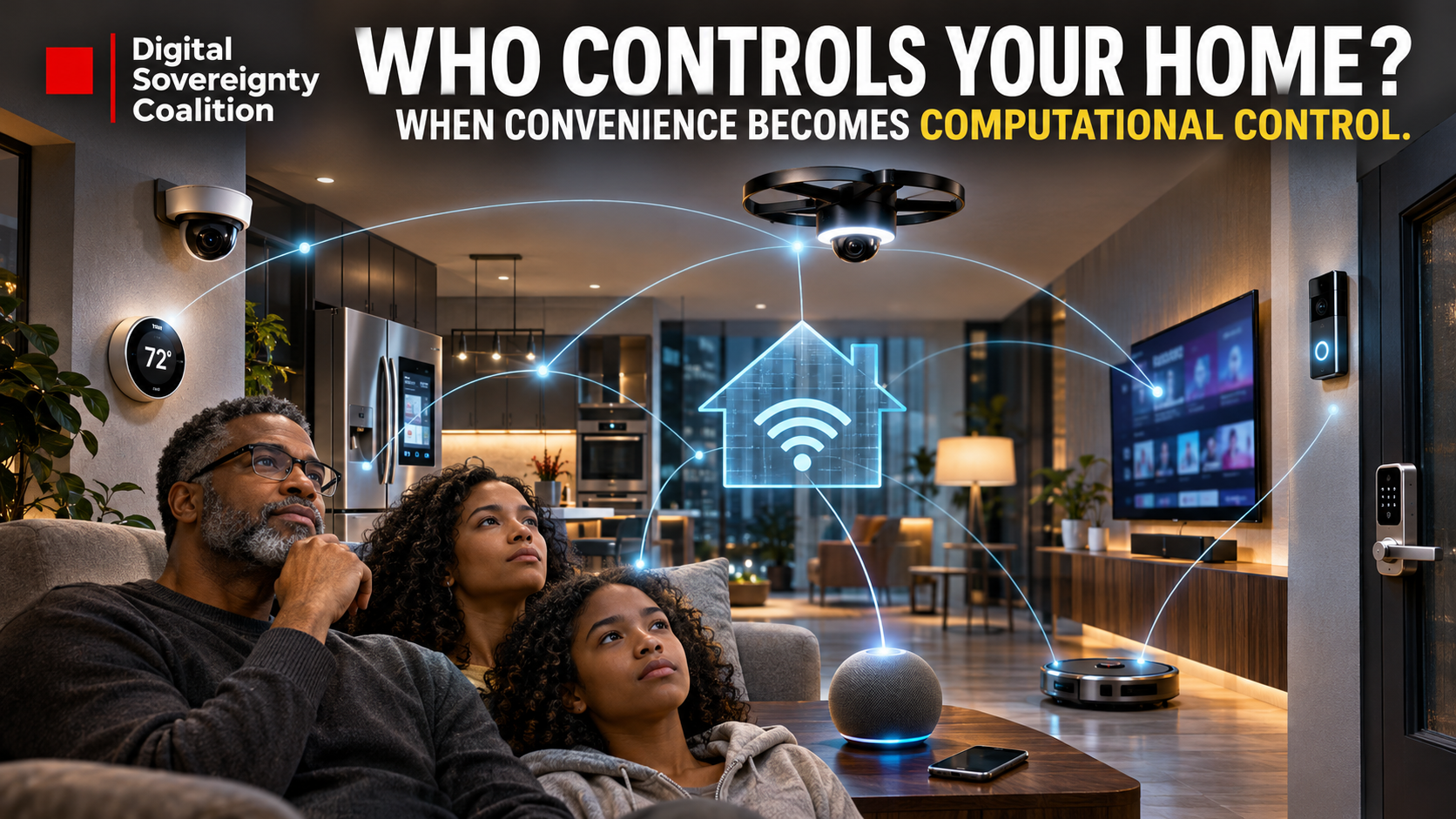
Hero artwork: the founder-approved desaturated WHO CONTROLS YOUR HOME? artwork, displayed at full content width with the original 16:9 composition preserved. This image is conceptual artwork, not documentary evidence of surveillance involving the depicted family.
EVIDENCE RULES
This investigation maintains clear distinctions between verified product functionality, documented company practices, potential risks, and policy recommendations. The labels below govern every claim in the sections that follow.
VERIFIED PRODUCT FUNCTIONALITY
A capability described in manufacturer documentation or demonstrated in the product as shipped.
DOCUMENTED PRACTICE
A company practice established by public records, official statements, or credible reporting.
POTENTIAL RISK
A governance or technical risk identified as possible. Not asserted as an observed event.
POLICY RECOMMENDATION
A DSC position on what responsible practice or regulation should require.
FOUNDER-SUPPLIED REFERENCE
A source provided in the founding directive and listed in the source registry.
DSC ANALYSIS
DSC's own framing or interpretation, labeled as such.
INVESTIGATION SECTIONS
SECTION 01 — INTRODUCTION
WHO CONTROLS YOUR HOME?
WHEN CONVENIENCE BECOMES COMPUTATIONAL CONTROL.
WHO CONTROLS WHOM? · TOPIC 24 · A DSC PUBLIC EDUCATION INITIATIVE
Your home was once primarily a private physical environment.
Today, it may contain an expanding network of connected cameras, microphones, televisions, speakers, appliances, environmental sensors, automated locks, and intelligent machines.
These technologies promise security, convenience, accessibility, energy efficiency, and independence.
They can also generate information about daily household life.
Depending on the product and its configuration, that information may concern occupancy, routines, entertainment preferences, energy consumption, access events, movement, speech, or interactions with connected systems.
Not every device collects the same information. Technical capabilities and privacy protections vary.
But as connected devices become integrated into broader platforms, the question changes.
It is no longer simply what each device does.
IT IS WHO CONTROLS THE COMPUTATIONAL INFRASTRUCTURE OF OUR HOMES.
SECTION 02 — ARCHITECTURE
THE ARCHITECTURE OF THE COMPUTATIONAL HOME
This investigation presents the computational home as a conceptual sequence:
DEVICE → SENSOR → LOCAL PROCESSING → NETWORK → CLOUD SERVICE → AI INFERENCE → ACTION
Not every device uses every stage. Some operate locally; others depend on external servers, cloud accounts, software subscriptions, or third-party integrations.
This investigation examines the distribution of control among:
THE DISTRIBUTION OF CONTROL
- Residents and device owners.
- Device manufacturers.
- Operating-system providers.
- Smart-home platform operators.
- AI-service providers.
- Cloud infrastructure companies.
- Third-party application developers.
- Network operators.
WHEN A RESIDENT OWNS THE PHYSICAL DEVICE BUT ANOTHER ORGANIZATION CONTROLS ITS SOFTWARE AND SERVICES, WHO ULTIMATELY DETERMINES ITS CAPABILITIES?
SECTION 03 — SECURITY AND OBSERVATION
SECURITY, SURVEILLANCE, AND AUTONOMOUS OBSERVATION
The security layer of the connected home includes:
SYSTEMS EXAMINED
- Indoor security cameras.
- Outdoor security cameras.
- Video doorbells.
- Smart locks.
- Connected garage doors.
- Alarm systems.
- Motion detectors.
- Occupancy sensors.
- Facial-recognition functionality where supported.
- Autonomous security robots.
- Mobile surveillance cameras.
Security monitoring offers genuine benefits. This investigation examines those benefits alongside questions of consent, recording, data retention, access, cybersecurity, and automated observation.
FEATURED CASE STUDY — AMAZON RING DRONE CAM
ARTWORK A1 — RESERVED — FILE REQUESTED
ARTWORK A1 — RESERVED. The founder-approved Ring flying-camera artwork belongs directly beneath this heading, at full article-content width. The approved file is not present in the current project assets; the specific approved file has been requested from the founder. No substitute will be used, and the artwork will not be regenerated. The artwork is conceptual editorial artwork and carries the Digital Sovereignty Coalition identification.
Amazon-owned Ring's expansion into autonomous security robotics illustrates a significant change in the relationship between household security and computational observation.
A stationary camera observes a defined area.
An autonomous flying camera can navigate between household spaces and investigate security events.
Ring has described an AI-enabled navigation system using cameras, sensors, vision models, and cloud processing to support navigation and obstacle avoidance.
The introduction of mobile observation raises new questions about spatial mapping, cloud dependency, retained information, software updates, third-party access, and the consent of people living or working inside the monitored home.
Ring's stated privacy and security safeguards, including camera-operation controls and encryption protections, must be acknowledged accurately.
The existence of autonomous capabilities is not proof of unauthorized surveillance. The governance concern is whether individuals possess meaningful control over the information and computational systems operating inside their homes.
SECTION 04 — VOICE ASSISTANTS
SMART SPEAKERS, MICROPHONES, AND AI ASSISTANTS
The voice-assistant ecosystems examined include:
ECOSYSTEMS EXAMINED
- Amazon Alexa and Echo.
- Apple Siri and HomePod.
- Google Home and Nest.
- Samsung SmartThings integrations.
- Other relevant smart speakers and conversational assistants.
This investigation addresses voice activation, audio processing, cloud dependency, voice recognition, household profiles, AI personalization, and connected-device automation.
A distinction is maintained between microphone activation readiness and actual recording, transmission, storage, and retention. Continuous unauthorized recording is not alleged without supporting evidence.
Who controls the information generated when household conversations become inputs to commercial computing systems?
SECTION 05 — SMART TELEVISIONS
SMART TELEVISIONS, STREAMING, AND BEHAVIORAL INFORMATION
The connected-television and streaming ecosystems examined include Samsung, LG, Roku, Amazon Fire TV, Google TV, Apple TV, and other relevant ecosystems.
WHAT IS EXAMINED
- Automatic content recognition where used.
- Viewing and engagement analytics.
- Personalized recommendations.
- Advertising technology.
- Household profiles.
- Application permissions.
- Data collection and retention.
- Software updates and interface control.
Smart televisions can become part of the broader household information environment. The cross-links below connect this investigation to WHO CONTROLS OUR CULTURE? and to the relevant information investigations.
SECTION 06 — CONNECTED APPLIANCES
CONNECTED APPLIANCES AND DOMESTIC ROUTINES
This section covers smart refrigerators, ovens, dishwashers, laundry machines, coffee makers, and related connected appliances.
The legitimate benefits are real: energy efficiency, maintenance diagnostics, accessibility, and automation.
WHAT IS INVESTIGATED
- Device telemetry.
- Remote controls.
- Cloud dependencies.
- Subscription requirements.
- Data collection.
- Repairability.
- Manufacturer support periods.
- Product discontinuation.
DOES PURCHASING A CONNECTED APPLIANCE MEAN CONTROLLING ITS OPERATION THROUGHOUT ITS USEFUL LIFE?
SECTION 07 — ENERGY AND ENVIRONMENT
ENERGY, ENVIRONMENTAL SYSTEMS, AND OCCUPANCY
This investigation examines connected thermostats, HVAC systems, lighting, blinds, leak detectors, air-quality monitors, smart meters, solar systems, battery storage, and EV charging infrastructure.
Energy management and household automation offer genuine advantages.
Operational information can also reveal patterns of occupancy, consumption, and household activity. Documented data practices are distinguished from hypothetical inferences.
SECTION 08 — DOMESTIC ROBOTICS
DOMESTIC ROBOTICS AND AUTONOMOUS MACHINES
The machines examined include:
MACHINES EXAMINED
- Robotic vacuum cleaners.
- Robotic mops.
- Autonomous lawn-care machines.
- Companion robots.
- Domestic assistance systems.
- Mobile security devices.
- Emerging general-purpose home robots.
Robotic mapping, navigation, object recognition, camera systems, AI decision-making, remote services, and software updates are examined where applicable.
A distinction is maintained between automated machines and genuinely autonomous or AI-enabled systems. The robotics dimension connects to WHO CONTROLS OUR ROBOTS? in the cross-links below.
SECTION 09 — HOUSEHOLD CONSENT
CHILDREN, ELDERCARE, AND HOUSEHOLD CONSENT
This investigation examines connected baby monitors, smart toys, educational devices, eldercare systems, wearable technologies, and home health-monitoring equipment.
These systems raise privacy questions for the people they monitor — including people who may not fully control the systems monitoring them.
ADDRESSED
- Children's privacy.
- Household consent.
- Caregiver access.
- Domestic-worker privacy.
- Older residents.
- People with disabilities.
- Visitors and guests.
- Household power imbalances.
A household device purchaser should not automatically become the sole authority over every person's privacy.
The legitimate benefits of caregiving, safety, and accessible technology are recognized.
SECTION 10 — THE HOME OPERATING SYSTEM
WHO CONTROLS THE HOME OPERATING SYSTEM?
The major smart-home platform ecosystems examined include:
PLATFORM ECOSYSTEMS
- Apple Home.
- Amazon Alexa and Ring.
- Google Home and Nest.
- Samsung SmartThings.
- Independent and open-source systems, including Home Assistant.
Vendor lock-in, account ownership, platform interoperability, Matter, Thread, software updates, local control, and cloud dependency are examined.
INTEROPERABILITY IS NOT THE SAME AS DIGITAL SOVEREIGNTY.
A device may operate across multiple platforms while still depending on external organizations for important functions.
SECTION 11 — THE COMPUTATIONAL HOME MOSAIC
THE COMPUTATIONAL HOME MOSAIC
The Computational Home Mosaic is a DSC analytical framework, introduced here as an extension of the broader Computational Mosaic and Inference Sovereignty concepts.
Connected household systems may generate information about:
INFORMATION GENERATED
- Presence.
- Movement.
- Schedules.
- Consumption.
- Entertainment.
- Environmental conditions.
- Access events.
- Device interactions.
- Spatial layouts.
- Household relationships.
The aggregation of information from separate systems may reveal patterns that are not apparent from individual devices.
Not every company collects or combines all of these categories.
A distinction is maintained between observed information and inferred information.
THE HOME IS NO LONGER ONLY A PHYSICAL PLACE. IT CAN ALSO BECOME A COMPUTATIONAL PROFILE.
SECTION 12 — HOUSEHOLD CYBERSECURITY
HOUSEHOLD CYBERSECURITY
The risks examined include:
RISKS EXAMINED
- Compromised connected devices.
- Insecure configurations.
- Weak passwords.
- Account takeover.
- Unpatched software.
- Vulnerable firmware.
- Remote access.
- Cloud-service outages.
- Abandoned products.
- Network segmentation.
- Connected-device supply chains.
Security risk varies by device, implementation, manufacturer, and household configuration. Residential cybersecurity increasingly concerns the entire connected environment.
SECTION 13 — GOVERNMENT ACCESS
GOVERNMENT ACCESS AND CIVIL LIBERTIES
This investigation examines the legal distinctions between corporate collection of household information and government access to privately held information.
The subjects include lawful process, warrants, subpoenas, emergency disclosures, and relevant constitutional protections.
THE FOURTH AMENDMENT GENERALLY RESTRICTS GOVERNMENT ACTION, NOT ORDINARY PRIVATE-COMPANY MONITORING.
Nothing in this investigation implies that all connected-home companies provide unrestricted access to government agencies.
The boundaries of lawful access and democratic oversight remain under investigation.
SECTION 14 — OWNERSHIP AND DEPENDENCY
OWNERSHIP, SUBSCRIPTIONS, AND DEPENDENCY
The economic structure of connected-home technology includes:
STRUCTURE EXAMINED
- Hardware ownership.
- Software licensing.
- Subscription services.
- Remote-feature restrictions.
- Cloud storage fees.
- Product discontinuation.
- Software-update policies.
- Repairability.
- Account termination.
- Vendor lock-in.
- Loss of functionality following service shutdowns.
WHEN YOU OWN THE DEVICE BUT DEPEND ON THE COMPANY TO OPERATE IT, WHAT DO YOU REALLY CONTROL?
SECTION 15 — ACCOUNTABILITY
CORPORATE ACCOUNTABILITY AND RESPONSIBLE INNOVATION
This investigation examines the responsibilities of manufacturers, smart-home platforms, cloud operators, software developers, and public regulators.
Meaningful accountability can involve:
MEANINGFUL ACCOUNTABILITY
- Data minimization.
- Clear consent mechanisms.
- Privacy-by-design.
- Secure default settings.
- Transparent retention policies.
- Security updates.
- Independent audits.
- Effective consumer remedies.
- Clear disclosure of material software changes.
- Appropriate limits on secondary data uses.
Demonstrated abuses, documented technical limitations, and prospective governance risks are differentiated.
Digital Sovereignty Coalition supports technological advancement accompanied by meaningful privacy and civil-liberties protections.
SECTION 16 — PROTECT YOUR DIGITAL SOVEREIGNTY AT HOME
TAKE CONTROL OF YOUR CONNECTED HOME
A practical guide:
TWELVE PRACTICAL STEPS
- Inventory connected devices.
- Review camera and microphone permissions.
- Enable multifactor authentication.
- Update routers and device firmware.
- Disable unnecessary remote access.
- Review cloud retention settings.
- Use separate IoT or guest networks where appropriate.
- Prefer local processing where practical.
- Review manufacturers' support commitments.
- Establish household consent expectations.
- Remove unused devices and integrations.
- Consider open-source or local-first alternatives.
Established consumer-protection guidance and independent testing are listed in the source registry below.
THE ARTWORK REGISTRY
ARTWORK A0 — MAIN INVESTIGATION HERO
PLACED
The founder-approved desaturated WHO CONTROLS YOUR HOME? artwork is placed at the top of the page, immediately beneath site navigation, at full content width with the original 16:9 composition, typography, DSC identity, family, connected-device composition, and approved color treatment preserved.
ARTWORK A1 — RING ROBOTICS CASE STUDY
RESERVED — FILE REQUESTED
The founder-approved Ring flying-camera artwork belongs in Section 03, directly under the Amazon Ring Drone Cam case-study heading. The approved file is not present in the current project assets; the specific approved file has been requested from the founder. No substitute will be used, and the artwork will not be regenerated.
THE SOURCE REGISTRY
The founder-supplied and editorial references below form the initial source library for this investigation. These references do not authorize unsupported company-specific allegations. The registry maintains clear distinctions between verified product functionality, documented company practices, potential risks, and policy recommendations.
Where the record is incomplete, the gap is stated rather than filled. No sources, quotations, privacy practices, or legal conclusions beyond this registry are asserted.
S-01
Consumer Reports — Smart Home Devices
FOUNDER-SUPPLIED REFERENCE
| SOURCE TYPE | Established independent consumer-testing publication. |
|---|---|
| WHAT IT SUPPORTS | General consumer guidance on smart-home devices, configuration, and privacy across the categories examined in this investigation. |
| URL | https://www.consumerreports.org/smart-home/smart-home-tech-devices-guide/ |
S-02
Consumer Reports — Apple HomeKit Devices
FOUNDER-SUPPLIED REFERENCE
| SOURCE TYPE | Established independent consumer-testing publication. |
|---|---|
| WHAT IT SUPPORTS | Independent testing context for one of the major smart-home platform ecosystems examined in Section 10. |
| URL | https://www.consumerreports.org/home-garden/smart-home/best-apple-homekit-devices-from-consumer-reports-tests-a2251482988/ |
S-03
B&H Photo — Smart Home
FOUNDER-SUPPLIED REFERENCE
| SOURCE TYPE | Commercial product catalog. |
|---|---|
| WHAT IT SUPPORTS | Product-category reference for the breadth of the connected-home hardware landscape. |
| URL | https://www.bhphotovideo.com/c/browse/smart-home/ci/25493 |
S-04
Federal Trade Commission — Securing Internet-Connected Devices
FOUNDER-SUPPLIED REFERENCE
| SOURCE TYPE | United States federal consumer-protection agency guidance. |
|---|---|
| WHAT IT SUPPORTS | Established consumer-protection guidance referenced by the practical guide in Section 16. |
| URL | https://consumer.ftc.gov/articles/securing-your-internet-connected-devices-home |
S-05
Connectivity Standards Alliance — Matter
FOUNDER-SUPPLIED REFERENCE
| SOURCE TYPE | Industry standards body documentation. |
|---|---|
| WHAT IT SUPPORTS | The Matter interoperability standard referenced in Section 10, together with Thread. |
| URL | https://csa-iot.org/all-solutions/matter/matter-faq/ |
S-06
Amazon — Ring Robotics
FOUNDER-SUPPLIED REFERENCE
| SOURCE TYPE | Manufacturer's own published announcement. |
|---|---|
| WHAT IT SUPPORTS | Ring's own description of its drone camera and security-robotics program, including the AI-enabled navigation system and the stated privacy and security safeguards acknowledged in Section 03. |
| URL | https://www.aboutamazon.com/news/devices/ring-drone-cam-rover-cam-security-robot |
S-07
Gizmodo — Ring drone reporting
FOUNDER-SUPPLIED REFERENCE
| SOURCE TYPE | Independent technology reporting. |
|---|---|
| WHAT IT SUPPORTS | Independent reporting on Ring's autonomous flying camera, referenced by the Section 03 case study. |
| URL | https://apple.news/ArO0t7dYISAuJ5CshSbfARQ |
WHO CONTROLS WHOM? · TOPIC 24 · A DSC PUBLIC EDUCATION INITIATIVE
YOUR HOME. YOUR PRIVACY. YOUR DIGITAL SOVEREIGNTY.
The connected home can improve comfort, accessibility, security, efficiency, and independence.
But technological convenience should not require the surrender of meaningful control over private life.
The question is not whether intelligent homes should exist.
It is whether individuals and families will retain the authority to determine what their homes observe, what information leaves them, how that information is used, and who ultimately controls the technology operating within their walls.
CONSTITUTION BEFORE CAPABILITY.
Digital Sovereignty Coalition
Digital Sovereignty Coalition · DSC.NYC