WHO CONTROLS WHOM? — TOPIC 19
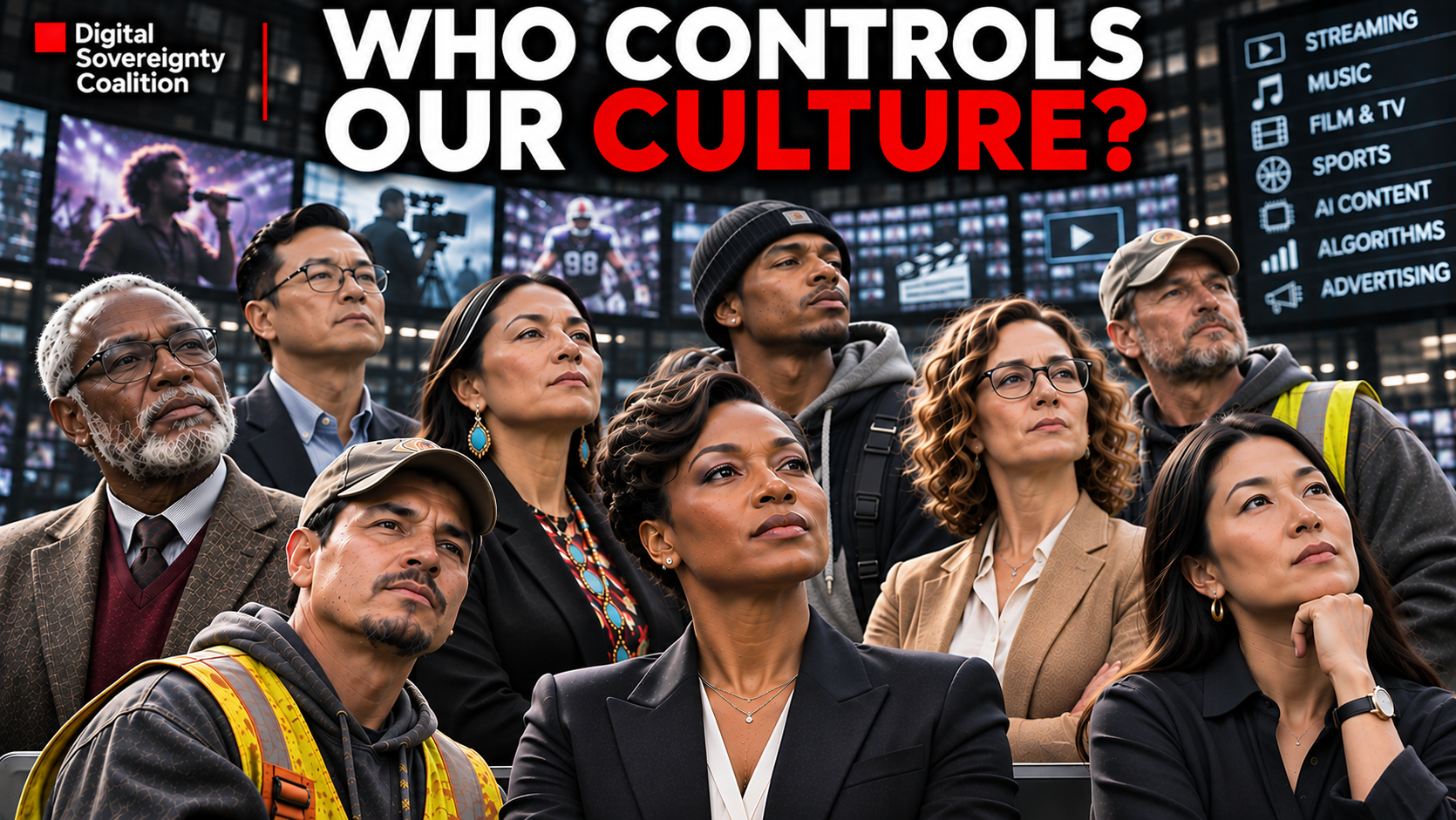
WHO CONTROLS OUR CULTURE?
Cultural Sovereignty. Corporate Media. Algorithmic Influence.
An investigation by Digital Sovereignty Coalition
SECTION 00 — THE CULTURAL POWER QUESTION
WHO CONTROLS HOW HUMANITY SEES ITSELF?
Humanity creates culture. Corporations increasingly control the infrastructure through which culture is financed, distributed, amplified, monetized, and synthetically reproduced.
Music, film, television, sports, advertising, gaming, social media, and artificial intelligence influence how societies understand race, gender, authority, success, identity, and belonging.
The convergence of corporate entertainment and technological distribution raises a fundamental question:
WHEN INSTITUTIONS CONTROL THE SYSTEMS THROUGH WHICH HUMANITY SEES ITSELF, HOW MUCH INFLUENCE DO THEY ACQUIRE OVER WHAT HUMANITY BECOMES?
This investigation examines that question through documented corporate structures, historical evidence, cultural research, emerging technologies, and civil rights principles.
This is an investigation of institutional power — not an indictment of artistic expression, individual demographic groups, or any particular musical genre.
EDITORIAL PRINCIPLE: INSTILL APPROPRIATE CONCERN THROUGH DOCUMENTED EVIDENCE, NOT SENSATIONALISM. EVERY IDENTIFIED RISK IS ACCOMPANIED BY A QUESTION OF ACCOUNTABILITY, GOVERNANCE, OR POSSIBLE REMEDY.
To ask who controls culture is really to ask about several distinct forms of power that often travel together:
- Creative power — who produces culture.
- Economic power — who finances and owns cultural assets.
- Distribution power — who determines access to audiences.
- Algorithmic power — who influences visibility and repetition.
- Computational power — who can reproduce identities and performances synthetically.
These forms of power can overlap in the same institutions and investment structures. Documenting an overlap is not the same as demonstrating coordination, and this investigation does not assume that every institution or investor acts in coordination.
CENTRAL QUESTION: Who controls the representation of humanity when the creators of culture do not necessarily control its distribution?
SECTION 01 — WHO CREATES CULTURE, WHO PROFITS?
THE DISTANCE BETWEEN INFLUENCE AND OWNERSHIP
Cultural production and institutional ownership are related but distinct positions in the cultural economy. The people who create a society's music, stories, styles, and movements are frequently not the people who own its recording catalogs, distribution channels, publishing rights, or streaming infrastructure.
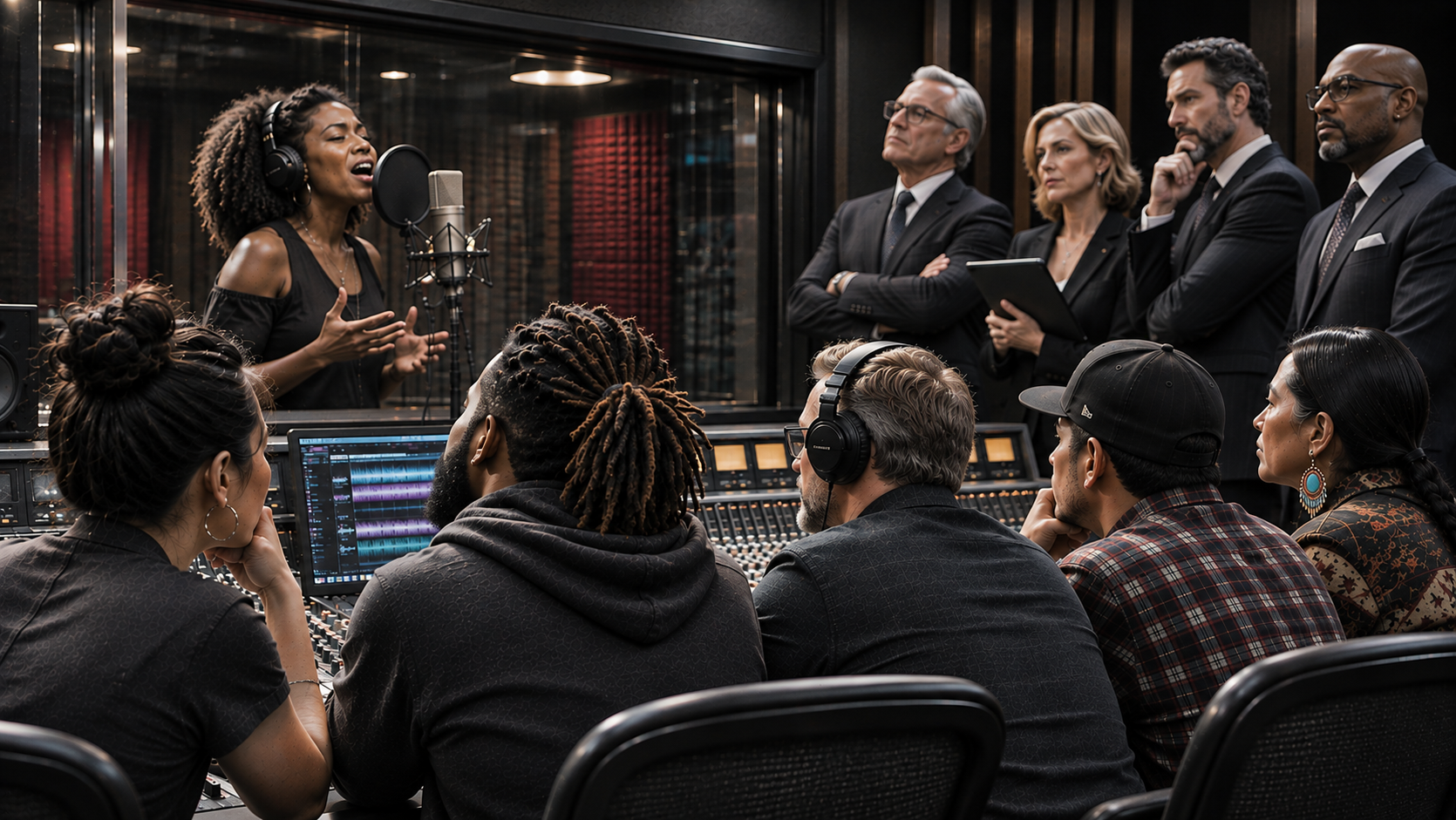
The cultural traditions that dominate global popular culture draw on contributions from African American, Asian, Latino, Indigenous, Caribbean, Middle Eastern, European, and many other communities. Popular music, dance, fashion, film, and digital culture are composite achievements — built across continents and generations.
African American contributions deserve particular attention: jazz, blues, gospel, rock and roll, soul, funk, hip-hop, R&B, dance, fashion, and much of contemporary popular culture trace substantial origins to Black American communities — often created under conditions of segregation and exclusion, and frequently commercialized by institutions that did not share their origins.
The historical record contains documented patterns of inequality in how cultural value has been captured: unfavorable recording and publishing contracts, inadequate or disputed rights transfers, limited ownership of masters and catalogs, unequal licensing terms, and distribution arrangements that concentrated returns with labels, publishers, and platforms rather than with creators and their communities.
The pattern matters for the present: cultural influence does not automatically translate into ownership or institutional control. A community can shape global culture while holding a limited share of the economic and infrastructure positions that culture generates.
This investigation examines the institutions that occupy those positions: major record labels, entertainment conglomerates, talent agencies, institutional investors, and technology platforms. This page does not publish specific ownership claims, statistics, or quotations until they can be verified against primary documents, regulatory filings, or credible journalism.
Can a community shape global culture while possessing limited control over how that culture is commercialized?
SECTION 02 — THE COMMERCIALIZATION OF STEREOTYPES
WHO PROFITS FROM NARROW REPRESENTATIONS?
Entertainment industries have long commercialized simplified and distorted representations. This investigation examines how commercial systems reward certain representations involving:
- Violence and criminality.
- Misogyny and sexual objectification.
- Hypermasculinity and domination.
- Wealth, status, and conspicuous consumption.
- Racial and ethnic stereotypes.
- Gender stereotypes.
- Substance abuse and destructive behavior.
These patterns appear across hip-hop, rock, country, pop, film, television, advertising, gaming, and social media. No genre holds a monopoly on degrading representation, and this investigation does not single out Black culture — or any culture — as uniquely responsible for misogyny or violence.
A critical distinction runs through this section: artistic expression is not the same thing as corporate financing, marketing, and algorithmic amplification. Artists make creative choices; institutions decide which of those choices get recorded, marketed, playlisted, promoted, and rewarded. The commercial machinery around culture shapes what reaches audiences — and that machinery is accountable for its own decisions.
Whether commercial incentives disproportionately reward narrow or degrading representations of particular communities is a DOCUMENTED RESEARCH FINDING candidate that requires verifiable evidence about promotion, playlisting, investment, and compensation decisions. Assertions of intentional demographic manipulation are not supported on this page: no claim of coordinated manipulation should be inferred without documented evidence.
If commercial systems reward the narrowest, most consumable version of a community's representation, who bears the cost — and who is accountable?
SECTION 03 — THE MANUFACTURING OF MASCULINITY AND FEMININITY
REPEATED NARRATIVES, REPEATED EXPOSURE
Cultural narratives are repeated across films, music, advertising, gaming, and social feeds. Over time, repeated exposure may influence attitudes toward:
- Masculinity and femininity.
- Relationships and sexual behavior.
- Authority and leadership.
- Respect and social status.
- Violence and conflict.
- Economic achievement.
- Gender equality.
Precision matters here. Cultural influence, social conditioning, algorithmic reinforcement, and deliberate social engineering are four different claims with different evidentiary standards. Cultural influence is the general observation that narratives affect attitudes. Social conditioning describes sustained environmental shaping. Algorithmic reinforcement describes systems that select and repeat content in ways that may amplify existing patterns. Deliberate social engineering asserts intentional design toward an objective — the strongest claim, and the one requiring the strongest evidence.
PROPOSED DSC TERM — ALGORITHMICALLY MEDIATED SOCIAL CONDITIONING: the reinforcement of attitudes and expectations through repeated, algorithmically selected cultural exposure.
DSC reserves a separate term — Algorithmically Mediated Social Engineering — for cases in which evidence establishes intentional efforts to influence behavior toward identifiable objectives. The distinction protects the analysis from its own weakest version: without documented intent, conditioning — not engineering — is the defensible description.
For children and adolescents, the stakes are higher and the research is harder: developmental effects of sustained algorithmically curated media exposure are complex, vary across individuals and circumstances, and are not conclusively established in either direction. This investigation flags the question; it does not manufacture certainty.
SECTION 04 — CULTURE, GENDER, AND POLITICAL LEADERSHIP
CAN CULTURAL NARRATIVES INFLUENCE WHO SOCIETY ACCEPTS AS A LEADER?
Gender stereotypes shape perceptions of authority. Perceptions of authority shape political leadership and democratic participation. That chain — from cultural narrative to leadership perception to electoral outcome — is where cultural power becomes most politically consequential, and where analytical discipline matters most.
The 2024 U.S. presidential election is examined here as a carefully qualified case study — a context in which questions about cultural narratives and perceptions of female political leadership were widely discussed.
INVESTIGATIVE HYPOTHESIS: Could sustained exposure to cultural narratives celebrating male domination or diminishing women's authority influence some voters' perceptions of female political leadership?
The following qualifications govern this analysis:
- This hypothesis has not been established as an explanation for Kamala Harris's defeat.
- Black and Latino men are not politically homogeneous.
- Many Black and Latino men voted for Harris.
- Economic conditions, partisan identification, immigration, turnout, campaign strategy, and other factors also influenced the election.
- No causal relationship between particular musical genres and the election result should be asserted without rigorous evidence.
The objective of this section is to examine cultural influence on political perceptions — not to advocate for a candidate or a political party.
SECTION 05 — SPORTS, CULTURAL POWER, AND OWNERSHIP
WHO OWNS THE VALUE OF HUMAN EXCELLENCE?
Professional sport is one of the largest cultural and economic institutions on earth. Its structure raises the same question this investigation asks of music and film: the performers are singular; the ownership of the value they generate is institutional.
- Athletes' cultural influence.
- Team and league ownership.
- Media and broadcasting rights.
- Technology-linked investment.
- Sports streaming.
- Sponsorship and endorsement agreements.
- Athlete likeness rights.
- AI-generated athlete representations.
- Economic disparities between athletic labor and institutional ownership.
Black, Asian, Latino, Indigenous, and other athletes have shaped global sports culture on and off the field — as performers, style-setters, and public figures. The economic question is who captures the value that performance creates: athletes' labor is compensated at extraordinary levels at the top of professional sport, while team franchises, broadcasting rights, and league equity have historically appreciated in institutional hands.
DSC distinguishes demonstrated sports investment trends from speculation about investors' motives. That investors have concentrated capital in sports franchises and media rights is observable; why each investor buys is not something this page asserts without documented evidence.
RESEARCH HYPOTHESIS — THE AUTHENTICITY SCARCITY PREMIUM: authentic, unpredictable human experiences may become more economically valuable as synthetic content becomes abundant.
The hypothesis has a countervailing risk that must be stated alongside it: if AI-driven unemployment or reduced purchasing power narrows who can afford tickets, merchandise, and subscriptions, demand for live entertainment could contract even as its cultural distinctiveness grows. The Authenticity Scarcity Premium describes a possibility, not a forecast.
Athlete likeness rights add a computational dimension: AI-generated athlete representations — in advertising, gaming, and media — raise consent, compensation, and control questions that parallel the synthetic-celebrity issues examined in Section 09.
SECTION 06 — THE ALGORITHMIC CULTURAL MACHINE
FROM CULTURAL PRODUCTION TO COMMERCIAL OPTIMIZATION
CULTURAL PRODUCTION → CORPORATE DISTRIBUTION → ALGORITHMIC SELECTION → AUDIENCE EXPOSURE → BEHAVIORAL DATA → COMMERCIAL OPTIMIZATION
This sequence describes how culture moves through the dominant distribution systems of the current era. Each stage is a point of control — and each is operated by institutions with their own commercial incentives:
- Streaming recommendation systems.
- Social media algorithms.
- Personalized advertising.
- Engagement optimization.
- Demographic targeting.
- Content visibility.
- Creator dependence on platforms.
- Feedback loops that may reinforce stereotypes.
The relevant companies include Alphabet/Google/YouTube, Meta, Apple, Amazon, ByteDance/TikTok, Spotify, and Netflix. These companies do not operate identical systems, do not share a single business model, and should not be assumed to share a unified objective. Each company's specific role in the sequence above requires its own verifiable evidence, and this page publishes no algorithm-specific claims about any named company without documented support.
What can be described structurally, without company-specific claims: recommendation systems select from more content than any audience could consume; engagement optimization rewards whatever retains attention; behavioral data feeds back into the next round of selection. The loop is the architecture. Its consequences for representation — whose culture gets amplified, whose gets buried — are the accountability question.
These dynamics connect to DSC's proposed concepts of algorithmic influence and cognitive sovereignty — concepts developed in the DSC Lexicon and applied throughout the WHO CONTROLS WHOM? series.
The cultural machine does not need a conspiracy to narrow culture. It needs only an optimization target — and an audience.
These concepts are defined in the DSC Lexicon and Knowledge Repository, alongside the terms used throughout this investigation.
SECTION 07 — WHO REPRESENTS HUMANITY?
CULTURAL INFLUENCE IS NOT CULTURAL SOVEREIGNTY
Representation is the mechanism through which the cultural economy describes human beings to themselves. This investigation examines representation across communities, and who creates, finances, selects, distributes, and profits from those representations:
- Black and African American communities.
- Asian communities, including East Asian, South Asian, Southeast Asian, and diaspora populations.
- Latino and Hispanic communities.
- Native American, Alaska Native, and other Indigenous peoples.
- Middle Eastern and North African communities.
- White and European-descended communities.
- Multiracial communities.
- Women and gender representation across communities.
No demographic group is culturally or politically homogeneous. Every category above contains internal diversity of opinion, taste, politics, and self-description — and no institution's dataset, market segment, or audience taxonomy should be mistaken for a community's self-understanding.
PROPOSED DSC CONCEPT — DEMOGRAPHIC REPRESENTATIONAL SOVEREIGNTY: meaningful participation, accountability, and agency for communities in the systems that represent them — in who creates representations, who finances them, who selects and distributes them, and who profits from them.
Two clarifications keep the concept honest. First, representational sovereignty does not grant any organization exclusive authority to define a demographic group. Second, it does not authorize suppressing artistic expression — including expression by members of the communities concerned. The concept demands participation and accountability in the machinery of representation; it does not install a new gatekeeper.
A community can be visible everywhere and still control almost nothing about how it is seen. Visibility is not sovereignty.
SECTION 08 — INDIGENOUS SOVEREIGNTY: FROM CULTURAL SUPPRESSION TO COMPUTATIONAL SELF-DETERMINATION
WHO GETS TO EXIST IN THE TECHNOLOGICAL FUTURE?
The relationship between Indigenous dispossession and cultural suppression is documented history, and its modern echo runs through the systems that now represent Indigenous peoples computationally. This section is substantial by design: Indigenous nations are living, diverse, sovereign communities and contemporary technological leaders — not historical footnotes and not merely historical victims.
A. THE DESTRUCTION OF THE BISON. For many Plains Indigenous nations, the bison was foundational — to food, clothing, shelter, ceremony, and economy. Commercial hunting, territorial expansion, and documented military encouragement of bison destruction undermined the material basis of Indigenous independence in the nineteenth century. Destroying an ecology of self-sufficiency was a mechanism of dispossession.
B. FORCED ASSIMILATION. The federal Indian boarding school system separated children from families, suppressed Indigenous languages, restricted religious and cultural practice, and pursued cultural coercion as policy. The documented consequences — intergenerational language loss, family trauma, cultural disruption — remain active realities for Native communities today.
C. HOLLYWOOD AND HISTORICAL REPRESENTATION. Western films long cast Indigenous peoples through stereotypes: as vanishing populations, as historical obstacles to settlement, as a single undifferentiated category. The screen taught generations of audiences a distorted pedagogy — and the people being described had little control over the description.
D. CONTEMPORARY TECHNOLOGICAL REPRESENTATION. Today the descriptive machinery is computational: search engines, AI systems, digital archives, streaming platforms, and image generators all portray Indigenous peoples — and each inherits the biases of its training data, its curation choices, and its design assumptions. EMERGING RISK: synthetic and automated systems may reproduce the same representational distortions at new scale, with new speed, and without Indigenous review.
E. INDIGENOUS TECHNOLOGICAL LEADERSHIP. Contemporary Native American engineers, scientists, filmmakers, and entrepreneurs are building the alternative: tribal broadband initiatives, digital archives under community control, language revitalization projects, and Indigenous-led technology governance. The future of Indigenous representation is being built by Indigenous hands — and that leadership belongs at the center of this story, not at its margins.
F. INDIGENOUS DATA SOVEREIGNTY. The CARE Principles for Indigenous Data Governance articulate a community-first framework for data about Indigenous peoples and their cultures:
- Collective Benefit — data ecosystems must be designed and function in ways that enable Indigenous Peoples to derive benefit from the data.
- Authority to Control — Indigenous Peoples' rights and interests in Indigenous data must be recognized, and their authority to control such data must be empowered.
- Responsibility — those working with Indigenous data have a responsibility to share how that data is used, in ways that support Indigenous self-determination and collective benefit.
- Ethics — Indigenous Peoples' rights and wellbeing must be the primary concern at all stages of the data life cycle and across the data ecosystem.
G. AI AND CULTURAL KNOWLEDGE. Generative systems trained on Indigenous languages, cultural materials, ceremonial knowledge, historical recordings, and recognizable likenesses raise risks that are not hypothetical in kind: unauthorized use, extraction without consent, and computational reproduction of cultural property outside community governance. DSC distinguishes individual rights — an individual's likeness or recording — from the collective rights and political sovereignty of Indigenous nations, which no individual consent mechanism can substitute for.
One distinction governs this entire section: historical genocide and forced assimilation are not equated with contemporary algorithmic practices. The historical record and the emerging technological risks are distinct phenomena. What connects them is a structural question — who controls the systems through which a people is described — and that question is presented as analysis, not as analogy-equivalence.
SECTION 09 — THE SYNTHETIC CELEBRITY
WHO OWNS THE COMPUTATIONAL HUMAN?
Creative Artists Agency's CAA Vault and its publicly documented digital-replica initiatives are this section's central case study — a talent-representation infrastructure for scanning, storing, and licensing performers' digital likenesses. All CAA-specific statements on this page are drawn from publicly documented, publicly announced material and remain SUBJECT TO SOURCE VERIFICATION before publication.
The case study opens a wider investigative field:
- Digital scanning of performers.
- Voice and likeness replication.
- AI-generated performances.
- Licensing and consent.
- Agency and technology-provider relationships.
- Training-data rights.
- Derivative likenesses.
- Synthetic substitutes.
- Contractual revocation.
- Posthumous identity rights.
- Independent audits and enforcement.
DSC also examines the publicly announced CAA–Ogilvy ECHO initiative — an advertising-industry application of digital-replica technology — subject to the same source-verification requirement. Publicly stated consent and ownership protections are described accurately and as stated: this investigation reports what institutions say about their own safeguards, and it does not accuse CAA or its partners of unauthorized exploitation without evidence.
The analytical distinction that gives this section its edge: ownership of a digital scan is not the same as legal and practical control over recognizable synthetic representations. A performer may own a scan file while contracts, licenses, platform terms, and derivative uses determine who actually controls what the world sees. Control, not title, is where the leverage lives.
Authorized digital-replica programs are publicly documented — including the CAA Vault and the CAA/Ogilvy ECHO advertising partnership announced in November 2026, as reported by independent trade press — while the contract terms of such programs are not publicly disclosed. No synthetic celebrity likeness appears on this page.
SECTION 10 — THE AUTHENTICITY SCARCITY ECONOMY
WHEN SYNTHETIC CONTENT BECOMES ABUNDANT, WHAT HAPPENS TO HUMAN VALUE?
Section 05 introduced the Authenticity Scarcity Premium as a sports hypothesis. Widened to the whole cultural economy, it becomes an economy-level question: as AI-generated content becomes abundant, does authentic human performance become more valuable — and who captures that value?
- Professional sports.
- Live theater.
- Concerts.
- Dance.
- Human storytelling.
- In-person cultural experiences.
- Venue ownership.
- Ticketing and distribution.
- Intellectual property.
- Performer compensation.
There is observable capital movement toward sports franchises and live entertainment, and commentary framing such assets as relatively resistant to AI substitution. DSC states the pattern and withholds the motive: whether any given acquisition is motivated by AI-exposure expectations is a claim about investors' intentions, and it is not asserted here without documented evidence.
A second distinction disciplines the analysis: the value of authentic performance is not the same as the economic rewards received by performers. A live experience can appreciate in institutional value while the performers who create it capture a shrinking share — the cultural economy can price authenticity highly and still pay the human beings who supply it poorly.
This section also connects to the employment side of the same transformation — how automation, robotics, and AI reshape work, workforce restructuring, and algorithmic management.
A note on independent productions: BLKMKT Media and its productions — including Media Without Mediation, Fifth Industrial Revolution AI, and Gotham Rider — are independent BLKMKT Media productions. They are not DSC initiatives, and DSC does not claim or represent them as DSC-owned programs.
DSC's examination of automation and workforce displacement continues in Robotics & Physical AI.
SECTION 11 — COMPUTATIONAL CULTURAL SOVEREIGNTY
HUMAN IDENTITY MUST NOT BECOME AN UNACCOUNTABLE COMPUTATIONAL RESOURCE
Computational Cultural Sovereignty is a proposed DSC framework addressing the relationship between cultural expression, digital identity, algorithmic distribution, and institutional control. Its premise: the machinery that represents humanity — and increasingly can reproduce humanity synthetically — must remain accountable to the people it represents.
The framework sits within DSC's broader conceptual architecture, alongside:
- Computational Self-Determination.
- Computational Identity.
- The Inferred Self.
- Inference Sovereignty.
- Synthetic Cognitive Influence.
- Computational Cognitive Sovereignty.
- The Computational Mosaic.
Computational Cultural Sovereignty proposes safeguards — including the following:
- Transparent cultural recommendation systems.
- Meaningful creator ownership and compensation.
- Purpose-limited digital-replica consent.
- Disclosure of relevant AI training and synthetic identity uses.
- Enforceable remedies for unauthorized likeness exploitation.
- Posthumous digital identity directives.
- Indigenous-led governance over Indigenous cultural data.
- Independent auditing and accessible appeals.
- Public-interest cultural archives.
- Support for independent, community-controlled distribution infrastructure.
An honest accounting requires distinguishing existing law from proposed protections. Some likeness, contract, and publicity-rights protections already exist in statute, case law, and collective bargaining agreements; the safeguards above are proposals that extend, close gaps in, or newly govern territory the law does not yet reach. Presenting proposals as settled law would be its own form of misrepresentation.
These principles connect to DSC's broader vision of plural digital sovereignty and accountable civic AI infrastructure: a cultural economy in which creators, communities, and audiences hold meaningful, distributed authority over the computational representation of humanity — rather than ceding it, by default, to whatever system owns the distribution layer.
EVIDENCE AND SOURCING
HOW THIS INVESTIGATION HANDLES EVIDENCE
This investigation documents institutions across eight sectors:
- Music production and publishing.
- Film and television.
- Sports ownership and broadcasting.
- Talent representation.
- Streaming and social media.
- Advertising technology.
- Cloud and AI infrastructure.
- Institutional investment.
Where this page documents an institution, the record states what the institution does, the ownership or contractual relationship involved, the source and its publication date, and the documented cultural or economic implications — together with unresolved questions and any response or safeguard the institution has offered.
Claims are classified into one of six evidence tiers, and the text says which tier a claim occupies:
- VERIFIED FACT.
- DOCUMENTED RESEARCH FINDING.
- REPORTED ALLEGATION.
- INVESTIGATIVE HYPOTHESIS.
- EMERGING RISK.
- PROPOSED SAFEGUARD.
Claims appear on this page only when their sources have been retrieved and reviewed. Material still under review is not published as finding, and this page does not invent citations, ownership relationships, statistics, quotations, or allegations.
An investigation that fills its evidence gaps with invention is worth less than one that marks its gaps honestly.
CIVIC FIREWALL — THE DSC PODCAST
THE CONVERSATION BEHIND THE INVESTIGATION
Civic Firewall, the Digital Sovereignty Coalition podcast, is the conversation layer for investigations like this one. For this topic, potential interview categories include cultural historians, Indigenous data-sovereignty scholars, entertainment attorneys, AI researchers, independent filmmakers, musicians and performers, professional athletes, media economists, civil rights scholars, and digital identity specialists.
No guests, partnerships, scheduled episodes, or completed interviews have been announced for this topic. This connection describes potential coverage — not confirmed programming.
Learn more about Civic Firewall — the DSC podcast.
THE DISTINCTION THAT REMAINS
WHO CONTROLS OUR CULTURE?
Creating culture is not the same as controlling its representation, distribution, or economic value. That distinction organizes every section of this investigation.
The arrival of generative AI introduces a further question: what happens when the institutions distributing human culture also possess the technological capacity to reproduce human identities, performances, and cultural narratives without requiring the original creator's continuing physical participation?
This investigation examines that emerging concentration of capability without presuming that capability necessarily establishes malicious intent. Capability is the condition; governance is the question.
No institution should possess unchecked authority over the computational representation of humanity.
CONSTITUTION BEFORE CAPABILITY.
Digital Sovereignty Coalition — DSC.NYC
WHO CONTROLS WHOM? — An ongoing digital civil rights investigation.
Continue the Investigation