Digital Sovereignty Coalition — Investigative Report
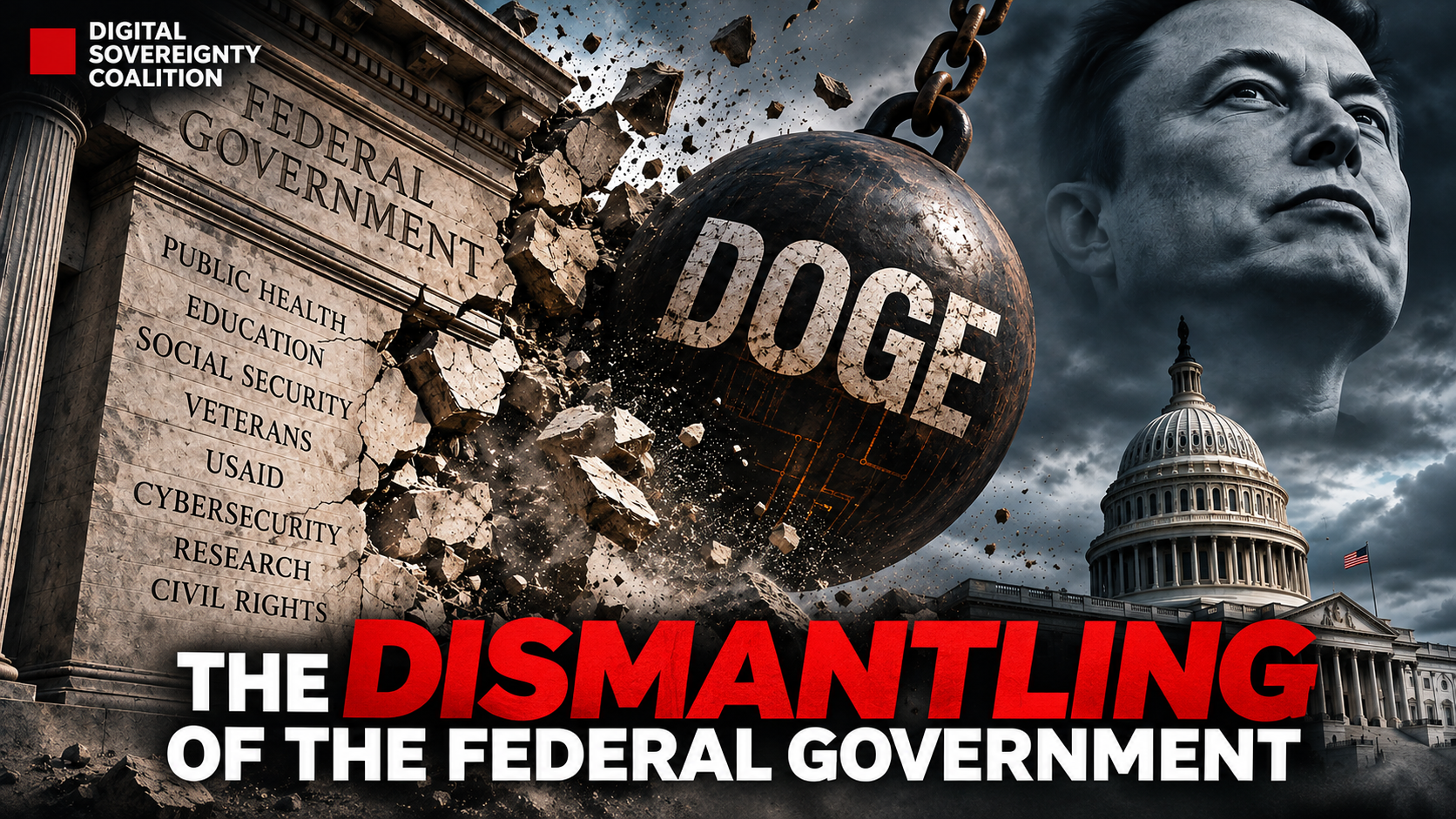
DOGE: The Dismantling of the Federal Government
The Human, Institutional, and National Security Costs of Government by Disruption
This investigation distinguishes verified findings from reported allegations, disputed claims, and unresolved questions. Numerical claims are sourced to primary records. DOGE actions are distinguished from agency, White House, and congressional actions where the record permits.
SECTION 00
The Promise of Efficiency
Stated objectives, legal foundations, executive authority, leadership, and claimed savings
The Department of Government Efficiency — operating as an advisory body outside the formal cabinet structure — was established by executive order in January 2025. Its stated mandate was to reduce federal expenditure, eliminate regulatory redundancy, and modernize government technology systems.
DOGE's leadership, drawn primarily from the private technology sector, framed the initiative as an application of Silicon Valley operational discipline to federal bureaucracy. Claimed savings figures have been disputed by independent budget analysts, the Congressional Budget Office, and investigative journalists who found discrepancies between announced cuts and verifiable reductions in obligated spending.
The legal basis for DOGE's authority over federal agencies, personnel decisions, and information systems has been challenged in multiple federal courts. Several courts have issued injunctions limiting specific DOGE activities pending further review.
SECTION 01
The Federal Workforce
Workforce reductions, institutional expertise, hiring freezes, operational disruptions, and the cost of rebuilding lost capabilities
Federal workforce reductions implemented or accelerated under DOGE direction have affected agencies across the executive branch. Reported figures include tens of thousands of employees separated through voluntary departure incentives, reductions in force, and probationary terminations — many of which were subsequently challenged in federal court.
Career civil servants with specialized expertise in areas including nuclear safety, pandemic preparedness, financial regulation, and environmental monitoring have departed. Independent analysts and former agency officials have noted that institutional knowledge accumulated over decades cannot be rapidly reconstructed.
Hiring freezes have compounded attrition effects. Agencies responsible for processing veterans' benefits, Social Security claims, tax enforcement, and food safety inspections have reported operational backlogs. The long-term cost of rebuilding workforce capacity — including recruitment, training, and security clearance processing — has not been included in DOGE's published efficiency calculations.
SECTION 02
USAID and Global Humanitarian Operations
Program terminations, documented humanitarian consequences, institutional capacity, and implications for American foreign policy
The United States Agency for International Development was effectively dismantled in early 2025. Thousands of employees were placed on administrative leave, contracts were terminated, and field operations across more than 60 countries were suspended or ended.
Humanitarian organizations documented immediate consequences: food assistance programs serving millions were interrupted, health programs including HIV treatment supply chains were disrupted, and development projects in conflict zones were abandoned. The State Department has assumed some USAID functions, though with significantly reduced capacity.
Foreign policy analysts have noted that the dismantling of USAID reduces American soft-power capacity and creates openings for competing geopolitical actors in regions where the United States previously maintained development relationships. The long-term diplomatic consequences remain unresolved.
SECTION 03
Social Security, Veterans, and Public Services
Documented changes affecting benefits administration, staffing, service availability, and vulnerable populations
The Social Security Administration has experienced significant staffing reductions. Field offices serving rural and low-income populations have been closed or had hours reduced. Processing times for disability determinations and benefit applications have increased. SSA officials and advocacy organizations have documented growing backlogs affecting elderly and disabled Americans.
The Department of Veterans Affairs has faced workforce reductions affecting healthcare delivery, benefits processing, and mental health services. Veterans' service organizations have raised concerns about wait times and service continuity for the approximately 9 million veterans enrolled in VA healthcare.
Across multiple agencies, reductions in customer-facing staff have increased processing times for passports, tax refunds, federal student loan administration, and housing assistance. The populations most affected are those with the fewest alternative resources.
SECTION 04
Public Health and Scientific Research
The effects of restructuring and funding disruptions on research institutions, healthcare preparedness, and public health
The Centers for Disease Control and Prevention, the National Institutes of Health, and the Food and Drug Administration have all experienced workforce reductions and funding disruptions. Researchers and public health officials have documented interruptions to ongoing studies, clinical trials, and surveillance programs.
NIH grant terminations have affected research institutions across the country. University medical centers, teaching hospitals, and independent research organizations have reported layoffs and program cancellations resulting from federal funding interruptions. The scientific community has raised concerns about the long-term effects on American research capacity and competitiveness.
Public health preparedness infrastructure — including pandemic early-warning systems, vaccine stockpile management, and emergency response coordination — has been affected by staffing and budget changes. Former CDC and HHS officials have described reduced capacity to detect and respond to emerging health threats.
SECTION 05
Education and Civil Rights
Institutional changes affecting the Department of Education, civil rights enforcement, and federal oversight responsibilities
The Department of Education has faced proposals for elimination and significant workforce reductions. Civil rights enforcement offices responsible for investigating discrimination complaints in schools and universities have been reduced. Advocacy organizations have documented delays in complaint processing and reduced investigative capacity.
Federal student loan administration has been affected by staffing changes, with borrowers reporting difficulties accessing income-driven repayment programs and loan forgiveness processes. The transition of loan servicing functions has created additional administrative complexity.
Title IX enforcement, special education oversight, and civil rights compliance monitoring have all been affected by staffing reductions. Education advocates have raised concerns about the federal government's capacity to enforce statutory protections for students with disabilities and students from protected classes.
SECTION 06
Cybersecurity and National Defense
CISA staffing losses, federal threat detection, critical infrastructure protection, and institutional recovery
The Cybersecurity and Infrastructure Security Agency — the federal agency responsible for protecting critical infrastructure from cyberattacks — experienced significant leadership and staffing disruptions beginning in early 2025. Director Jen Easterly departed, and subsequent leadership changes created continuity concerns among cybersecurity professionals and allied governments.
Reporting by Broadband Breakfast, CGNET, and SC Media documented the departure of experienced cybersecurity personnel, the suspension of information-sharing programs with private sector partners, and concerns among state and local government officials about reduced federal support for election security and critical infrastructure protection.
The timing of these disruptions coincided with continued threat activity from state-sponsored actors. The Volt Typhoon and Salt Typhoon campaigns — attributed to Chinese state-sponsored actors — targeted American telecommunications infrastructure and critical systems. Federal cybersecurity professionals have noted that institutional disruption reduces the government's capacity to detect, attribute, and respond to sophisticated persistent threats.
CISA's public-private coordination programs, including the Joint Cyber Defense Collaborative and election security partnerships with state officials, were affected by staffing and operational changes. The long-term effects on federal cyber defense capacity remain a subject of ongoing assessment by independent security researchers and congressional oversight committees.
SECTION 07
Federal Data Access and Privacy
Government data systems, privacy safeguards, legal challenges, and the intersection of private technology interests
DOGE personnel were reported to have obtained access to federal information systems containing sensitive data, including Social Security records, tax information, and personnel files. Multiple federal courts issued orders limiting or enjoining this access pending review of whether proper legal authorization and privacy safeguards were in place.
Privacy advocates, former federal data security officials, and members of Congress raised concerns about the concentration of access to sensitive government data in the hands of individuals without standard security clearance processes, conflict-of-interest reviews, or congressional oversight. The Privacy Act, the Federal Information Security Modernization Act, and other statutory frameworks establish requirements for access to federal data systems that were alleged to have been bypassed.
The intersection of private technology interests and access to federal data systems raises questions about the use of government data for commercial purposes, the security of sensitive personal information, and the integrity of federal systems. These questions remain subjects of ongoing litigation and congressional inquiry.
SECTION 08
The Cost of the Cuts
Claimed savings versus independently documented results, administrative costs, litigation, and long-term consequences
DOGE published claimed savings figures that independent analysts, the Congressional Budget Office, and investigative journalists found difficult to verify against federal spending records. Discrepancies between announced cuts and verifiable reductions in obligated spending have been documented by multiple news organizations.
The administrative costs of implementing workforce reductions — including severance payments, litigation costs, rehiring expenses for personnel whose terminations were reversed by court order, and contractor costs for functions previously performed by federal employees — have not been included in DOGE's published efficiency calculations.
Long-term costs including the loss of institutional knowledge, reduced regulatory enforcement capacity, degraded public health infrastructure, and diminished national security capabilities are difficult to quantify but represent real costs to the public. The question of whether claimed short-term savings justify these long-term costs is a matter of ongoing public and congressional debate.
SECTION 09
Congressional Authority and Constitutional Accountability
Executive power, congressional appropriations, independent agencies, judicial challenges, and oversight
The Constitution vests the power of the purse in Congress. Federal agencies operate under statutory authority established by Congress and are funded through congressional appropriations. DOGE's authority to direct agency spending, personnel decisions, and operational changes without congressional authorization has been challenged in federal courts on separation of powers grounds.
Independent agencies — including the Consumer Financial Protection Bureau, the Federal Trade Commission, and others — have statutory independence designed to insulate regulatory functions from direct executive control. DOGE activities affecting these agencies have been the subject of litigation testing the boundaries of executive authority over independent regulatory bodies.
Congressional oversight of DOGE has been limited. Requests for documentation, testimony, and access to records have been resisted. The accountability mechanisms established by the Federal Advisory Committee Act and other oversight statutes have been subjects of legal dispute. The long-term precedent established by DOGE's operational model — private sector actors directing federal agency operations outside normal accountability structures — raises constitutional questions that courts are still resolving.
SECTION 10
Technological Power and Government Restructuring
Private technology interests, federal decision-making, public data, government contracts, and institutional independence
DOGE's leadership and operational model represent a novel arrangement: private technology sector actors directing the restructuring of federal agencies, with access to government data systems, personnel records, and operational infrastructure. This arrangement raises questions about conflicts of interest, the use of government access for commercial advantage, and the appropriate relationship between private technology power and public institutions.
Federal contracts with technology companies owned or controlled by DOGE-affiliated individuals have been scrutinized by oversight organizations and members of Congress. The potential for government restructuring to benefit private technology interests — through contract awards, regulatory changes, or access to government data — is a subject of ongoing investigation.
The broader question raised by DOGE is whether the institutions of democratic government can maintain their independence and public accountability when private technological power is embedded in their operational structure. This question connects to DSC's broader investigation of techno-state capture and the architecture of AI power.
SECTION 10A — INVESTIGATIVE SUBSECTION
Elon Musk, DOGE, and the Regulators of His Own Empire
When the Regulated Gain Influence Over the Regulators
CENTRAL INVESTIGATIVE QUESTION: What happens when an executive with extensive government contracts, regulatory disputes, and commercial interests participates in restructuring the agencies responsible for regulating those same interests?
Elon Musk's companies — Tesla, SpaceX, Starlink, and X — collectively hold billions of dollars in federal contracts, operate under federal regulatory oversight, and have been subjects of enforcement actions, investigations, and litigation by multiple federal agencies. Musk's role in DOGE placed him in proximity to decisions affecting the agencies responsible for that oversight. This investigation examines the documented record. It does not assume that proximity establishes unlawful conduct.
EVIDENCE CLASSIFICATION: CONFIRMED — Supported by primary records. REPORTED — Attributed to credible reporting but not independently established by primary documentation. DISPUTED — Materially contested by relevant parties. UNRESOLVED — Evidence insufficient for a firm conclusion. ANALYSIS — DSC's explicitly identified institutional or constitutional interpretation.
SECTION 11
The Long-Term Consequences
Documented outcomes, forecasts, and unresolved institutional risks
Documented consequences of DOGE's first year include: workforce reductions across federal agencies; disruption of humanitarian programs; reduced capacity in public health, cybersecurity, and civil rights enforcement; ongoing litigation challenging the legal basis of DOGE's authority; and congressional inquiries into data access and conflicts of interest.
Forecasted consequences — which this investigation presents as projections, not established outcomes — include long-term degradation of federal institutional capacity, reduced regulatory deterrence, and the normalization of private sector actors directing public institutions outside standard accountability frameworks.
The institutional precedent established by DOGE — regardless of the specific outcomes of any individual regulatory proceeding — is that private technological power can be embedded in the operational structure of federal government without the conflict-of-interest reviews, transparency requirements, and accountability mechanisms that apply to confirmed executive branch officials.
SECTION 12
The DSC Response
Institutional accountability, democratic oversight, and the principles at stake
The Digital Sovereignty Coalition holds that democratic institutions derive their legitimacy from public accountability, not operational efficiency. Government agencies exist to serve the public interest under statutory authority established by elected representatives. Their restructuring must occur through transparent, accountable processes subject to congressional oversight and judicial review.
DSC calls for: full transparency regarding DOGE's legal authority, personnel, and operational decisions; congressional oversight of federal data access by private actors; conflict-of-interest review for individuals directing federal agency operations; and restoration of independent agency authority where it has been unlawfully compromised.
The question is not whether government should be more efficient. The question is what happens when the pursuit of efficiency disrupts the institutions responsible for protecting the public — and who benefits when those institutions are weakened.
THE QUESTION IS NOT WHETHER GOVERNMENT SHOULD BE MORE EFFICIENT.
THE QUESTION IS WHAT HAPPENS WHEN THE PURSUIT OF EFFICIENCY DISRUPTS THE INSTITUTIONS RESPONSIBLE FOR PROTECTING THE PUBLIC.
Digital Sovereignty Coalition
Related Investigations
Continue the Investigation
Techno-State Capture
When private technological power embeds itself in government
Techno-Welfare Royalty
How public contracts and subsidies build private technological fortunes
Who Controls Our Cybersecurity?
CISA, federal cyber defense, and the Volt/Salt Typhoon threat landscape
Who Controls Our Homeland Security?
Federal security infrastructure and institutional resilience
Who Controls Our Democracy?
The institutions of democratic governance under technological pressure
Who Controls Our Health?
Federal public health infrastructure and research capacity
Who Controls Our Data?
Federal data systems, privacy safeguards, and surveillance
Architecture of AI Power
Who owns the infrastructure of intelligence?