The Predictive Human
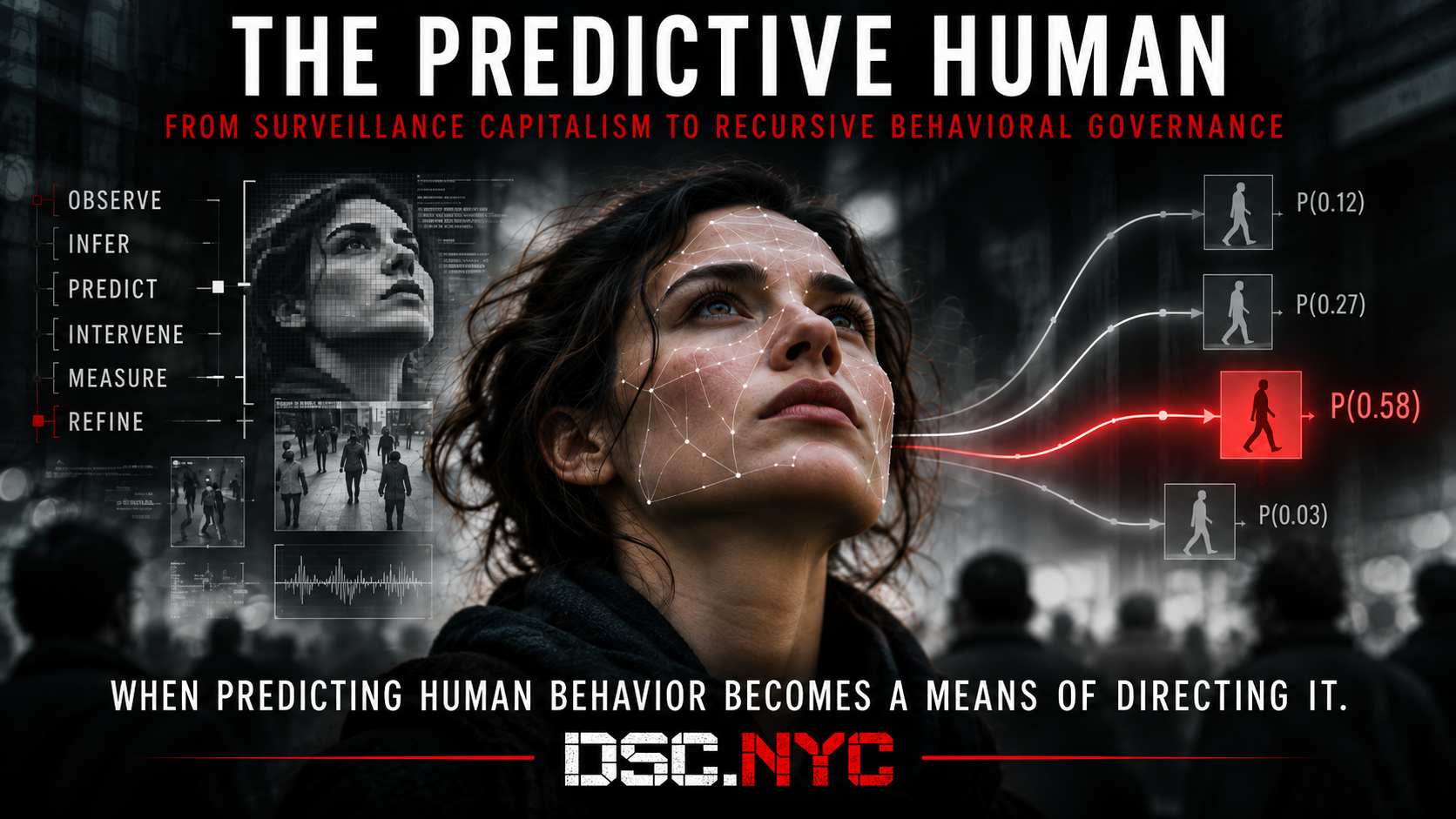
00 — THE HUMAN AS A PREDICTABLE VARIABLE
What will you do next?
What will you purchase? Where will you travel? Whom will you trust? What information will you believe? What opportunities will you pursue? What injustices will you tolerate? Under what circumstances will you resist?
These questions are no longer exclusively philosophical, psychological or sociological. They are increasingly computational.
Every interaction with digital infrastructure has the potential to reveal something about the human being behind it. Our searches, movements, communications, purchases, preferences and relationships can become components of a continuously evolving representation of our lives.
Digital Sovereignty Coalition describes the aggregation of these fragments as the Computational Mosaic.
The emergence of generative artificial intelligence introduces a new dimension to this architecture. When integrated with personal data, predictive systems, persistent memory and digital platforms, AI may become capable of generating increasingly sophisticated interpretations of human behavior and personalized interventions.
The human being risks becoming a variable within an optimization process whose objectives are determined elsewhere.
The fundamental question is no longer simply who controls our data.
It is who controls the intelligence derived from our data, who determines its objectives and whose interests those objectives ultimately serve.
01 — SHOSHANA ZUBOFF AND SURVEILLANCE CAPITALISM
In her landmark 2019 book, The Age of Surveillance Capitalism: The Fight for a Human Future at the New Frontier of Power, Harvard Business School professor emerita Shoshana Zuboff examined an economic logic that transforms private human experience into commercially valuable behavioral information.
In a March 1, 2019, interview with Democracy Now!, Zuboff explained how commercial incentives extend beyond observing behavior toward actively influencing it.
Her analysis distinguished digital technology from the economic arrangements governing its deployment. Technology itself was not inherently extractive. The problem lay in business models that benefited from appropriating human experience and converting it into predictive commercial value.
This distinction remains essential.
Digital Sovereignty Coalition extends this intellectual inquiry into the emerging age of generative AI, autonomous agents and concentrated computational infrastructure.
What happens when systems designed to predict human behavior become increasingly capable of interacting with the individuals whose behavior they seek to predict?
What happens when the process becomes continuous, personalized and recursive?
And what happens when the economic institutions operating these systems become deeply intertwined with public authority?
02 — FROM BEHAVIORAL EXTRACTION TO BEHAVIORAL INTERVENTION
Behavioral extraction and behavioral intervention are related but fundamentally different activities.
Extraction observes what people have done.
Prediction estimates what they may do.
Intervention attempts to influence what they do next.
A digital platform may observe an individual's preferences, infer an interest, recommend content and measure the resulting response.
The response generates additional information, which can inform subsequent recommendations.
A 2014 study involving Facebook's News Feed examined how changes in exposure to emotional content affected the emotional language subsequently expressed by users.
The experiment involved 689,003 Facebook users. Although the observed effects on written emotional expression were small, the study demonstrated that alterations to digital information environments could produce measurable behavioral responses.
PNAS subsequently published an editorial expression of concern regarding informed consent and participants' opportunity to opt out. A separate correction addressed author affiliations. These notices are relevant to both the scientific interpretation and ethical implications of the experiment.
The study demonstrated measurable effects under experimental conditions, although it did not establish comprehensive control over users' emotional states or decisions.
Such research illustrates an important principle: digital environments are not always passive intermediaries. Their design can affect observable human responses.
Generative AI introduces the possibility of interventions that are conversational rather than merely presentational.
Instead of displaying information, a system can discuss it.
Instead of presenting a recommendation, it can provide reasons for accepting it.
Instead of observing a response from a distance, it can participate in the interaction that produces the response.
The implications for human autonomy depend substantially on who determines the system's objectives.
03 — THE COMPUTATIONAL MOSAIC AND THE INFERRED SELF
A human being exists beyond the information recorded about them.
Yet digital systems can assemble representations of individuals from fragmented behavioral evidence.
The Computational Mosaic describes this aggregation of digital traces, including information generated through communications, transactions, device interactions and physical movements.
From this mosaic emerges what DSC describes as the Inferred Self: a computational representation composed not only of known facts but also of probabilistic interpretations.
A system may infer preferences, interests, likely vulnerabilities or behavioral tendencies that an individual has never explicitly disclosed.
These interpretations can be useful. They can also be incomplete, inaccurate, discriminatory or misleading.
The Inferred Self is not the human being.
Nevertheless, institutions may increasingly make consequential decisions based on computational representations rather than direct knowledge of the individual.
A person can therefore experience consequences arising from an identity they did not create, cannot fully inspect and may have limited power to correct.
The civil rights implications extend beyond ownership of raw data toward authority over the inferences generated from it.
04 — FROM NEXT-TOKEN PREDICTION TO NEXT-ACTION PREDICTION
Large language models generate language by estimating probable tokens within a given context.
This does not mean that an LLM inherently knows what a particular human being will do next.
However, language models integrated with behavioral histories, specialized predictive models and external data sources may contribute to systems that estimate possible future decisions.
These integrated systems could interpret patterns, generate hypothetical scenarios, formulate personalized recommendations and communicate with individuals through natural language.
The distinction must remain technically precise: predicting language is not equivalent to predicting human action.
Nevertheless, combining language generation with behavioral analytics creates an architecture in which prediction and persuasion can coexist.
In 2025, a peer-reviewed study published in Nature Human Behaviour examined whether personalized AI-generated arguments could be more persuasive than non-personalized ones in structured debates.
Among debate pairs where human and AI opponents were not equally persuasive, personalized GPT-4 opponents were more persuasive in 64.4 percent of cases.
The experiment does not establish universal AI superiority in persuasion or demonstrate population-scale behavioral control.
In September 2026, the journal published an author correction addressing a statistical comparison between personalized and non-personalized AI conditions. The original publication continues to report the 64.4 percent finding for non-tied human versus personalized AI debate outcomes.
The evidence therefore supports the potential persuasive effectiveness of personalized AI under experimental conditions, but should not be interpreted as establishing that personalization invariably improves AI persuasion or that AI systems can deterministically control human behavior.
It does establish that personalized AI conversation can influence expressed opinions under specific experimental conditions.
The possibility of integrating such capabilities into persistent commercial environments deserves substantial democratic scrutiny.
05 — RECURSIVE BEHAVIORAL GOVERNANCE
Digital Sovereignty Coalition proposes the term Recursive Behavioral Governance to describe a potential architecture in which observation, prediction, intervention and behavioral response form a continuously adaptive feedback process.
The process consists of six conceptual stages:
- Surveillance — capture behavioral information.
- Representation — construct or update a computational profile.
- Prediction — estimate possible future actions.
- Intervention — modify or personalize the decision-making environment.
- Observation — measure the resulting response.
- Refinement — update the representation and inform subsequent interactions.
The defining characteristic is recursion.
The individual's response becomes additional information within the system.
This need not involve continuous retraining of a foundation model. Adaptation can occur through updated user profiles, memory systems, recommendation mechanisms or changes in the information presented.
Recursive Behavioral Governance does not imply that human behavior is perfectly predictable or controllable.
It describes the risk of persistent institutional influence through adaptive computational systems.
Its central governance question is the optimization objective.
Who decides what constitutes a successful outcome?
06 — LLMS, PERSISTENT MEMORY AND AGENTIC INTELLIGENCE
The significance of AI-enabled behavioral governance lies not in a single model but in the integration of multiple technological capabilities.
Large language models facilitate natural-language interaction.
Persistent memory can provide continuity across interactions.
Multimodal systems can process information from different media and data formats.
Predictive analytics can estimate patterns and probabilities.
Agentic systems can perform permitted actions across connected digital services.
When these capabilities are integrated, a system may develop a more extensive understanding of a user's circumstances while gaining additional means of influencing the environment in which that user operates.
Such an architecture can provide substantial benefits when its objectives are transparent, consensual and aligned with the individual's interests.
It can also create conflicts when institutional incentives diverge from those interests.
The same assistant that helps a person navigate the digital world could, under a different governance model, prioritize commercial outcomes that the individual has not knowingly authorized.
The danger is not artificial intelligence itself.
The danger is the concentration of intelligence, data, access and decision-making authority without corresponding accountability.
07 — THE DIGITAL MAJORITY AND THE DIGITAL MINORITY
DSC uses the Digital Majority to describe the broad population living within technological systems over which it exercises limited structural control.
The Digital Minority describes a concentrated group possessing disproportionate ownership, authority or influence over those systems.
These are proposed political-economic categories, not demographic or racial classifications.
The distinction concerns access to power.
Members of the Digital Majority may generate the information from which predictive systems derive their value without possessing equivalent access to the resulting intelligence.
Members of the Digital Minority may exercise considerable influence over the platforms, computational infrastructure and optimization objectives governing those systems.
This creates an asymmetry between those who are computationally represented and those who determine how those representations are used.
The distribution of this power is neither uniform nor absolute. Corporations compete, governments regulate, individuals resist and alternative technological models exist.
Nevertheless, meaningful digital sovereignty requires examining who possesses the ability to observe, interpret and influence whom.
08 — PREDICTIVE INEQUALITY
The industrial era made economic inequality a defining question of political life.
The information age introduced profound inequalities in access to knowledge.
The AI age introduces another potential dimension: predictive inequality.
Predictive Inequality is the unequal distribution of the capacity to anticipate behavior and act upon those anticipations.
An institution may possess extensive information about an individual's probable preferences, decisions or circumstances, while the individual possesses little information about the institution's predictive processes.
This imbalance can affect commercial negotiations, access to opportunities and the exercise of personal autonomy.
In January 2025, the Federal Trade Commission published initial findings from its surveillance pricing study describing how consumer-related information can inform individualized pricing and promotional offers.
The FTC's preliminary findings examined intermediaries serving at least 250 commercial clients. The study identified capabilities for tailoring prices, discounts and product presentation using consumer-related information. Its published illustrative scenarios were hypothetical, reflecting restrictions on disclosure of confidential company information.
These findings demonstrate a concrete commercial context in which unequal access to behavioral information may influence the conditions of an economic transaction.
Predictive inequality asks a broader question.
What happens when one party enters an interaction possessing computationally derived knowledge about the other that the other party cannot reasonably access or contest?
09 — THE DIGITAL ROBBER BARONS AND THE OPTIMIZATION OBJECTIVE
DSC uses the term Digital Robber Barons as a critical framework for examining concentrated technological wealth and power.
The term does not establish that every technology executive or company engages in identical practices.
Its analytical value lies in directing attention toward ownership, incentives, institutional accountability and the distribution of technological benefits.
A computational system can be optimized for many purposes.
It may prioritize user welfare, accessibility, educational achievement, commercial conversion, engagement or operational efficiency.
These objectives are not interchangeable.
An assistant optimized to serve an individual's interests may behave differently from one optimized primarily to increase consumption or dependence on a commercial ecosystem.
A system's outward appearance may reveal little about its underlying optimization objective.
A friendly interface does not guarantee an aligned institutional objective.
The central issue is therefore not whether AI appears helpful, intelligent or empathetic.
It is whether the interests governing its operation are transparent and accountable to the people affected by it.
10 — THE ILLUSION OF FREE CHOICE
Human beings have always been influenced by their environments.
Education, advertising, culture, relationships and social institutions shape our understanding of the world.
Artificial intelligence does not introduce influence into an otherwise uninfluenced human existence.
It introduces the possibility of increasingly individualized and adaptive influence at computational scale.
When information environments are personalized, different individuals may encounter different representations of the same world.
The selection, ordering and framing of information can affect the alternatives a person considers.
This does not invalidate human agency.
It does, however, raise questions about the conditions under which meaningful agency can be exercised.
The freedom to choose becomes less meaningful when consequential information is concealed, alternatives are artificially restricted or the objectives behind an intervention are deliberately obscured.
Digital sovereignty requires more than the formal existence of choice.
It requires conditions in which informed, independent and meaningful choice remains possible.
11 — ALIGNMENT WITHOUT CONTROL: WHO IS BEING ALIGNED?
Much of the artificial intelligence alignment discourse examines how AI systems can be made to behave consistently with human intentions and values.
An equally important question concerns the possibility of reversing that relationship.
What happens when artificial intelligence becomes a means of aligning human behavior with institutional objectives?
These are two fundamentally different approaches to alignment.
One seeks to ensure that artificial intelligence serves human beings.
The other risks treating human beings as variables to be optimized in service of an institution.
The distinction between these objectives is central to DSC's analysis of Alignment Without Control.
An AI system may satisfy the objectives established by its developers or operators without those objectives necessarily reflecting the interests of every person affected by it.
Technical alignment alone cannot resolve questions of democratic legitimacy.
The authority to establish consequential optimization objectives must itself be subject to accountability.
12 — FROM COMMERCIAL MANIPULATION TO THE PREDICTIVE STATE
The transition from commercial prediction to governmental prediction raises additional civil liberties concerns.
Commercial institutions may seek to anticipate consumer decisions.
Public institutions may employ predictive systems in administrative, security or law enforcement contexts.
These applications differ in purpose, authority and legal consequence.
When commercial data, computational infrastructure and public authority converge, the resulting institutional relationships deserve particular scrutiny.
The risk is not merely that public institutions possess more information.
It is that computational interpretations may influence consequential decisions before individuals have an opportunity to understand or challenge them.
Inaccurate profiles, opaque assessments and unaccountable automated recommendations can undermine principles of fairness and due process.
DSC describes the broader potential convergence of predictive intelligence and governmental authority through its Predictive State framework.
The transition is not inevitable.
It is a governance question that requires legal safeguards, institutional oversight and meaningful public accountability.
13 — CHILDREN AND THE COMPUTATIONALLY CONDITIONED GENERATION
Future generations may encounter artificial intelligence before they develop the capacity to understand the institutional incentives governing it.
Children may interact with conversational systems through education, entertainment, companionship and everyday digital assistance.
These systems can provide valuable learning opportunities and accessibility benefits.
However, children are entitled to develop their identities without being subjected to concealed commercial behavioral experimentation or exploitative forms of personalization.
A child who grows up within a persistently personalized digital environment may have limited awareness of how that environment differs from those experienced by others.
The protection of childhood therefore requires more than restrictions on harmful content.
It also requires attention to data extraction, psychological autonomy, commercial influence and the development of independent judgment.
The digital civil rights of future generations must include the opportunity to become individuals whose identities and aspirations are not subordinated to hidden optimization objectives.
14 — THE RIGHT TO AN UNPREDICTABLE FUTURE
Digital Sovereignty Coalition proposes the Right to an Unpredictable Future as a normative principle of digital sovereignty.
Human beings must retain the freedom to change.
They must retain the freedom to contradict previous behavior, revise their beliefs, reject expectations and pursue possibilities that computational systems have not anticipated.
This principle does not demand the elimination of legitimate statistical research or forecasting.
It challenges the assumption that an institution's ability to infer probable behavior should grant it authority to determine an individual's future.
A prediction is not a verdict.
A probability is not a destiny.
An inferred identity is not the totality of a human being.
A society committed to human dignity must preserve the possibility that individuals can become something other than what their historical data suggests.
15 — INFERENCE SOVEREIGNTY AND COMPUTATIONAL SELF-DETERMINATION
Data protection alone cannot address every consequence of predictive intelligence.
Even when an individual restricts access to certain personal information, institutions may generate new inferences from information already available to them.
Inference Sovereignty concerns meaningful authority over the generation, application and consequences of those inferences.
Computational Self-Determination concerns the ability of individuals and communities to shape their relationship with computational systems.
Together, these principles support a broader framework of digital civil rights.
Such a framework should consider rights to meaningful disclosure, correction, contestation, data minimization, freedom from exploitative profiling and meaningful alternatives to consequential automated decision-making.
It must also recognize collective dimensions of sovereignty, including the rights and interests of Indigenous peoples and communities whose knowledge and identities may be computationally represented.
Human beings should not be required to surrender their autonomy as the price of participating in an increasingly digital society.
16 — CIVIC AI AS A DEMOCRATIC ALTERNATIVE
Digital Sovereignty Coalition rejects the proposition that technological innovation necessarily requires extractive economic relationships.
Artificial intelligence can expand access to knowledge, support accessibility, improve public services and strengthen civic participation.
The question is how such systems are designed, governed, financed and held accountable.
Civic AI represents DSC's proposed alternative framework.
Its purpose is to explore artificial intelligence architectures that prioritize human agency, privacy, transparency, constitutional principles and democratic accountability.
Such systems should minimize unnecessary data collection, disclose consequential optimization objectives and provide meaningful mechanisms for individual and collective oversight.
They should distinguish assistance from manipulation and personalization from exploitation.
They should protect children and vulnerable populations while preserving legitimate innovation.
The Right to Civic AI represents a proposed principle that access to beneficial artificial intelligence should not require submission to opaque systems of commercial or governmental influence.
The future of artificial intelligence must remain open to institutional alternatives.
Constitution must precede capability.
17 — EVIDENCE, RESEARCH AND INTELLECTUAL FOUNDATIONS
This investigation distinguishes three categories of knowledge.
Documented evidence: Published research, regulatory findings and attributable scholarship concerning surveillance capitalism, behavioral influence, personalization and artificial intelligence.
Emerging technological risk: Potential consequences arising from the integration of generative models, behavioral analytics, persistent memory, automated systems and concentrated infrastructure.
DSC theoretical contributions: Recursive Behavioral Governance, the Computational Mosaic, the Inferred Self, Predictive Inequality, Inference Sovereignty, Computational Self-Determination and the Right to an Unpredictable Future.
These theoretical concepts are presented as analytical and normative contributions rather than established scientific findings or universally recognized legal rights.
No assertion is made that every AI company operates a unified system of behavioral governance or that existing technologies possess deterministic control over human decisions.
The purpose of this investigation is to examine the conditions under which computational intelligence could threaten human autonomy and to establish a foundation for meaningful democratic responses.
EVIDENCE REGISTRY
PH-01
Zuboff, Shoshana. The Age of Surveillance Capitalism: The Fight for a Human Future at the New Frontier of Power. PublicAffairs, January 15, 2019.
Classification: Attributed scholarship — surveillance capitalism and behavioral prediction.
PH-02
Zuboff, Shoshana (interviewee); Goodman, Amy (interviewer). Age of Surveillance Capitalism: "We Thought We Were Searching Google, But Google Was Searching Us." Democracy Now! March 1, 2019.
Classification: Primary-source interview and attributed scholarship. Associated sections: 01, 02, 05, 08 and 10.
PH-03
Kramer, Adam D. I.; Guillory, Jamie E.; Hancock, Jeffrey T. Experimental evidence of massive-scale emotional contagion through social networks. Proceedings of the National Academy of Sciences, 2014.
doi.org/10.1073/pnas.1320040111
Classification: Peer-reviewed research — behavioral influence through digital environment design.
PH-04
Salvi, Francesco; Horta Ribeiro, Manoel; Gallotti, Riccardo; West, Robert. On the conversational persuasiveness of large language models: A randomized controlled trial. Nature Human Behaviour, 2025.
doi.org/10.1038/s41562-024-02046-9
Classification: Peer-reviewed research — personalized AI persuasion under experimental conditions.
PH-05
Federal Trade Commission. Surveillance Pricing: A Report of the Federal Trade Commission. January 2025.
ftc.gov/reports/surveillance-pricing
Classification: Regulatory findings — surveillance pricing and predictive inequality.
PH-06
Federal Trade Commission. A Look Behind the Screens: Examining the Data Practices of Social Media and Video Streaming Services. September 2024.
Classification: Federal regulatory investigation and staff report. Associated sections: 03, 06, 09 and 13.
PH-07
National Institute of Standards and Technology. Artificial Intelligence Risk Management Framework: Generative Artificial Intelligence Profile. NIST AI 600-1. July 26, 2024.
Classification: Federal technical risk management framework. Associated sections: 06, 11, 15 and 16.
PH-08
European Parliament and Council of the European Union. Regulation (EU) 2024/1689 — Artificial Intelligence Act, Article 5: Prohibited AI Practices. Adopted June 13, 2024. Consolidated text as of July 27, 2026.
Classification: Binding European Union regulation. Associated sections: 10, 11, 12, 13 and 15. Article 5 prohibits specified manipulative, deceptive and exploitative AI practices that meet applicable statutory conditions; it does not prohibit every form of AI persuasion, personalization or behavioral influence.
PH-09
United Nations Educational, Scientific and Cultural Organization (UNESCO). Recommendation on the Ethics of Artificial Intelligence. Adopted November 23, 2021.
Classification: International normative governance instrument (non-binding). Associated sections: 13, 14, 15 and 16.
PH-10
Editorial Expression of Concern: Experimental evidence of massive-scale emotional contagion through social networks. Proceedings of the National Academy of Sciences, 2014.
doi.org/10.1073/pnas.1412469111
Classification: Research ethics and informed consent.
PH-11
Correction for Kramer et al., Experimental evidence of massive-scale emotional contagion through social networks. Proceedings of the National Academy of Sciences, 2014.
doi.org/10.1073/pnas.1412583111
Classification: Author affiliation correction.
PH-12
Salvi, Francesco; Horta Ribeiro, Manoel; Gallotti, Riccardo; West, Robert. Author Correction: On the conversational persuasiveness of GPT-4. Nature Human Behaviour, 2026.
doi.org/10.1038/s41562-026-02588-0
Classification: Statistical correction.
CONCLUSION
Surveillance established the capacity to observe.
Predictive intelligence introduced the capacity to anticipate.
Generative and agentic intelligence introduces new possibilities for interaction and intervention.
Their integration creates an emerging question of power.
Who determines the objectives of the systems that increasingly mediate human experience?
The digital civil rights movement must address not only who owns our information, but who possesses the authority to interpret it, act upon it and shape the environments in which we make decisions.
The human being must remain the sovereign subject of technological progress, never merely its optimization variable.
WHO CONTROLS WHOM?
Digital Sovereignty Coalition
DSC.NYC